

188
W. Ritzrau . H. Fohrmann
Implementing aggregate interaction like differential settling, turbulent aggregation and/or aggregate disaggregation as a simple reaction term in the diffusion-advection equation at each time step describes the natural process rather
straightforwardly. At each time step, the newly formed aggregate is redistributed
according to its "new" properties. Thus, the influence of aggregate interaction on
the continuous concentration distribution of various aggregate size classes becomes transparent.
2
Model Description
The used numerical model consists of 85 layers with logarithmic grid spacing,
ranging from 1 mm at the lower boundary at the sediment-water interface to
1660 m at the upper boundary. Due to the specific interest in particle dynamics
in the BBL, particular emphasis was set on a high model resolution in the vicinity of the seafloor (58 model layers for 0-1 m above the sediment). The model is
mass conservative. The large vertical extension (0-5600 m) eliminates effects at
the upper boundary of the model.
3
The Basic Diffusion-Advection Equation
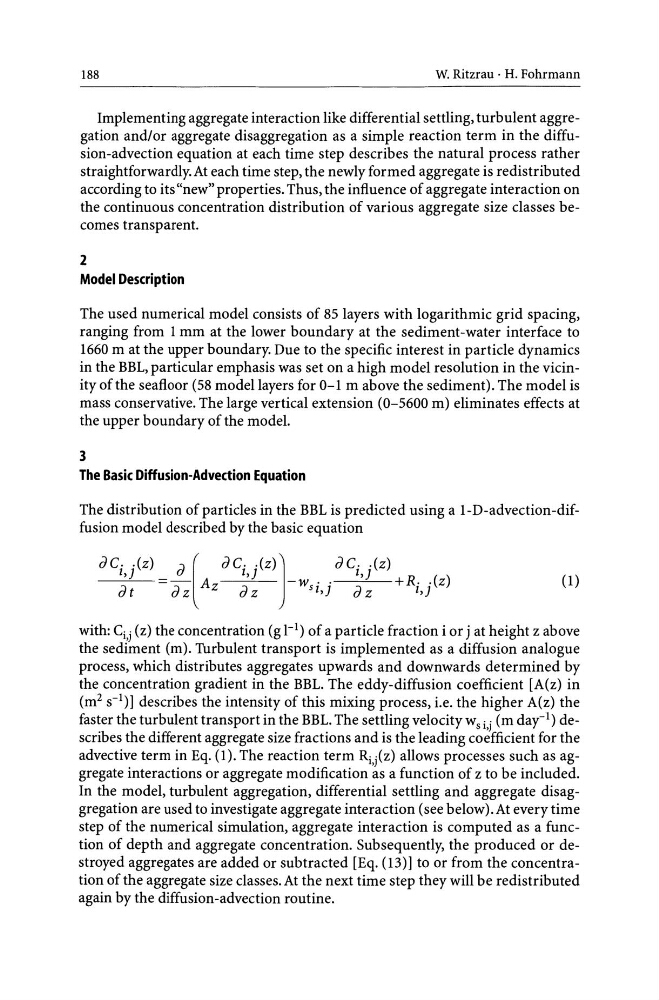
The distribution of particles in the BBL is predicted using a I-D-advection-diffusion model described by the basic equation
l,j
_ u
l,j
l,j
R ()
dC .. (z)
:J [
dC .. (Z)]
dC .. (z)
dt
- dz A z
dz
-Wsi,j dz + i,j z
(1)
with: Ci,j (z) the concentration (g 1-1) of a particle fraction i or j at height z above
the sediment (m). Turbulent transport is implemented as a diffusion analogue
process, which distributes aggregates upwards and downwards determined by
the concentration gradient in the BBL. The eddy-diffusion coefficient [A(z) in
(m 2 s-I)] describes the intensity of this mixing process, i.e. the higher A(z) the
faster the turbulent transport in the BBL. The settling velocity Ws i,j (m day-I) describes the different aggregate size fractions and is the leading coefficient for the
advective term in Eq. (1). The reaction term Ri,/Z) allows processes such as aggregate interactions or aggregate modification as a function of z to be included.
In the model, turbulent aggregation, differential settling and aggregate disaggregation are used to investigate aggregate interaction (see below). At every time
step of the numerical simulation, aggregate interaction is computed as a function of depth and aggregate concentration. Subsequently, the produced or destroyed aggregates are added or subtracted [Eq. (13)] to or from the concentration of the aggregate size classes. At the next time step they will be redistributed
again by the diffusion-advection routine.
W. Ritzrau . H. Fohrmann
Implementing aggregate interaction like differential settling, turbulent aggregation and/or aggregate disaggregation as a simple reaction term in the diffusion-advection equation at each time step describes the natural process rather
straightforwardly. At each time step, the newly formed aggregate is redistributed
according to its "new" properties. Thus, the influence of aggregate interaction on
the continuous concentration distribution of various aggregate size classes becomes transparent.
2
Model Description
The used numerical model consists of 85 layers with logarithmic grid spacing,
ranging from 1 mm at the lower boundary at the sediment-water interface to
1660 m at the upper boundary. Due to the specific interest in particle dynamics
in the BBL, particular emphasis was set on a high model resolution in the vicinity of the seafloor (58 model layers for 0-1 m above the sediment). The model is
mass conservative. The large vertical extension (0-5600 m) eliminates effects at
the upper boundary of the model.
3
The Basic Diffusion-Advection Equation
The distribution of particles in the BBL is predicted using a I-D-advection-diffusion model described by the basic equation
l,j
_ u
l,j
l,j
R ()
dC .. (z)
:J [
dC .. (Z)]
dC .. (z)
dt
- dz A z
dz
-Wsi,j dz + i,j z
(1)
with: Ci,j (z) the concentration (g 1-1) of a particle fraction i or j at height z above
the sediment (m). Turbulent transport is implemented as a diffusion analogue
process, which distributes aggregates upwards and downwards determined by
the concentration gradient in the BBL. The eddy-diffusion coefficient [A(z) in
(m 2 s-I)] describes the intensity of this mixing process, i.e. the higher A(z) the
faster the turbulent transport in the BBL. The settling velocity Ws i,j (m day-I) describes the different aggregate size fractions and is the leading coefficient for the
advective term in Eq. (1). The reaction term Ri,/Z) allows processes such as aggregate interactions or aggregate modification as a function of z to be included.
In the model, turbulent aggregation, differential settling and aggregate disaggregation are used to investigate aggregate interaction (see below). At every time
step of the numerical simulation, aggregate interaction is computed as a function of depth and aggregate concentration. Subsequently, the produced or destroyed aggregates are added or subtracted [Eq. (13)] to or from the concentration of the aggregate size classes. At the next time step they will be redistributed
again by the diffusion-advection routine.