

170
K.Fennel·LNeumann
2
The Coupled Model
We use the Modular Ocean Model (MOM 1) which is a version of the primitive
equation ocean model of Bryan and Cox (GFDL-model). The model area covers
the southwestern Baltic Sea (Fig. 1) with a horizontal grid scale of 1 nautical
mile, and a vertical resolution of 2 m for the first 12 layers and gradually increasing for deeper layers with a total of 22 layers. The model area is closed by solid
walls. This model is able to produce mesoscale current patterns which evolve in
response to the wind (see for example Fennel and Seifert 1995). The horizontal
turbulent viscosities and diffusivities are constant. For the vertical mixing we
use the Richardson -number model of Pacanowski and Philander (1981). The numeric values of the mixing parameters are given in Table 1. The model is forced
by realistic wind and solar radiation measured at the weather station Arkona
and the lOW mast-station at the Darss sill.
The chemical-biological dynamics is introduced by a simple model which describes the behaviour of nutrients and plankton with four state variables: limiting nutrient (N), phytoplankton (P), zooplankton (Z), and detritus (D) (Fennel
1995). The chemical-biological model is incorporated into the circulation model
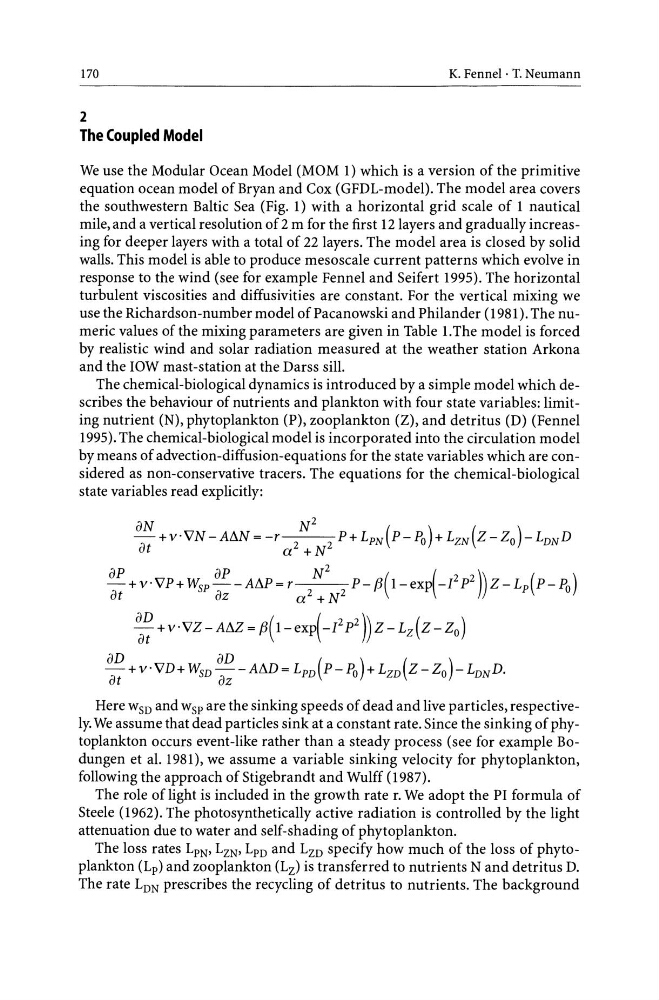
by means of advection-diffusion-equations for the state variables which are considered as non-conservative tracers. The equations for the chemical-biological
state variables read explicitly:
aN
N 2
-+v'VN -AtlN = -r
P+LPN(P-Po)+LZN(Z -ZO)-LDND
at
a 2 +N2
ap +v'VP+W sp ap -AtlP=r N
2
p-f3(1-exP(-12p2))Z-Lp(P-Po)
at
az
a 2 +N2
~~ +V· VZ -AtlZ = f3( 1-exp( _12 p2 ))z -Lz(Z -Zo)
aD +v'VD+W SD aD -AtlD=LPD(P-Po)+LzD(Z-Zo)-LDND.
at
az
Here wSD and WSP are the sinking speeds of dead and live particles, respectively. We assume that dead particles sink at a constant rate. Since the sinking of phytoplankton occurs event-like rather than a steady process (see for example Bodung en et al. 1981), we assume a variable sinking velocity for phytoplankton,
following the approach of Stigebrandt and Wulff (1987).
The role of light is included in the growth rate r. We adopt the PI formula of
Steele (1962). The photosynthetically active radiation is controlled by the light
attenuation due to water and self-shading of phytoplankton.
The loss rates LpN' L ZN ' LpD and LZD specify how much of the loss of phytoplankton (Lp) and zooplankton (L z ) is transferred to nutrients N and detritus D.
The rate LDN prescribes the recycling of detritus to nutrients. The background
K.Fennel·LNeumann
2
The Coupled Model
We use the Modular Ocean Model (MOM 1) which is a version of the primitive
equation ocean model of Bryan and Cox (GFDL-model). The model area covers
the southwestern Baltic Sea (Fig. 1) with a horizontal grid scale of 1 nautical
mile, and a vertical resolution of 2 m for the first 12 layers and gradually increasing for deeper layers with a total of 22 layers. The model area is closed by solid
walls. This model is able to produce mesoscale current patterns which evolve in
response to the wind (see for example Fennel and Seifert 1995). The horizontal
turbulent viscosities and diffusivities are constant. For the vertical mixing we
use the Richardson -number model of Pacanowski and Philander (1981). The numeric values of the mixing parameters are given in Table 1. The model is forced
by realistic wind and solar radiation measured at the weather station Arkona
and the lOW mast-station at the Darss sill.
The chemical-biological dynamics is introduced by a simple model which describes the behaviour of nutrients and plankton with four state variables: limiting nutrient (N), phytoplankton (P), zooplankton (Z), and detritus (D) (Fennel
1995). The chemical-biological model is incorporated into the circulation model
by means of advection-diffusion-equations for the state variables which are considered as non-conservative tracers. The equations for the chemical-biological
state variables read explicitly:
aN
N 2
-+v'VN -AtlN = -r
P+LPN(P-Po)+LZN(Z -ZO)-LDND
at
a 2 +N2
ap +v'VP+W sp ap -AtlP=r N
2
p-f3(1-exP(-12p2))Z-Lp(P-Po)
at
az
a 2 +N2
~~ +V· VZ -AtlZ = f3( 1-exp( _12 p2 ))z -Lz(Z -Zo)
aD +v'VD+W SD aD -AtlD=LPD(P-Po)+LzD(Z-Zo)-LDND.
at
az
Here wSD and WSP are the sinking speeds of dead and live particles, respectively. We assume that dead particles sink at a constant rate. Since the sinking of phytoplankton occurs event-like rather than a steady process (see for example Bodung en et al. 1981), we assume a variable sinking velocity for phytoplankton,
following the approach of Stigebrandt and Wulff (1987).
The role of light is included in the growth rate r. We adopt the PI formula of
Steele (1962). The photosynthetically active radiation is controlled by the light
attenuation due to water and self-shading of phytoplankton.
The loss rates LpN' L ZN ' LpD and LZD specify how much of the loss of phytoplankton (Lp) and zooplankton (L z ) is transferred to nutrients N and detritus D.
The rate LDN prescribes the recycling of detritus to nutrients. The background