

130
B. J. Haupt· K. Stattegger . D. Seidov
3
The particle-tracing model PATLOB
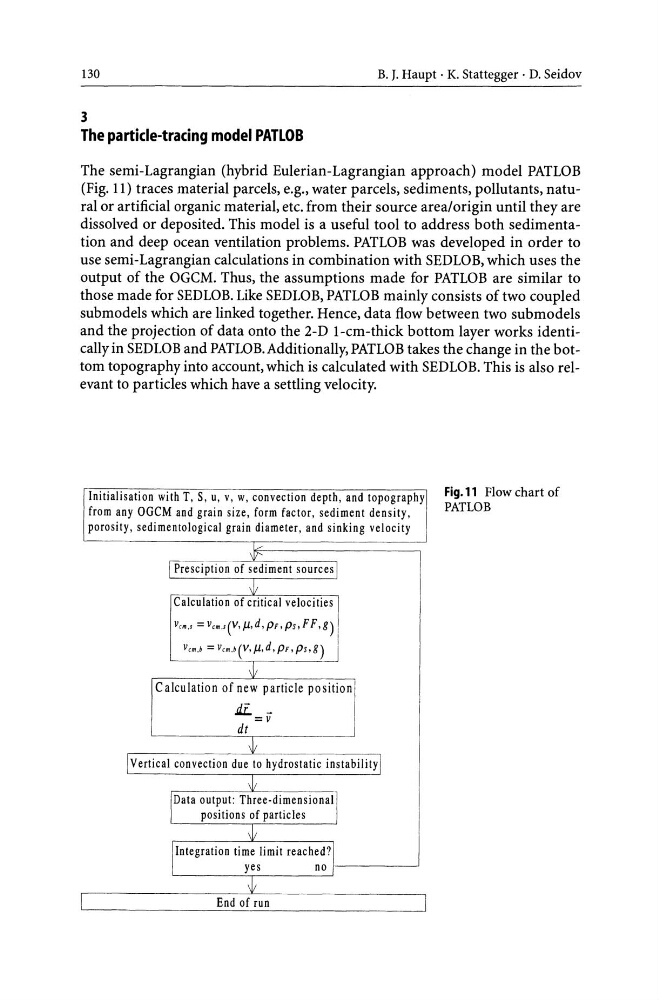
The semi-Lagrangian (hybrid Eulerian-Lagrangian approach) model PATLOB
(Fig. 11) traces material parcels, e.g., water parcels, sediments, pollutants, natural or artificial organic material, etc. from their source area/origin until they are
dissolved or deposited. This model is a useful tool to address both sedimentation and deep ocean ventilation problems. PATLOB was developed in order to
use semi-Lagrangian calculations in combination with SEDLOB, which uses the
output of the OGCM. Thus, the assumptions made for PATLOB are similar to
those made for SEDLOB. Like SEDLOB, PATLOB mainly consists of two coupled
submodels which are linked together. Hence, data flow between two submodels
and the projection of data onto the 2-D I-cm-thick bottom layer works identically in SEDLOB and PATLOB. Additionally, PATLOB takes the change in the bottom topography into account, which is calculated with SEDLOB. This is also relevant to particles which have a settling velocity.
Initialisation with T, S, u, v, w, convection depth, and topography
from any OGCM and grain size, form factor, sediment density,
porosity, sedimentological grain diameter, and sinking velocity
W-Presciption of sediment sources
~
Calculation of critical velocities
Vem" =Vem"(V,f.l,,d,PF,ps,FF,g)
Vem,b =Vem,b(V,f.l"d,PF,Ps,g)
~
Calculation of new particle po sition
JJi.. =V
dt
~
IVertical convection due to hydrostatic instability I
~
Data output: Three-dimensionalj
positions of particles
~
Integration time limit reached?i
yes
no
~
End of run
Fig. 11 Flow chart of
PATLOB
B. J. Haupt· K. Stattegger . D. Seidov
3
The particle-tracing model PATLOB
The semi-Lagrangian (hybrid Eulerian-Lagrangian approach) model PATLOB
(Fig. 11) traces material parcels, e.g., water parcels, sediments, pollutants, natural or artificial organic material, etc. from their source area/origin until they are
dissolved or deposited. This model is a useful tool to address both sedimentation and deep ocean ventilation problems. PATLOB was developed in order to
use semi-Lagrangian calculations in combination with SEDLOB, which uses the
output of the OGCM. Thus, the assumptions made for PATLOB are similar to
those made for SEDLOB. Like SEDLOB, PATLOB mainly consists of two coupled
submodels which are linked together. Hence, data flow between two submodels
and the projection of data onto the 2-D I-cm-thick bottom layer works identically in SEDLOB and PATLOB. Additionally, PATLOB takes the change in the bottom topography into account, which is calculated with SEDLOB. This is also relevant to particles which have a settling velocity.
Initialisation with T, S, u, v, w, convection depth, and topography
from any OGCM and grain size, form factor, sediment density,
porosity, sedimentological grain diameter, and sinking velocity
W-Presciption of sediment sources
~
Calculation of critical velocities
Vem" =Vem"(V,f.l,,d,PF,ps,FF,g)
Vem,b =Vem,b(V,f.l"d,PF,Ps,g)
~
Calculation of new particle po sition
JJi.. =V
dt
~
IVertical convection due to hydrostatic instability I
~
Data output: Three-dimensionalj
positions of particles
~
Integration time limit reached?i
yes
no
~
End of run
Fig. 11 Flow chart of
PATLOB