

SEDLOB and PAlLOB
121
ity [cf. Eq. (6) J. Similarly, the total vertical velocity, W g' is the sum of the vertical
velocity W [cf. Eq. (2) J and the settling velocity Ws of a single particle [cf. Eq. (5) J.
Even though the I-cm bottom boundary layer is quasi-2-D, this vertical velocity
is needed for coupling both submodels.
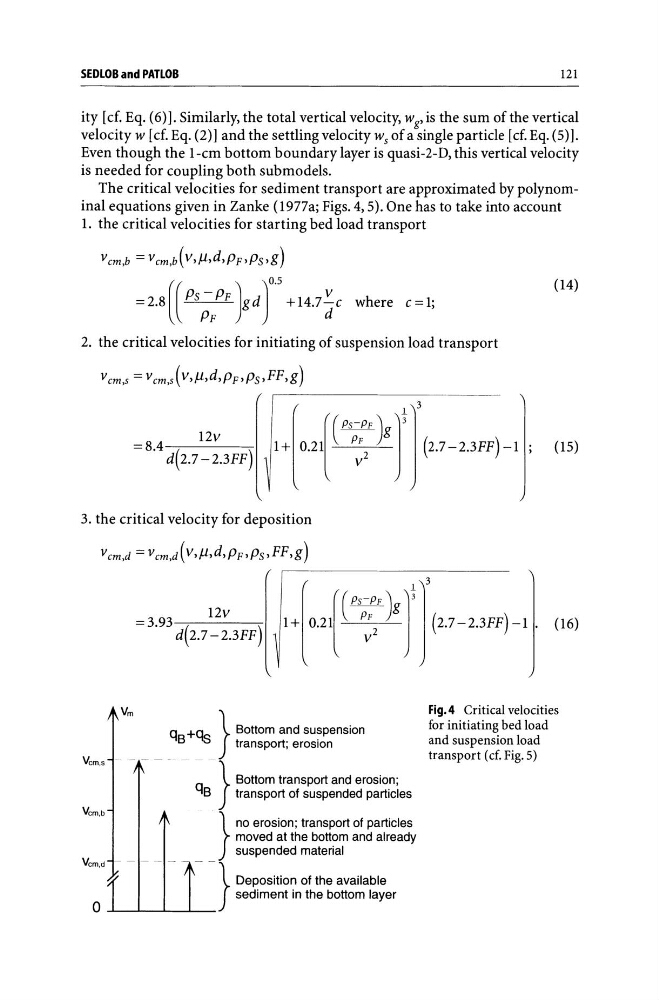
The critical velocities for sediment transport are approximated by polynominal equations given in Zanke (I977a; Figs. 4, 5). One has to take into account
l. the critical velocities for starting bed load transport
vcm,b =vcm ,b(v,f.1,d,pp,Ps,g)
=2.8[ (PS;:F 19d r +14.7~C who« '=1;
(14)
2. the critical velocities for initiating of suspension load transport
I [
l]3
(PS-PF) 3
=8.4 ( 12v
) 11+ O.21[ PF gj (2.7-2.3FF)-I
d 2.7 - 2.3FF ~
v 2
(15)
3. the critical velocity for deposition
Vem,s
q +n~ } Bottom and suspension
B -.::;
transport; erosion
I- -!~ - - - - -} Bottom transport and erosion;
qB
transport of suspended particles
Vcm,b
moved at the bottom and already
V.
1 - - - - - -
cm,d [,.
~~
!
}
no erosion; transport of particles
suspended material
o -L--L--.J~..l...-_
}
Deposition of the available
sediment in the bottom layer
Fig.4 Critical velocities
for initiating bed load
and suspension load
transport (cf. Fig. 5)
121
ity [cf. Eq. (6) J. Similarly, the total vertical velocity, W g' is the sum of the vertical
velocity W [cf. Eq. (2) J and the settling velocity Ws of a single particle [cf. Eq. (5) J.
Even though the I-cm bottom boundary layer is quasi-2-D, this vertical velocity
is needed for coupling both submodels.
The critical velocities for sediment transport are approximated by polynominal equations given in Zanke (I977a; Figs. 4, 5). One has to take into account
l. the critical velocities for starting bed load transport
vcm,b =vcm ,b(v,f.1,d,pp,Ps,g)
=2.8[ (PS;:F 19d r +14.7~C who« '=1;
(14)
2. the critical velocities for initiating of suspension load transport
I [
l]3
(PS-PF) 3
=8.4 ( 12v
) 11+ O.21[ PF gj (2.7-2.3FF)-I
d 2.7 - 2.3FF ~
v 2
(15)
3. the critical velocity for deposition
Vem,s
q +n~ } Bottom and suspension
B -.::;
transport; erosion
I- -!~ - - - - -} Bottom transport and erosion;
qB
transport of suspended particles
Vcm,b
moved at the bottom and already
V.
1 - - - - - -
cm,d [,.
~~
!
}
no erosion; transport of particles
suspended material
o -L--L--.J~..l...-_
}
Deposition of the available
sediment in the bottom layer
Fig.4 Critical velocities
for initiating bed load
and suspension load
transport (cf. Fig. 5)