

88
VEGE -
ClAY
INCREASING
TATION PELLETS SALINITY
AND SOLL
OF LAKE W .
------I E
I
PROCESSES
AND PRIMARY
SEDIMENTS ' )
FINE - GRAINED
CLASTICS
FINAL
SEDIMENTARY
RECORD 1)
Chapter 2 Continental Sediments
I
- - - - - - - - ,
DOLOMITIC CLAY
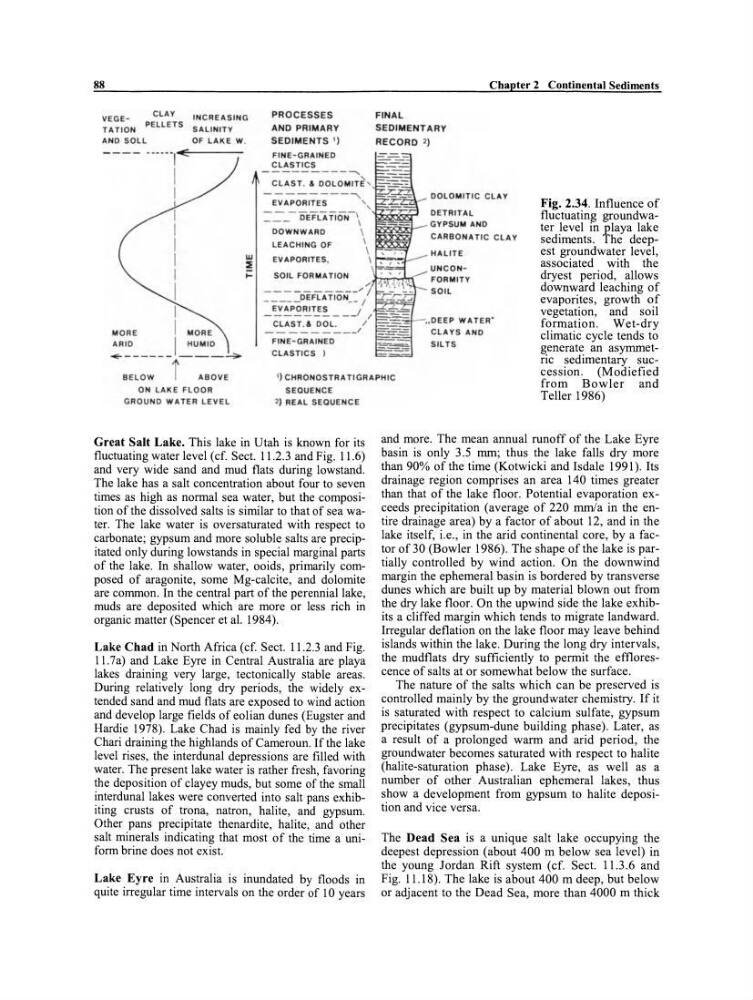
Fig. 2.34. Influence of
fluctuating groundwater level in playa lake
sediments. The deepest groundwater level,
associated with the
dryest period, allows
down ward leaching of
evaporites, growth of
vegetation, and soil
formation. Wet-dry
climatic cycle tends to
generate an asymmetrie sedimentary succession. (Modiefied
from Bowler and
Teller 1986)
EVAPORITES
"
=--=-_ - OEFCÄ nON-I\ 'tinf.-Q.:7&-' DETRITAL
""-:>crr_Y'.J---- GYPSUM AND
DOWN WARD
\
CARBONATIC CLAY
LEACHING OF
\
EVAPORITES.
\ r-"~Ir--- HALlTE
UNCON -
SOlL FORMATION
FORMITY
MORE
MORE
ARID
I HUMID
~-- - - - - ---.;...;.
CLASTICS )
SOlL
" DEEP WATER·
CLAYS AND
SIL TS
BELOW
ABOVE
ON LAKE FLOOR
GROUND WATER LEVEL
.) CHRONOSTRATIGRAPHIC
SEOUENCE
1) REAL SEOUENCE
Great Salt Lake. This lake in Utah is known for its
fluctuating water level (cf. Sect. 11.2.3 and Fig. 11.6)
and very wide sand and mud flats during lowstand.
The lake has a salt concentration about four to seven
times as high as normal sea water, but the composition of the dissolved salts is similar to that of sea water. The lake water is oversaturated with respect to
carbonate; gypsum and more soluble salts are precipitated only during lowstands in special marginal parts
of the lake. In shallow water, ooids, primarily composed of aragonite, some Mg-calcite, and dolomite
are common. In the central part of the perenniallake,
muds are deposited which are more or less rich in
organic matter (Spencer et al. 1984).
Lake Chad in North Africa (cf. Sect. 11.2.3 and Fig.
11.7a) and Lake Eyre in Central Australia are playa
lakes draining very large, tectonically stable areas.
During relatively long dry periods, the widely extended sand and mud flats are exposed to wind action
and develop large fields of eolian dunes (Eugster and
Hardie 1978). Lake Chad is mainly fed by the river
Chari draining the highlands of Cameroun. If the lake
level rises, the interdunal depressions are filled with
water. The present lake water is rather fresh, favoring
the deposition of clayey muds, but some of the small
!~terdunallakes were converted into salt pans exhibl1mg crusts of trona, natron, halite, and gypsum.
Other pans precipitate thenardite, halite, and other
salt minerals indicating that most of the time a uniform brine does not exist.
Lake Eyre in Australia is inundated by floods in
quite irregular time intervals on the order of 10 years
and more. The mean annual runoff of the Lake Eyre
basin is only 3.5 mm; thus the lake falls dry more
than 90% of the time (Kotwicki and Isdale 1991). Its
drainage region comprises an area 140 times greater
than that of the lake floor. Potential evaporation exceeds precipitation (average of 220 rnm/a in the entire drainage area) by a factor of about 12, and in the
lake itself, i.e., in the arid continental core, by a factor of 30 (Bowler 1986). The shape of the lake is partially controlled by wind action. On the downwind
margin the ephemeral basin is bordered by transverse
dunes which are built up by material blown out from
the dry lake floor. On the upwind side the lake exhibits a cliffed margin which tends to migrate landward.
Irregular deflation on the lake floor may leave behind
islands within the lake. During the long dry intervals,
the mudflats dry sufficiently to permit the efflorescence of salts at or somewhat below the surface.
The nature of the salts which can be preserved is
controlled mainly by the groundwater chemistry. If it
is saturated with respect to calcium sulfate, gypsum
precipitates (gypsum-dune building phase). Later, as
a result of a prolonged warm and arid period, the
groundwater becomes saturated with respect to halite
(halite-saturation phase). Lake Eyre, as weil as a
number of other Australian ephemeral lakes, thus
show a development from gypsum to halite deposition and vice versa.
The Dead Sea is a unique salt lake occupying the
deepest depression (about 400 m below sea level) in
the young Jordan Rift system (cf. Sect. 11.3.6 and
Fig. 11.18). The lake is about 400 m deep, but below
or adjacent to the Dead Sea, more than 4000 m thick
VEGE -
ClAY
INCREASING
TATION PELLETS SALINITY
AND SOLL
OF LAKE W .
------I E
I
PROCESSES
AND PRIMARY
SEDIMENTS ' )
FINE - GRAINED
CLASTICS
FINAL
SEDIMENTARY
RECORD 1)
Chapter 2 Continental Sediments
I
- - - - - - - - ,
DOLOMITIC CLAY
Fig. 2.34. Influence of
fluctuating groundwater level in playa lake
sediments. The deepest groundwater level,
associated with the
dryest period, allows
down ward leaching of
evaporites, growth of
vegetation, and soil
formation. Wet-dry
climatic cycle tends to
generate an asymmetrie sedimentary succession. (Modiefied
from Bowler and
Teller 1986)
EVAPORITES
"
=--=-_ - OEFCÄ nON-I\ 'tinf.-Q.:7&-' DETRITAL
""-:>crr_Y'.J---- GYPSUM AND
DOWN WARD
\
CARBONATIC CLAY
LEACHING OF
\
EVAPORITES.
\ r-"~Ir--- HALlTE
UNCON -
SOlL FORMATION
FORMITY
MORE
MORE
ARID
I HUMID
~-- - - - - ---.;...;.
CLASTICS )
SOlL
" DEEP WATER·
CLAYS AND
SIL TS
BELOW
ABOVE
ON LAKE FLOOR
GROUND WATER LEVEL
.) CHRONOSTRATIGRAPHIC
SEOUENCE
1) REAL SEOUENCE
Great Salt Lake. This lake in Utah is known for its
fluctuating water level (cf. Sect. 11.2.3 and Fig. 11.6)
and very wide sand and mud flats during lowstand.
The lake has a salt concentration about four to seven
times as high as normal sea water, but the composition of the dissolved salts is similar to that of sea water. The lake water is oversaturated with respect to
carbonate; gypsum and more soluble salts are precipitated only during lowstands in special marginal parts
of the lake. In shallow water, ooids, primarily composed of aragonite, some Mg-calcite, and dolomite
are common. In the central part of the perenniallake,
muds are deposited which are more or less rich in
organic matter (Spencer et al. 1984).
Lake Chad in North Africa (cf. Sect. 11.2.3 and Fig.
11.7a) and Lake Eyre in Central Australia are playa
lakes draining very large, tectonically stable areas.
During relatively long dry periods, the widely extended sand and mud flats are exposed to wind action
and develop large fields of eolian dunes (Eugster and
Hardie 1978). Lake Chad is mainly fed by the river
Chari draining the highlands of Cameroun. If the lake
level rises, the interdunal depressions are filled with
water. The present lake water is rather fresh, favoring
the deposition of clayey muds, but some of the small
!~terdunallakes were converted into salt pans exhibl1mg crusts of trona, natron, halite, and gypsum.
Other pans precipitate thenardite, halite, and other
salt minerals indicating that most of the time a uniform brine does not exist.
Lake Eyre in Australia is inundated by floods in
quite irregular time intervals on the order of 10 years
and more. The mean annual runoff of the Lake Eyre
basin is only 3.5 mm; thus the lake falls dry more
than 90% of the time (Kotwicki and Isdale 1991). Its
drainage region comprises an area 140 times greater
than that of the lake floor. Potential evaporation exceeds precipitation (average of 220 rnm/a in the entire drainage area) by a factor of about 12, and in the
lake itself, i.e., in the arid continental core, by a factor of 30 (Bowler 1986). The shape of the lake is partially controlled by wind action. On the downwind
margin the ephemeral basin is bordered by transverse
dunes which are built up by material blown out from
the dry lake floor. On the upwind side the lake exhibits a cliffed margin which tends to migrate landward.
Irregular deflation on the lake floor may leave behind
islands within the lake. During the long dry intervals,
the mudflats dry sufficiently to permit the efflorescence of salts at or somewhat below the surface.
The nature of the salts which can be preserved is
controlled mainly by the groundwater chemistry. If it
is saturated with respect to calcium sulfate, gypsum
precipitates (gypsum-dune building phase). Later, as
a result of a prolonged warm and arid period, the
groundwater becomes saturated with respect to halite
(halite-saturation phase). Lake Eyre, as weil as a
number of other Australian ephemeral lakes, thus
show a development from gypsum to halite deposition and vice versa.
The Dead Sea is a unique salt lake occupying the
deepest depression (about 400 m below sea level) in
the young Jordan Rift system (cf. Sect. 11.3.6 and
Fig. 11.18). The lake is about 400 m deep, but below
or adjacent to the Dead Sea, more than 4000 m thick