

14.4 Evolution of Coal
727
eOAL EVOLUTION AND RELEASE OF GAS
MEDIUM
AND LOW SEMI-ANTHRACITE
k BIT UM. COAL
3l!lOL. C;;:k AND ANTHRACITE
HIGH- VOLATILE
1
:
1 DECREASING
do
35 1 28
1'00/0VOLATILE MATTER)
+--+---1f--+---I-...---r-"I-t-t-I-+---t--I---1 ... "1----+-+
1-4--+-4--+-~!~+II-4~I-+-+~:~~~~=t~~
100+
-'.... -
- - CH 4
, :
I /~I
+--+--f-+--l--t-~-t+-blL...f-t---t---t ... -f---+--+
I I
11
~
+--+--f-+--l-+--t-!--iJ'+--t-+---t---l .... '1<--+--+
l I I
'
+--+--I--+--f-+--i-~-+---l--t--+-i ..... r--+--+
I I J 1
1
+--+-I---+----1~+--+_+H__--+--+--t--t----1 ..... f---+--+
I /'
I
r-r-III-r-lt!/ft~i, 11""'::j:::i1::::t::::t····1:::+=~ -- H2 0
+--+--f-+--l--I--f1bo"""-t---t-7---t---l'" .. 1---+--+
, ./'r ,
l
+-+-+--+---I--+:. y~-t--I-, -+--+----+,--+---1'" .. t--t---t- "cö 2
+-+--+--+--i7L!1-'-J+--t~--~T-"1---1""'\-+-+ ,.. CO
t ±~t/~"'~I~L)Jt:::lr:~i§§·····t:~=E ~ ~ He
-~
:J' L I"'"
I
...... I-j::-t-t- ' " N2
b
0;
80
C') ......
E
~
Cf)
60
«
(!)
LL
0
40
UJ
Cf)
« UJ
...J
20
UJ
ce
0
,
, UPLIFT
a
1
iTEMPERATURE
/i 1 ,
1 J
J\ ' *'
1 50
125 ~
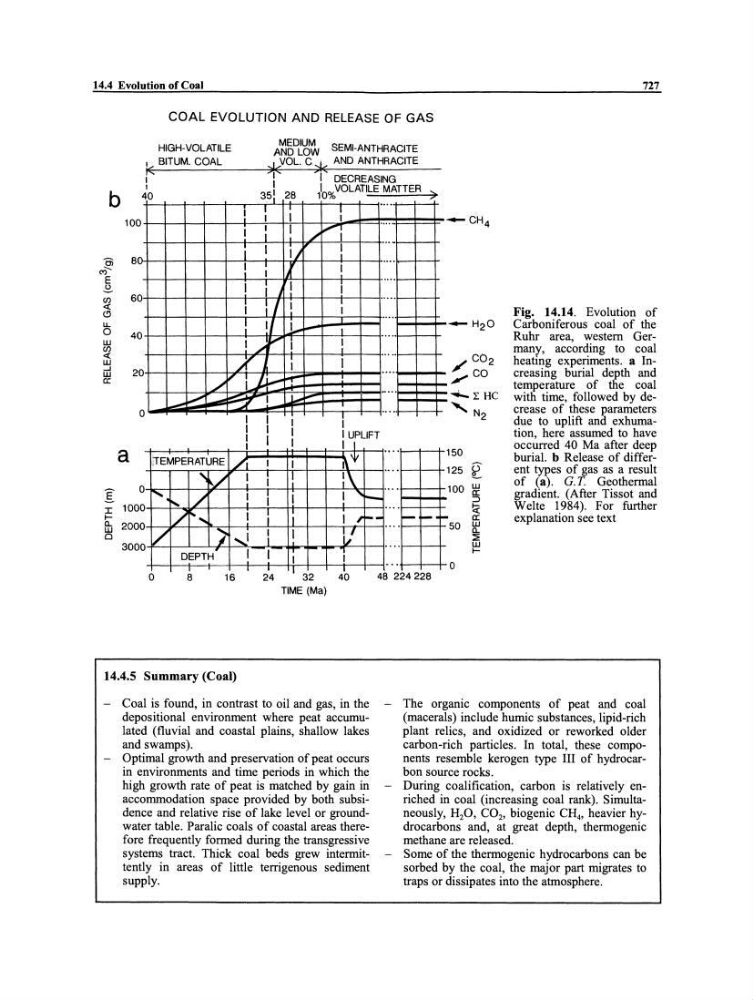
Fig. 14.14. Evolution of
Carboniferous coa1 of the
Ruhr area, western Germany, according to coa1
heating experiments. a Increasing buria1 depth and
temperature of the coa1
with time, followed by decrease of these parameters
due to up1ift and exhumation, here assumed to have
occurred 40 Ma after deep
burial. b Release of different types of gas as a result
of (a). G.T Geothermal
gradient. (After Tissot and
Welte 1984). For further
explanation see text
.s
0
I
1000
ICl. 2000
UJ
0
3000
, ~/
1
1'. "- /
,
!/ ~ ...
1
V
"I ,I
DEPTH'
1
I
I I!
l\
I 1
1 ...
I ;
1 .~
I
1
V
I ~
-~
t-~
100
UJ
a::
~
~
a::
t- 't- 50 ~
o
:::iE
UJ
Io
8
16
I1
.'.
24
32
40
48 224228
TIME (Ma)
14.4.5 Summary (Coal)
Coa1 is found, in contrast to oi1 and gas, in the
depositiona1 environment where peat accumu1ated (fluvia1 and eoasta1 p1ains, shallow 1akes
and swamps).
- Optimal growth and preservation of peat oceurs
in environments and time periods in whieh the
high growth rate of peat is matched by ga in in
accommodation space provided by both subsidence and relative rise of lake level or groundwater tab1e. Para1ic coa1s of coasta1 areas therefore frequently formed during the transgressive
systems traet. Thick coa1 beds grew intermittently in areas of 1itt1e terrigenous sediment
supp1y.
The organie components of peat and eoa1
(macera1s) inc1ude humic substances, lipid-rich
plant relics, and oxidized or reworked older
carbon-rich partic1es. In total, these components resemb1e kerogen type III of hydrocarbon source rocks.
During coa1ifieation, carbon is re1ative1y enriched in coa1 (increasing eoa1 rank). Simultaneous1y, HP, CO 2 , biogenie CH 4 , heavier hydrocarbons and, at great depth, thermogenic
methane are re1eased.
Some of the thermo genie hydrocarbons ean be
sorbed by the coa1, the major part migrates to
traps or dissipates into the atmosphere.