

704
o
46"
PACIFIC
42 ° PLATE
a
HIGH SEDIMENTATION RATE
b
:r
ICo
UJ
o
c
POROSITY
SUBDUCTION·
RED UCEE>
POROSITY
Chapter 13 Diagenesis
PORE FLUID VENTING
(H'l&' METHANE)
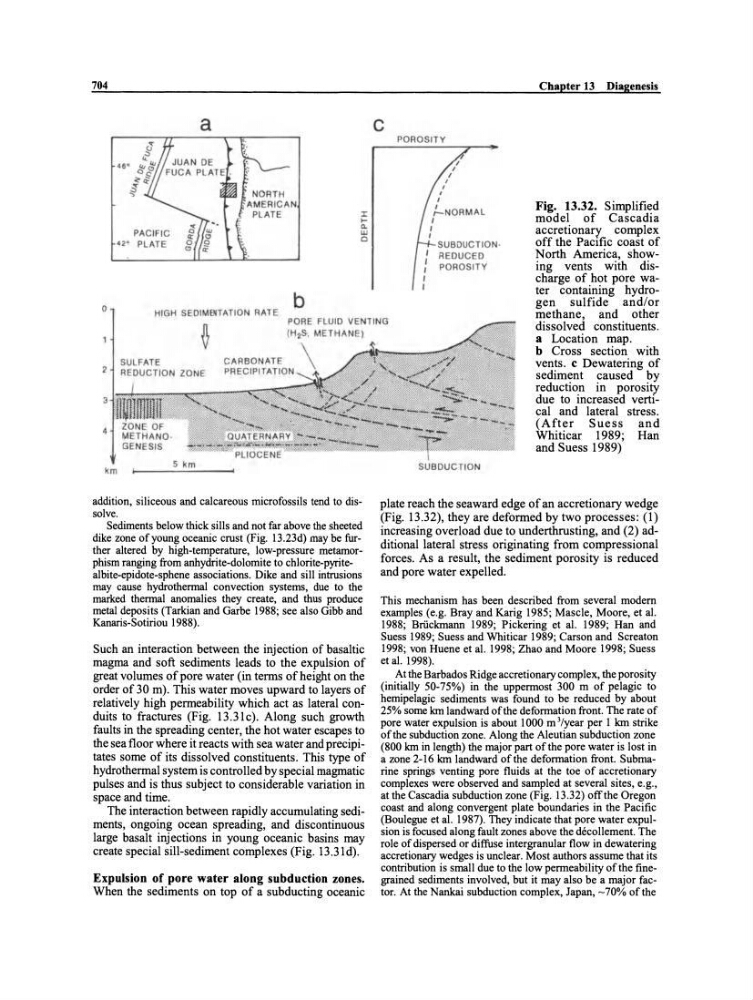
Fig. 13.32. Simplified
model of Cascadia
accretionary complex
off the Pacific coast of
North America, showing vents with discharge of hot pore water containing hydrogen sulfide and/or
methane, and other
dissolved constituents.
a Location map.
2
\
3
4
km
5 km
addition, siliceous and ca\careous microfossils tend to dissolve.
Sediments below thick sills and not far above the sheeted
dike zone ofyoung oceanic ernst (Fig. 13.23d) may be further altered by high-temperature, low-pressure metamorphism ranging from anhydrite-dolomite to chlorite-pyritealbite-epidote-sphene associations. Dike and sill intrusions
may cause hydrothermal convection systems, due to the
marked thermal anomalies they create, and thus produce
metal deposits (Tarkian and Garbe 1988; see also Gibb and
Kanaris-Sotiriou 1988).
Such an interaction between the injection of basaltic
magma and soft sediments leads to the expulsion of
great volumes ofpore water (in terms ofheight on the
order of 30 m). Ihis water moves upward to layers of
relatively high permeability which act as lateral conduits to fractures (Fig. 13 .31 c). Along such growth
faults in the spreading center, the hot water escapes to
the sea floor where it reacts with sea water and precipitates some of its dissolved constituents. Ihis type of
hydro thermal system is controlled by special magmatic
pulses and is thus subject to considerable variation in
space and time.
Ihe interaction between rapidly accumulating sediments, ongoing ocean spreading, and discontinuous
large basalt injections in young oceanic basins may
create special sill-sediment complexes (Fig. 13.3ld).
Expulsion of pore water along subduction zones.
When the sediments on top of a subducting oceanic
SUBDUCTION
b Cross section with
vents. c Dewatering of
sediment caused by
reduction in porosity
due to increased vertical and lateral stress.
(After Suess and
Whiticar 1989; Han
and Suess 1989)
plate reach the seaward edge of an accretionary wedge
(Fig. 13.32), theyare deformed by two processes: (1)
increasing overload due to underthrusting, and (2) additional lateral stress originating from compressional
forces. As a result, the sediment porosity is reduced
and pore water expelled.
This mechanism has been described from several modern
examples (e.g. Bray and Karig 1985; Masc1e, Moore, et al.
1988; Briickmann 1989; Pickering et al. 1989; Han and
Suess 1989; Suess and Whiticar 1989; Carson and Screaton
1998; von Huene et al. 1998; Zhao and Moore 1998; Suess
et al. 1998).
At the Barbados Ridge accretionary complex, the porosity
(initially 50-75%) in the uppermost 300 m of pelagic to
hemipelagic sediments was found to be reduced by about
25% some km landward ofthe deformation front. The rate of
pore water expulsion is about 1000 m 3/year per I km strike
of the subduction zone. Along the Aleutian subduction zone
(800 km in length) the major part of the pore water is lost in
a zone 2-16 km landward ofthe deformation front. Submarine springs venting pore fluids at the toe of accretionary
complexes were observed and sampled at several sites, e.g.,
at the Cascadia subduction zone (Fig. 13.32) offthe Oregon
coast and along convergent plate boundaries in the Pacific
(Boulegue et al. 1987). They indicate that pore water expulsion is focused along fault zones above the decollement. The
role of dispersed or diffuse intergranular flow in dewatering
accretionary wedges is unc1ear. Most authors assume that its
contribution is small due to the 10w permeability of the finegrained sediments involved, but it mayaIso be a major factor. At the Nankai subduction complex, Japan, -70% ofthe
o
46"
PACIFIC
42 ° PLATE
a
HIGH SEDIMENTATION RATE
b
:r
ICo
UJ
o
c
POROSITY
SUBDUCTION·
RED UCEE>
POROSITY
Chapter 13 Diagenesis
PORE FLUID VENTING
(H'l&' METHANE)
Fig. 13.32. Simplified
model of Cascadia
accretionary complex
off the Pacific coast of
North America, showing vents with discharge of hot pore water containing hydrogen sulfide and/or
methane, and other
dissolved constituents.
a Location map.
2
\
3
4
km
5 km
addition, siliceous and ca\careous microfossils tend to dissolve.
Sediments below thick sills and not far above the sheeted
dike zone ofyoung oceanic ernst (Fig. 13.23d) may be further altered by high-temperature, low-pressure metamorphism ranging from anhydrite-dolomite to chlorite-pyritealbite-epidote-sphene associations. Dike and sill intrusions
may cause hydrothermal convection systems, due to the
marked thermal anomalies they create, and thus produce
metal deposits (Tarkian and Garbe 1988; see also Gibb and
Kanaris-Sotiriou 1988).
Such an interaction between the injection of basaltic
magma and soft sediments leads to the expulsion of
great volumes ofpore water (in terms ofheight on the
order of 30 m). Ihis water moves upward to layers of
relatively high permeability which act as lateral conduits to fractures (Fig. 13 .31 c). Along such growth
faults in the spreading center, the hot water escapes to
the sea floor where it reacts with sea water and precipitates some of its dissolved constituents. Ihis type of
hydro thermal system is controlled by special magmatic
pulses and is thus subject to considerable variation in
space and time.
Ihe interaction between rapidly accumulating sediments, ongoing ocean spreading, and discontinuous
large basalt injections in young oceanic basins may
create special sill-sediment complexes (Fig. 13.3ld).
Expulsion of pore water along subduction zones.
When the sediments on top of a subducting oceanic
SUBDUCTION
b Cross section with
vents. c Dewatering of
sediment caused by
reduction in porosity
due to increased vertical and lateral stress.
(After Suess and
Whiticar 1989; Han
and Suess 1989)
plate reach the seaward edge of an accretionary wedge
(Fig. 13.32), theyare deformed by two processes: (1)
increasing overload due to underthrusting, and (2) additional lateral stress originating from compressional
forces. As a result, the sediment porosity is reduced
and pore water expelled.
This mechanism has been described from several modern
examples (e.g. Bray and Karig 1985; Masc1e, Moore, et al.
1988; Briickmann 1989; Pickering et al. 1989; Han and
Suess 1989; Suess and Whiticar 1989; Carson and Screaton
1998; von Huene et al. 1998; Zhao and Moore 1998; Suess
et al. 1998).
At the Barbados Ridge accretionary complex, the porosity
(initially 50-75%) in the uppermost 300 m of pelagic to
hemipelagic sediments was found to be reduced by about
25% some km landward ofthe deformation front. The rate of
pore water expulsion is about 1000 m 3/year per I km strike
of the subduction zone. Along the Aleutian subduction zone
(800 km in length) the major part of the pore water is lost in
a zone 2-16 km landward ofthe deformation front. Submarine springs venting pore fluids at the toe of accretionary
complexes were observed and sampled at several sites, e.g.,
at the Cascadia subduction zone (Fig. 13.32) offthe Oregon
coast and along convergent plate boundaries in the Pacific
(Boulegue et al. 1987). They indicate that pore water expulsion is focused along fault zones above the decollement. The
role of dispersed or diffuse intergranular flow in dewatering
accretionary wedges is unc1ear. Most authors assume that its
contribution is small due to the 10w permeability of the finegrained sediments involved, but it mayaIso be a major factor. At the Nankai subduction complex, Japan, -70% ofthe