

13.8 Special Methods and Processes in Diagenesis
701
a
d
REGIONAL RECHARGE
REGIONAL DISCHARGE
:r
IQ.
W
o
TEMPERATURE
n---------~
r~--------~
b
c
STRATIGRAPHIC
BOUNDARIES
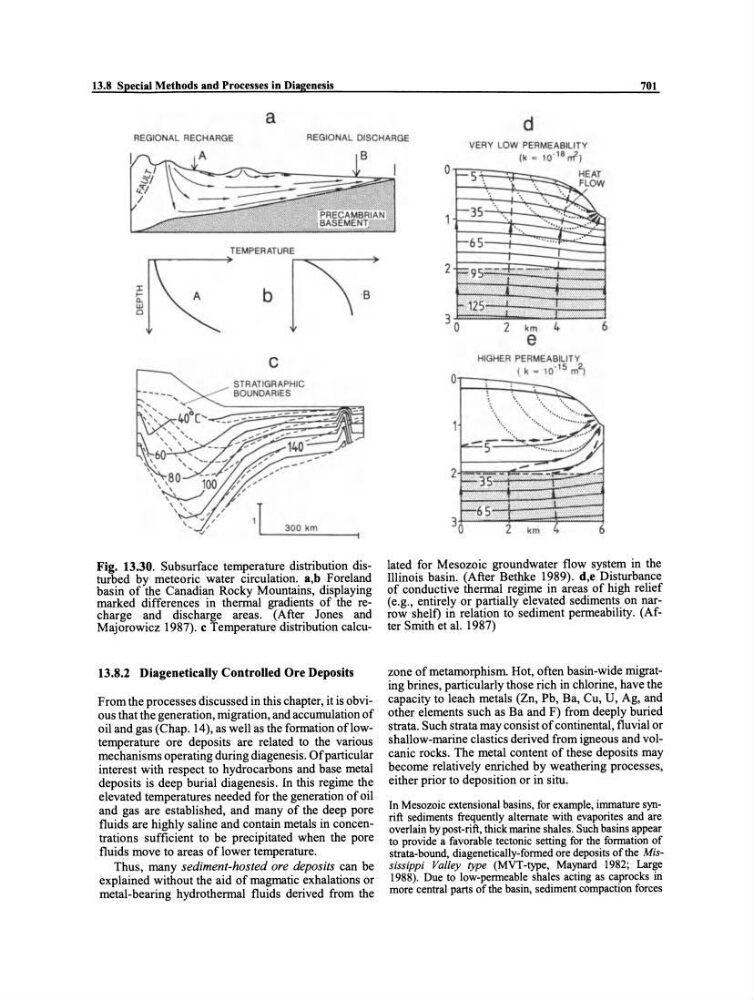
Fig. 13.30. Subsurface temperature distribution disturbed by meteoric water circulation. a,b Foreland
basin of the Canadian Rocky Mountains, displaying
rnarked differences in thermal gradients of the recharge and discharge areas. (After Jones and
Majorowicz 1987). c Temperature distribution calcu13.8.2 Diagenetically ControlIed Ore Deposits
From the processes discussed in this chapter, it is obvious that the generation, migration, and accumulation of
oil and gas (Chap. 14), as weB as the formation oflowtemperature ore deposits are related to the various
mechanisms operating during diagenesis. Ofparticular
interest with respect to hydrocarbons and base metal
deposits is deep burial diagenesis. In this regime the
elevated temperatures needed for the generation of oil
and gas are established, and many of the deep pore
fluids are highly saline and contain metals in concentrations sufficient to be precipitated when the pore
fluids move to areas of lower temperature.
Thus, rnany sediment-hosted ore deposits can be
explained without the aid of magrnatic exhalations or
metal-bearing hydrothermal fluids derived from the
2
VERY LOW PERMEABILITY
(k = 10· '8 ".f)
2 km 4
e
HIGHER PERMEABILITY
( k = 10. 15 m 2 )
U r - -__
lated for Mesozoic groundwater flow system in the
Illinois basin. (After Bethke 1989). d,e Disturbance
of conductive thermal regime in areas of high relief
(e.g., entirely or partially elevated sediments on narrow shelf) in relation to sediment permeability. (After Smith et al. 1987)
zone of metamorphism. Hot, often basin-wide migrating brines, particularly those rich in chlorine, have the
capacity to leach metals (Zn, Pb, Ba, Cu, U, Ag, and
other elements such as Ba and F) from deeply buried
strata. Such strata may consist of continental, fluvial or
shallow-marine c1astics derived from igneous and volcanic rocks. The metal content of these deposits may
become relatively enriched by weathering processes,
either prior to deposition or in situ.
In Mesozoic extensional basins, for exarnple, inunature synrift sediments frequently alternate with evaporites and are
overlain by post-rift, thick marine shales. Such basins appear
to provide a favorable tectonic setting for the formation of
strata-bound, diagenetically-formed ore deposits ofthe Mississippi Val/ey type (MVT-type, Maynard 1982; Large
1988). Due to low-permeable shales acting as caprocks in
more central parts of the basin, sediment compaction forces