

696
Chapter 13 Diagenesis
VADOSE (METEORIC)
•
SILT
' --41)f-.' -----p--:..---.....,a ~
C MARINE CALCITE CEMENT SEQUENCE
(BURIAL AND EXHUMATION)
PH
ST ALACTITIC
b
RADIAXIALFIBROUS
d MARINE CALCITE SEQUENCE
(BURIAL AND EXHUMATION)
1) MARINE
2) VADOSE
3) DEEP PHREATIC
MATRIX DOLO
(RECRYSTALLIZED )
CEMENT TYPES OF SANDSTONES
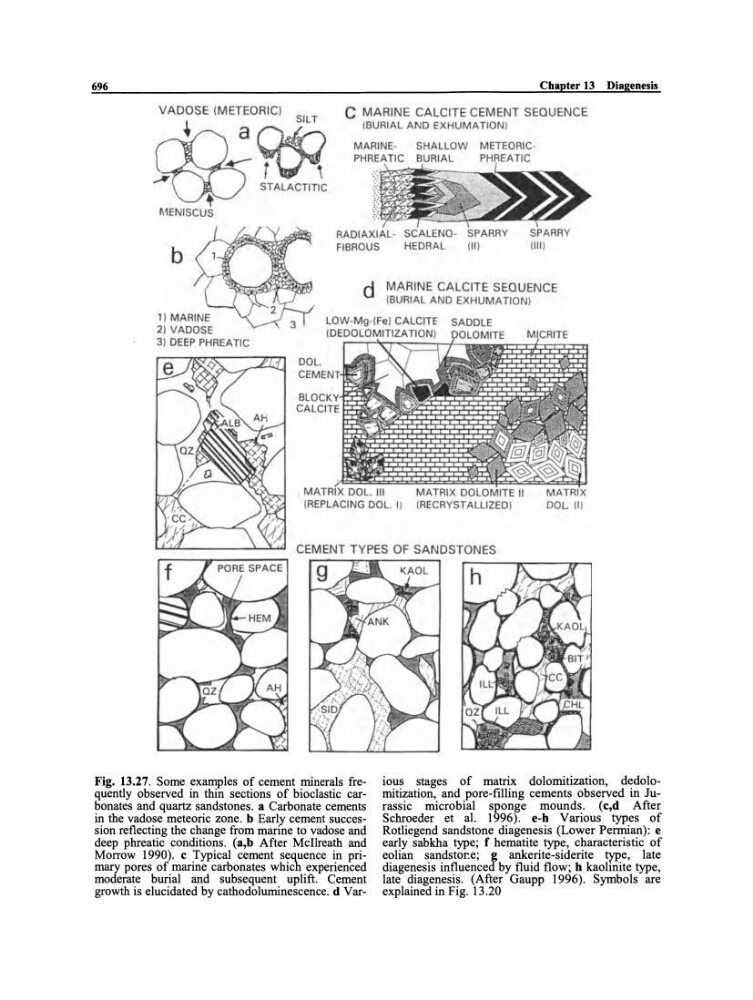
Fig. 13.27. Some examples of cement minerals frequently observed in thin sections of bioclastic carbonates and quartz sandstones. a Carbonate cements
in the vadose meteoric zone. b Early cement succession reflecting the change from marine to vadose and
deep phreatic conditions. (a,b After McIlreath and
Morrow 1990). c Typical cement sequence in primary pores of marine carbonates which experienced
moderate burial and subsequent uplift. Cement
growth is elucidated by cathodoluminescence. d Various stages of matrix dolomitization, dedolomitization, and pore-filling cements observed in Jurassic microbial sponge mounds. (c,d After
Schroeder et al. 1996). e-h Various types of
Rotliegend sandstone diagenesis (Lower Perrnian): e
early sabkha type; f hematite type, characteristic of
eolian sandstm:e; g ankerite-siderite type, late
diagenesis influenced by fluid flow; h kaolinite type,
late diagenesis. (After Gaupp 1996). Symbols are
explained in Fig. 13.20