

682
d
CEMENT 1%.1
n:
0
10
20
30
40
~
_40
o 0
;F.
u
UJ
:r:~
~
u~ 30
UJZ
...J
~O
0
~§
>
a:
<1)-'
-« 20
00<1) 0
-'
oU)
~
...Jch
Z
«
>-
ffi 10
-a:
U)o..
a:
~e
LU
IeZ
~
0..«
0
'00
00
'00
POROSITY LOSS BY CEMENTATION (%)
INITIAL
SED. VOLr
1= 100%)
INTER·
GRANULAR
POROSITY
SOLIDS
e
40
Chapter 13 Diagenesis
62% LOSS OF INITIAL
-.... POROSITY BY MECH.
COMPACTION AND
PRESSURE SOLUTION
16 -.f"~SIDUAL POR.
11
I
I CEMENT. PARTLY
I FROM PRESS. SOl.
I
COMPACTION AND CEMENTATION
POROSITY AND PERMEABILITY
C PORE TYPES
1000 PlATFORM MARGI
o
(BASINWARD)
E 100
>- t:::i
10
öl
~ .
« w
'fiI ... NDSTONES
:2
a: 0,1
w
b
a..
~PLATFORM INTERIOR
0.01
~
10
20
30
1000
a
DOLOMITE AND
0 100
ANHYDR(TE < 5%
E
PT 4
>- 10
t:::i
öl
« w
:2 0,1
ROTLlEGEND SANDSTONE
a:
w
(lOWER PERMIAN)
a.. 0.01
0
10
20
POROSITY (%)
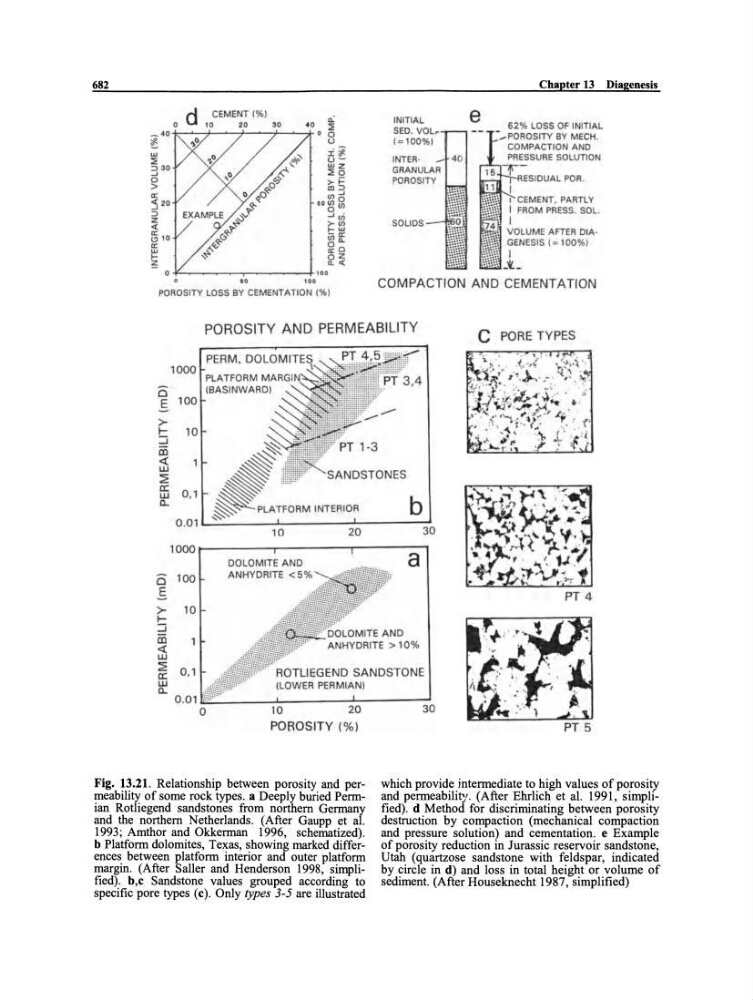
Fig. 13.21. Relationship between porosity and permeability of some rock types. a Deeply buried Permian Rotliegend sands tones from northem Germany
and the northem Netherlands. (After Gaupp et al.
1993; Amthor and Okkerman 1996, schematized).
b Platform dolomites, Texas, showing marked differences between platform interior and outer platform
margin. (After SaUer and Henderson 1998, simplified). b,c Sandstone values grouped according to
specific pore types (c). Only types 3-5 are iUustrated
30
which provide intermediate to high values of porosity
and permeabilipj. (After Ehrlich et al. 1991, simplified). d Method for discrirninating between porosity
destruction by compaction (mechanical compaction
and pressure solution) and cementation. e Example
of porosity reduction in Jurassie reservoir sandstone,
Utah (quartzose sandstone with feldspar, indicated
by circle in d) and loss in total height or volume of
sediment. (After Houseknecht 1987, simplified)