

13.3 Chemical Diagenesis
Chemical diagenesis is commonly accompanied by
compaction. The term "chemical compaction" may refer to pressure solution, but is also used in a broader
sense to describe the total compaction effect of chemical diagenesis. We may, however, distinguish between
processes retarding the onset and efficiency of chemical compaction (e.g., early cementation, pore filling
with oil) and situations accelerating chemical compaction (presence of metastable mineral phases, aggressive pore fluids, effective flow systems; Moore 1989).
Carbonates normally undergo earlier and more intensive diagenesis than siliciclastic sediments.
Most geologists and sedimentologists dealing with
diagenesis distinguish between processes of "early"
(shallow-burial diagenesis or eodiagenesis) and "late"
(deep-burial) diagenesis, but some experts have described more stages of diagenesis for particular rock
sequences or regions, including intermediate or
mesodiagenesis. A sharp boundary between early and
late diagenesis is difficult to define, because it depends
on the nature of the process which is considered most
CARBONATE GRAINSTONES
MINERAL PRECIPITATION
AND DISSOLUTION
TRANSFORMATION OF HIGH- TO
LOW-Mg CALCITE. LlnLE OR NO
CEMENTATION. ot K,ARSTIFICATION
CALCITE PRECIPITATION AND
CEMENTATIO N. EARLY
DOLOMITIZATION
1 DO' C
CALCITE
~
C~MENTATI O
ANHYDRITE
REPLACEMENI
COMPACTIONAL
PROCESSES
GRAIN BREAKAGE
IN-TO ' GRAIN
ESSURE SO
STYLOLITHI ZATION
ROCK FRACTURING
DOLOMITE
CEMENTATION
[
SADOLE
150' C
SOLID BITUMEN1 "
(PYRO BITUMEN) ~
PRECIPITATION ~
11
AN HYDRITE
AND CALCITIZATION.
ELEMENTAL SULFUR
POST-BITUMEN
~
CALCITE CEMENTATION
210·C
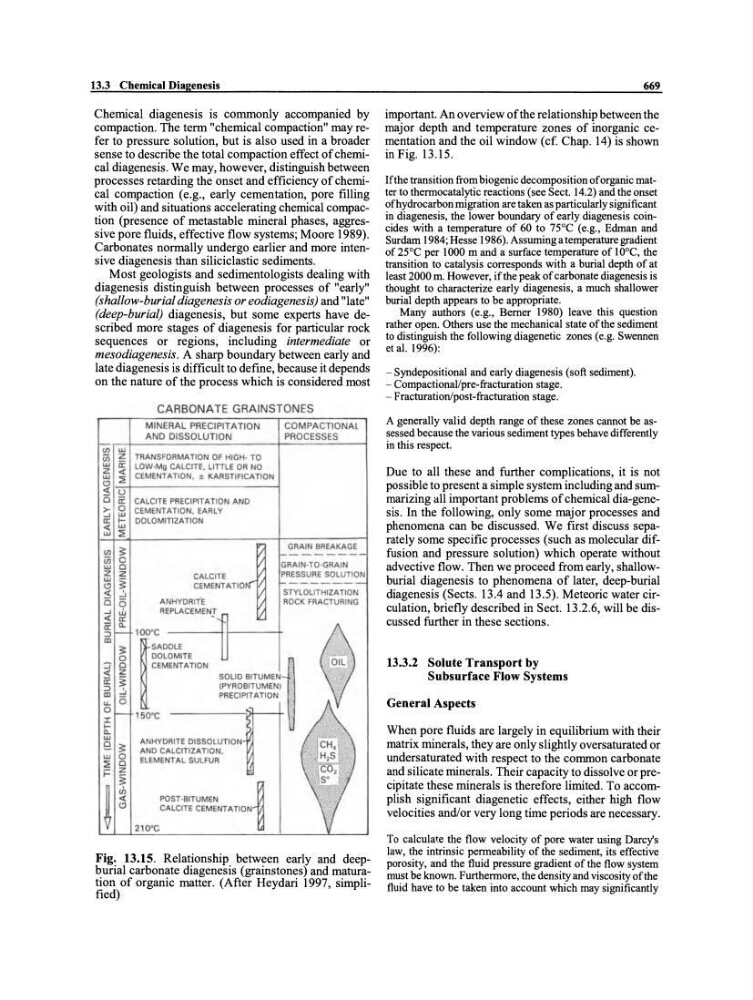
Fig. 13.15. Relationship between early and deepburial carbonate diagenesis (grainstones ) and maturation of organic matter. (After Heydari 1997, simplified)
669
important. An overview ofthe relationship between the
major depth and temperature zones of inorganic cementation and the oil window (cf. Chap. 14) is shown
in Fig. 13.15.
Ifthe transition from biogenic decomposition of organic matter to thermocatalytic reactions (see Sect. 14.2) and the onset
ofhydrocarbon migration are taken as particularly significant
in diagenesis, the lower boundary of early diagenesis coincides with a temperature of 60 to 75°C (e.g., Edman and
Surdam 1984; Hesse 1986). Assuming a temperature gradient
of 25°C per 1000 m and a surface temperature of 10°C, the
transition to catalysis corresponds with aburial depth of at
least 2000 m. However, ifthe peak of carbonate diagenesis is
thought to characterize early diagenesis, a much shallower
burial depth appears to be appropriate.
Many authors (e.g., Bemer 1980) leave this question
rather open. Others use the mechanical state ofthe sediment
to distinguish the following diagenetic zones (e.g. Swennen
et al. 1996):
- Syndepositional and early diagenesis (soft sediment).
- Compactional!pre-fracturation stage.
- Fracturationlpost-fracturation stage.
A generally valid depth range of these zones cannot be assessed because the various sediment types behave differently
in this respect.
Due to all these and further complications, it is not
possible to present a simple system including and SUillmarizing all important problems of chemical dia-genesis. In the following, only some major processes and
phenomena can be discussed. We first discuss separately some specific processes (such as molecular diffusion and pressure solution) which operate without
advective flow. Then we proceed from early, shallowburial diagenesis to phenomena of later, deep-burial
diagenesis (Sects. 13.4 and 13.5). Meteoric water circulation, briefly described in Sect. 13.2.6, will be discussed further in these sections.
13.3.2 Solute Transport by
Subsurface Flow Systems
General Aspects
When pore fluids are largely in equilibrium with their
matrix minerals, theyare only slightly oversaturated or
undersaturated with respect to the common carbonate
and silicate minerals. Their capacity to dissolve or precipitate these minerals is therefore limited. To accomplish significant diagenetic effects, either high flow
velocities andlor very long time periods are necessary.
To caJculate the flow velocity of pore water using Darcy's
law, the intrinsic permeability ofthe sediment, its effective
porosity, and the fluid pressure gradient of the flow system
must be known. Furthermore, the density and viscosity ofthe
fluid have to be taken into account which rnay significantly