

13.1 General Aspects
649
a
b
NORMALLY CONSOLIDATED
HYDROSTATIC
PRESSURE, Ph
UNDERCONSOLIDATED
,-I - -:.:.:1. _____ ___ __ _ .---___ --:::.
r -,-""" ,
, Y WATER
l / j
,
L_I"'-_~
.l!.h fl
I
J:
I
~ I
W I
~ Z
~ I
1il
I
, ,
\
SEDIMENT
I
I
0 /'\
U=
, _ /)\
(al ' . 12~
UNDER -
CONSOLlDATION
\
,
v~'--....J>
_ _ _ '
_L~
EXCESS PORE
PORE WATER
WATER PRESSURE, U
C
OVERCONSOLIDATED
; . . . . . r - ::-. . . . . ,
I' -,- -r ,
,
I
(b)
n, POROSITY
~ , SUBMERGED BULK DENSITY
Pe EFF EC TIVE OVERBURDN PRESSURE
,
REDEPOS'TlON
Pe
~---.--=--r-----::' - - - - r - - - - - - ? > -
ZONE OF OVERCONSOLlDATlON
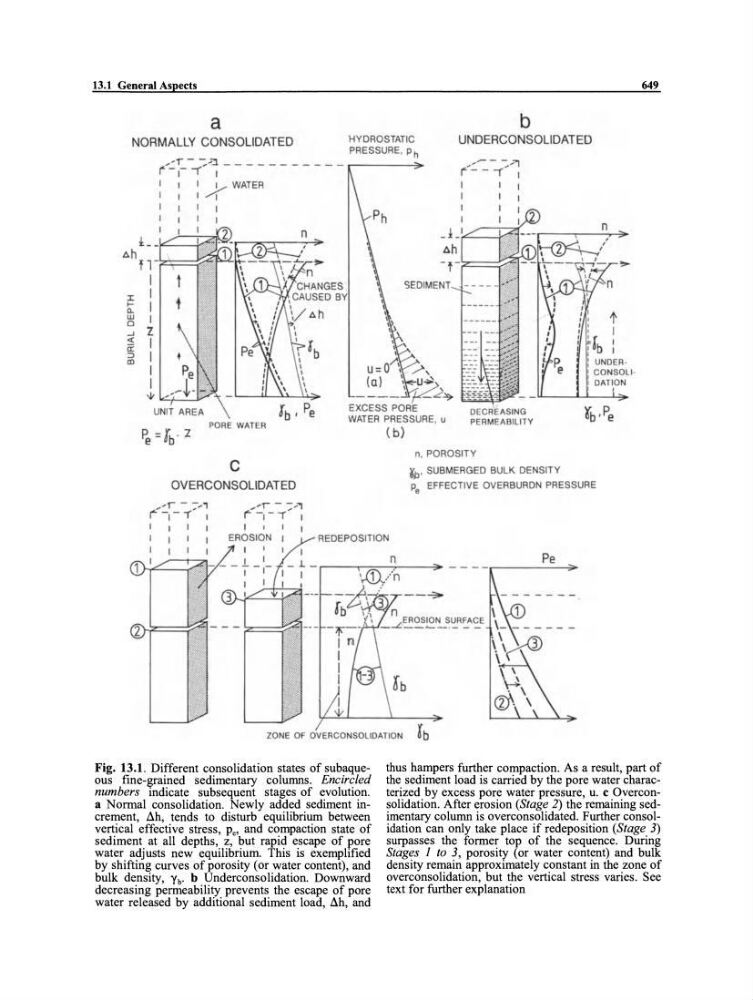
Fig. 13.1. Different consolidation states of subaqueous fine-grained sedimentary columns. Encircled
numbers indicate subsequent stages of evolution.
aNormal consolidation. Newly added sediment increment, ßh, tends to disturb equilibrium between
vertical effective stress, Pe' and compaction state of
sediment at all depths, z, but rapid escape of pore
water adjusts new equilibrium. This is exemplified
by shifting curves of porosity (or water content), and
bulk density, Yh' b Underconsolidation. Downward
decreasing permeability prevents the escape of pore
water released by additional sediment load, ßh, and
thus hampers further compaction. As a result, part of
the sediment load is carried by the pore water characterized by excess pore water pressure, u. c Overconsolidation. After erosion (Stage 2) the remaining sedimentary column is overconsolidated. Further consolidation can only take place if redeposition (Stage 3)
surpasses the former top of the sequence. During
Stages 1 to 3, porosity (or water content) and bulk
density remain approximately constant in the zone of
overconsolidation, but the vertical stress varies. See
text for further explanation