

12.9 Basin-TyPe Transitions
EARLY RIFT SEDIMENTS
SPREADING TROUGH (S) •
POTENTIAL UPLIFT
AND EROSION
639
SEDIMENTS OF EARL Y
DRIFTING (INITIAL.
POSSIBLY DIKE AND SILL INTRUSIONS
OCEANIC
b
NARROW SHELF
PROTO -GULF AND INITIAL OCEANIC PHASE,
SEDIMENTS OF EARLY RIFTING ,
-(BASAL CLASTIC PHASE)
c
d
Basin Inversion
WIDE SHELF (SHALES,
CARBONATE BUILDUP)
In recent years, the tenn "basin inversion" has been
widely used. It describes the trend to uplift of an originally subsiding extensional basin which later is
subjected to compression or transpression. Structural
inversion is the reversal of the original sense of motion, for example along a nonnal fault which is later
transfonned into a reverse fault.
Many ancient basins were affected by basin inversion after thermal subsidence and sediment accuCOASTAL BASIN
, : ::
,
. ,: :'
- - .
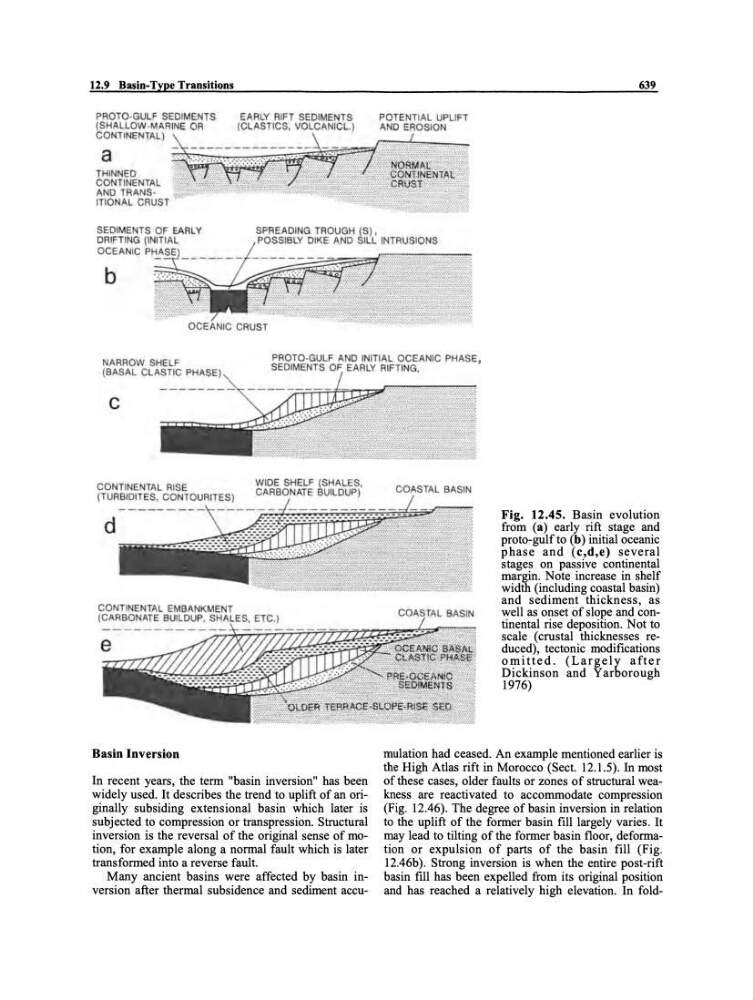
Fig. 12.45. Basin evolution
from (a) early rift stage and
proto-gulf to (b) initial oceanic
phase and (c,d,e) severa1
stages on passive continenta1
margin. Note increase in shelf
width (including coastal basin)
and sediment thickness, as
weIl as onset of slope and continental rise deposition. Not to
scale (crustal thicknesses reduced), tectonic modifications
omitted. (Largely after
Dickinson and Yarborough
1976)
mulation had ceased. An example mentioned earlier is
the High Atlas rift in Morocco (Sect. 12.l.5). In most
of these cases, older faults or zones of structura1 weakness are reactivated to accommodate compression
(Fig. 12.46). The degree of basin inversion in relation
to the uplift of the fonner basin fill large1y varies. It
may lead to tilting of the fonner basin floor, defonnation or expulsion of parts of the basin fill (Fig.
12.46b). Strong inversion is when the entire post-rift
basin fill has been expelled from its original position
and has reached a relatively high elevation. In fold-