

12.7 Pannonian-Type Basins
INTERVAL
1 - : ,
: : : : : : : : : 1· 2
2-3
3-4
> 4
km
km
4
50 km
c
SE
PRE·NEOGENE
Ma
BASEMENT
(INCLUDING INACTIVE ALPINE NAPPES)
9
l' :.:":"" .... , .' , .-..
o
~
a..
::J
~ ,',.', -: -: ,': :.: ,',
:.:.: ....... : .... : ..
DELTA PLAIN FACIES
FLUVIAL TO LACUSTRINE
SILTY CLAYS, MARLS, MARSH,
AND SANDS, LOCALLY
LIGNITE AND PALEOSOLS
DELTA FRONT FACIES
SAND, SILTS, AND MARLS,
INClINED AND DEFORMED BEDS
PRODELTA FACIES,MARINE
SANDS AND MARLS
~ SLUMPS AND TURBIDITES
DEEP BASIN FACIES,MARINE
SHALES AND MARLS + TURBIDITES
PARTIALLY EUXINIC
d
e
!
200 km ,
> 30DOm
SEDIMENT
IV 15 Ma B.P,
EUROPEAN
FORE LAND
EAST CARP.
GHP
--TS
. :~ " ... . _S!'~
'" 1 0 Ma B.P.
(AFTER EXTENSION)
GHP
A
TS
MIGRATION OF EXTENSION
AND SUBSIDENCE
S OR W <:
NORE
627
I
I
I
I
\V
BASAL FACIES, SHALLOW-MARINE
OR CONTINENTAL
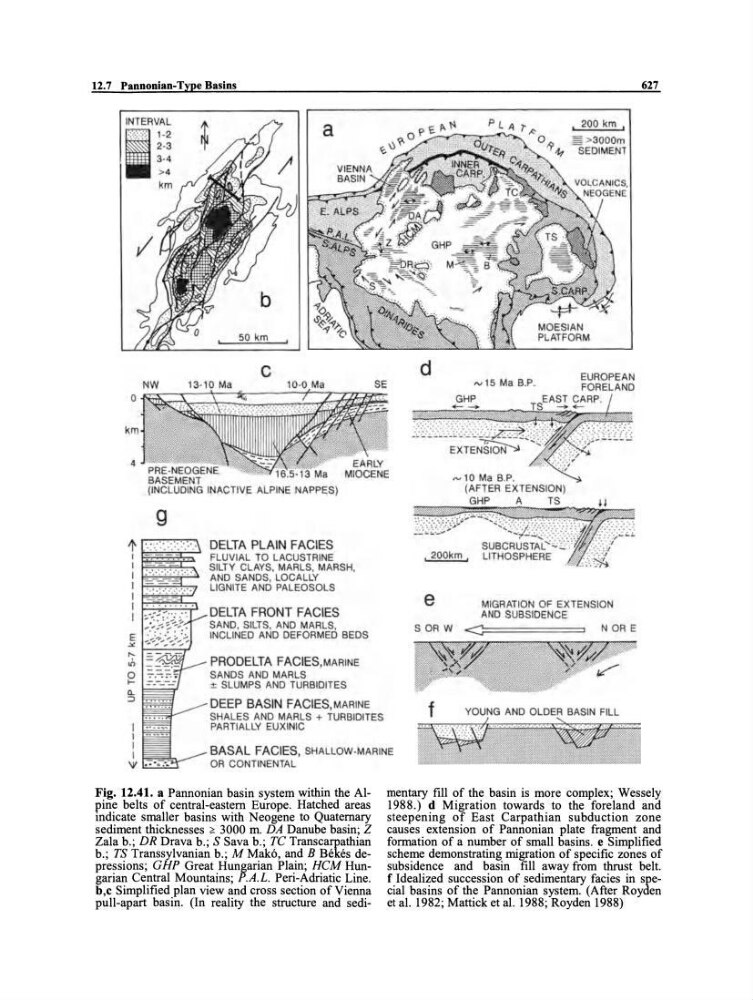
Fig. 12.41. a Pannonian basin system within the Alpine belts of central-eastem Europe, Hatched areas
indicate smaller basins with Neogene to Quatemary
sediment thicknesses ~ 3000 m. DA Danube basin; Z
Zala b.; DR Drava b.; S Sava b.; TC Transcarpathian
b.; TS Transsylvanian b.; M Mako, and B Bekes depressions; GHP Great Hungarian Plain; HCM Hungarian Central Mountains; P.AL Peri-Adriatic Line.
b,c Simplified plan view and cross section of Vienna
pull-apart basin. (In reality the structure and sedimentary fill of the basin is more complex; Wessely
1988.) d Migration towards to the fore land and
steepening of East Carpathian subduction zone
causes extension of Pannonian plate fragment and
formation of a number of small basins. e Simplified
scheme demonstrating migration of specific zones of
subsidence and basin fill away from thrust belt.
e Idealized succession of sedimentary facies in special basins of the Pannonian system. (After Royden
et al. 1982; Mattick et al. 1988; Royden 1988)