

2.3 Eolian Sediments
LAYERED ROCK
a
WIND
~
DIRECTIONS
b .,.
I
I
UP TO
SEVERAL 100's
TO 1000's m
t
53
," , JI
: " l~
:
DUST IN
SILT SIZE PARTICLE
:/"'.J SUSPENSION
!
GRAVEL TRANSPORT
PLANE BED
LAMINATION
UP TO SEVERAL ..
1000's km
---+
UP TO SEVERAL
10's km
MODIFIED SALTATION
< (70-100 flm)
SALTATION
\
> 500,um
70· 500 )Jm
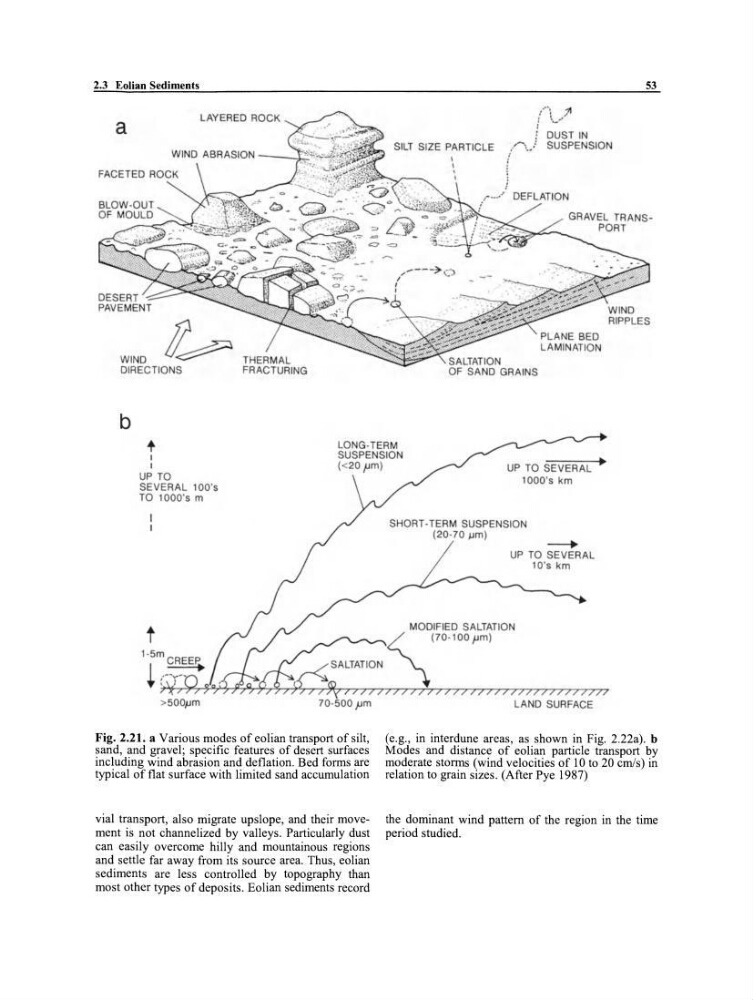
Fig. 2.21. a Various modes of eolian transport of silt,
sand, and gravel; specific features of desert surfaces
including wind abrasion and deflation. Bed forms are
typical of flat surface with limited sand accumulation
vial transport, also migrate upslope, and their movement is not channelized by valleys. Particularly dust
can easily overcome hilly and mountainous regions
and settle far away from its source area. Thus, eolian
sediments are less controlled by topography than
most other types of deposits. Eolian sediments record
LAND SURFACE
(e.g., in interdune areas, as shown in Fig. 2.22a). b
Modes and distance of eolian particle transport by
moderate storms (wind velocities of 10 to 20 cmls) in
relation to grain sizes. (After Pye 1987)
the dominant wind pattern of the region in the time
period studied.
LAYERED ROCK
a
WIND
~
DIRECTIONS
b .,.
I
I
UP TO
SEVERAL 100's
TO 1000's m
t
53
," , JI
: " l~
:
DUST IN
SILT SIZE PARTICLE
:/"'.J SUSPENSION
!
GRAVEL TRANSPORT
PLANE BED
LAMINATION
UP TO SEVERAL ..
1000's km
---+
UP TO SEVERAL
10's km
MODIFIED SALTATION
< (70-100 flm)
SALTATION
\
> 500,um
70· 500 )Jm
Fig. 2.21. a Various modes of eolian transport of silt,
sand, and gravel; specific features of desert surfaces
including wind abrasion and deflation. Bed forms are
typical of flat surface with limited sand accumulation
vial transport, also migrate upslope, and their movement is not channelized by valleys. Particularly dust
can easily overcome hilly and mountainous regions
and settle far away from its source area. Thus, eolian
sediments are less controlled by topography than
most other types of deposits. Eolian sediments record
LAND SURFACE
(e.g., in interdune areas, as shown in Fig. 2.22a). b
Modes and distance of eolian particle transport by
moderate storms (wind velocities of 10 to 20 cmls) in
relation to grain sizes. (After Pye 1987)
the dominant wind pattern of the region in the time
period studied.