

600
Chapter 12 Basin Evolution and Sediments
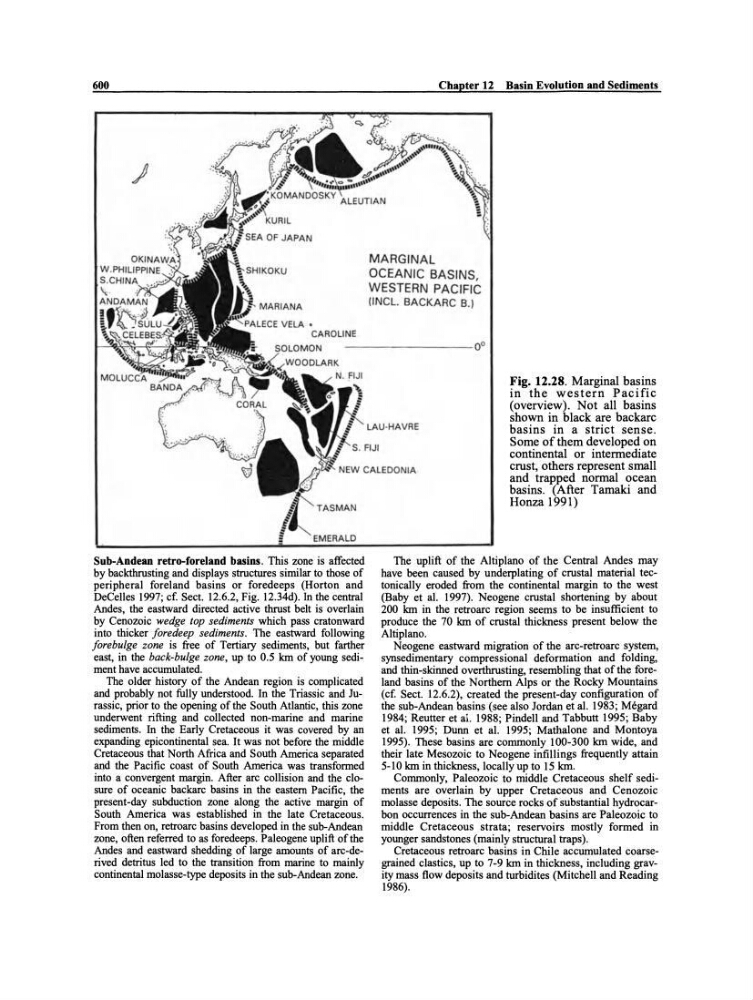
MARGINAL
OCEANIC BASINS,
WESTERN PACIFIC
(lNCL. BACKARC B.)
--------------------0°
Sub-Andean retro-foreland basins. This zone is affected
by backthrusting and displays structures similar to those of
peripheral foreland basins or foredeeps (Rorton and
DeCelles 1997; cf. Sect. 12.6.2, Fig. 12.34d). In the central
Andes, the eastward directed active thrust belt is overlain
by Cenozoic wedge top sediments which pass cratonward
into thicker foredeep sediments. The eastward following
forebulge zone is free of Tertiary sediments, but farther
east, in the back-bulge zone, up to 0.5 km of young sediment have aeeumulated.
The older history of the Andean region is eomplieated
and probably not fully understood. In the Triassie and Jurassie, prior to the opening of the South Atlantie, this zone
underwent rifting and eolleeted non-marine and marine
sediments. In the Early Cretaeeous it was covered by an
expanding epieontinental sea. It was not before the middle
Cretaeeous that North Afriea and South America separated
and the Pacific eoast of South America was transformed
into a eonvergent margin. After are collision and the closure of oceanie backarc basins in the eastem Paeifie, the
present-day subduction zone along the aetive margin of
South Ameriea was established in the late Cretaeeous.
From then on, retroarc basins developed in the sub-Andean
zone, often referred to as foredeeps. Paleogene uplift ofthe
Andes and eastward shedding of large arnounts of are-derived detritus led to the transition from marine to mainly
continental molasse-type deposits in the sub-Andean zone.
Fig. 12.28. Marginal basins
in the western Paeifie
(overview). Not all basins
shown in blaek are baekare
basins in astriet sense.
Some of them developed on
eontinental or intermediate
ernst, others represent small
and trapped normal oeean
basins. (After Tamaki and
Honza 1991)
The uplift of the Altiplano of the Central Andes may
have been caused by underplating of crustal material tectonically eroded from the continental margin to the west
(Baby et al. 1997). Neogene erustal shortening by about
200 km in the retroarc region seems to be insuffieient to
produee the 70 km of crustal thickness present below the
Altiplano.
Neogene eastward migration of the arc-retroarc system,
synsedimentary eompressional deformation and folding,
and thin-skinned overthrusting, resembling that ofthe foreland basins of the Northern Alps or the Rocky Mountains
(cf. Seet. 12.6.2), created the present-day configuration of
the sub-Andean basins (see also Jordan et al. 1983; Megard
1984; Reutter et ai. 1988; Pindell and Tabbutt 1995; Baby
et al. 1995; Dunn et al. 1995; Mathalone and Montoya
1995). These basins are commonly 100-300 km wide, and
their late Mesozoic to Neogene infillings frequently attain
5-10 km in thickness, loeally up to 15 km.
Commonly, Paleozoie to middle Cretaceous shelf sediments are overlain by upper Cretaceous and Cenozoic
molasse deposits. The souree rocks of substantial hydrocarbon occurrences in the sub-Andean basins are Paleozoic to
middle Cretaceous strata; reservoirs mostly forrned in
younger sandstones (mainly structural traps).
Cretaeeous retroare basins in Chile aeeumulated coarsegrained clasties, up to 7-9 km in thickness, including gravity mass flow deposits and turbidites (Mitchell and Reading
1986).