

12.5 Foreare Basins
593
a
INTRA·MASSIF
TRAPPED OCEANIC OR TRANSITIONAL CRUST
GENERAL UPLlFT:·· .
WITH LOCAl
BLOCK . ... . . .
:;>t,JB.S1DEt'!·C.E
b CONSTAUCTED BASIN
~RANSITION
COMPOSITE BASIN
e
NORMAl
FAULTING
NO TRAPPEO OCEANIC
CRUST PRESENT BENEATH
FOREARr.
OR SHElVEO FOREARC BASIN
TYPES AND
FILLING
OF
FOREARC
BASINS
Ü
TENDENCY TO UPLIFT
AND COMPRESSION
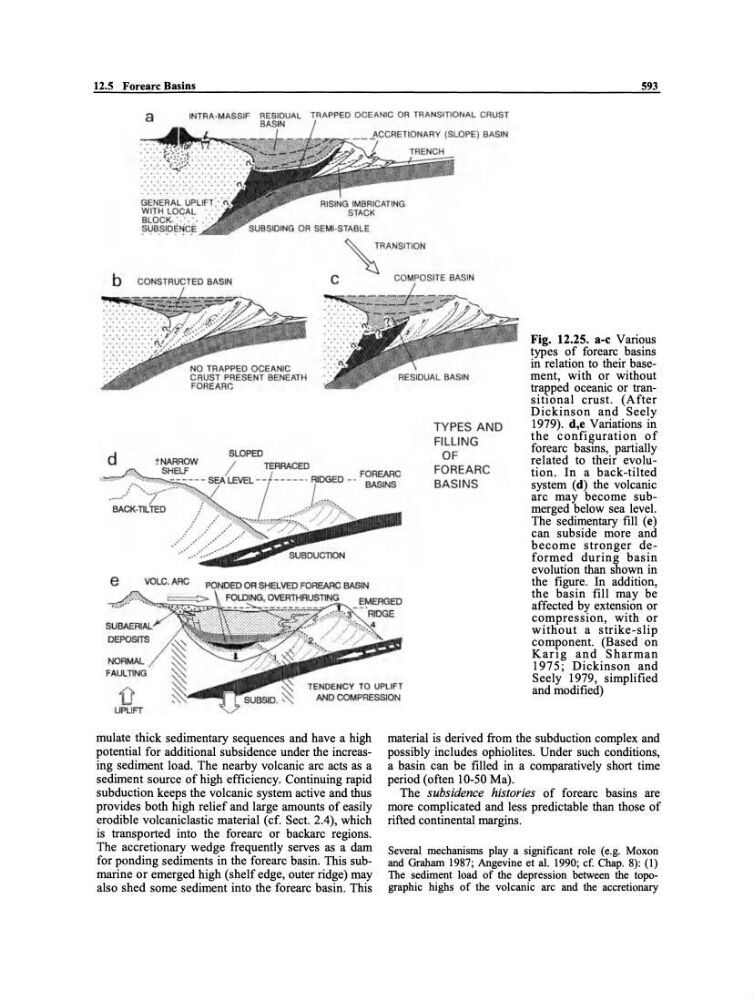
Fig. 12.25. a-c Various
types of forearc basins
in relation to their basement, with or without
trapped oceanic or transitional crust. (After
Dickinson and Seely
1979). d,e Variations in
the configuration of
forearc basins, partially
related to their evolution. In a back-tilted
system (d) the volcanic
arc may become submerged below sea level.
The sedimentary fill (e)
ean subside more and
become stronger deformed during basin
evolution than shown in
the figure. In addition,
the basin fill may be
affected by extension or
compression, with or
without a strike-slip
component. (Based on
Karig and Sharman
1975; Dickinson and
Seely 1979, simplified
and modified)
UPUFT
mulate thiek sedimentary sequenees and have a high
potential for additional subsidenee under the inereasing sediment load. The nearby volcanie are acts as a
sediment source of high effieiency. Continuing rapid
subduetion keeps the volcanic system active and thus
provides both high relief and large amounts of easily
erodible volcanic1astic material (cf. Sect. 2.4), which
is transported into the forearc or baekarc regions.
The aceretionary wedge frequently serves as adam
for ponding sediments in the foreare basin. This submarine or emerged high (shelf edge, outer ridge) may
also shed some sediment into the forearc basin. This
material is derived from the subduetion complex and
possibly· inc1udes ophiolites. Under such conditions,
a b.asin can be fi1led in a eomparatively short time
period (often 10-50 Ma).
The subsidence histories of forearc basins are
more complicated and less predictable than those of
rifted continental margins.
Several mechanisms playa significant role (e.g. Moxon
and Graham 1987; Angevine et al. 1990; ef. Chap. 8): (1)
The sediment load of the depression between the topographie highs of the voleanie are and the aeeretionary