

50
b
a
ACTIVE FAULTING
ALLUVIAL FAN DEPOSITS
BRAIDED RIVER (BED-LOAD) DEP.
MEANDERING RIVER (MIXED -LOAD) DEP.
Chapter 2 Continental Sediments
CHANGING RIVER
COURSE
MEAND. RIVER (MAINLY SUSPENDED LOAD)
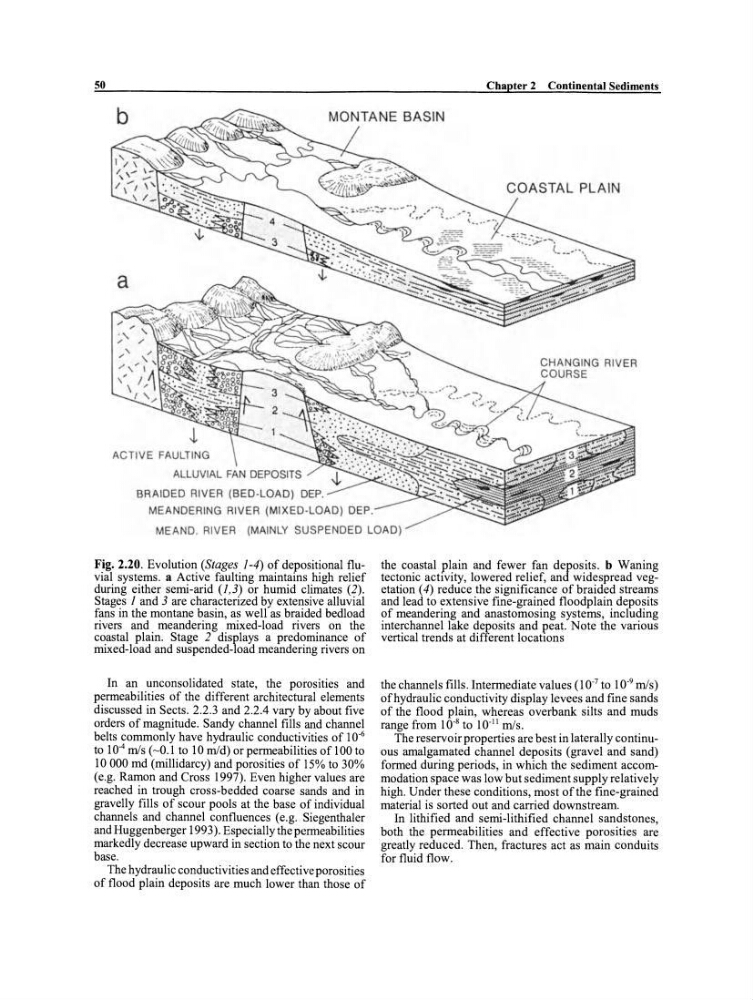
Fig. 2.20. Evolution (Stages 1-4) of depositional fluvia I systems. a Active faulting maintains high relief
during either semi-arid (1,3) or humid c1imates (2).
Stages 1 and 3 are characterized by extensive alluvial
fans in the montane basin, as weil as braided bedload
rivers and meandering mixed-load rivers on the
coastal plain. Stage 2 displays a predominance of
mixed-load and suspended-Ioad meandering rivers on
In an unconsolidated state, the porosities and
permeabilities of the different architectural elements
discussed in Sects. 2.2.3 and 2.2.4 vary by about five
orders of magnitude. Sandy channel fills and channel
belts commonly have hydraulic conductivities of 10. 6
to 10. 4 m/s (~0.1 to 10 m/d) or permeabilities of 100 to
10000 md (millidarcy) and porosities of 15% to 30%
(e.g. Ramon and Cross 1997). Even higher values are
reached in trough cross-bedded coarse sands and in
gravelly fills of scour pools at the base of individual
channels and channel confluences (e.g. Siegenthaler
and Huggenberger 1993). Especially the permeabilities
markedly decrease upward in section to the next scour
base.
The hydraulic conductivities and effectiveporosities
of flood plain deposits are much lower than those of
the coastal plain and fewer fan deposits. b Waning
tectonic aCt!vity, lowered relief, and widespread vegetation (4) reduce the significance of braided streams
and lead to extensive fine-grained floodplain deposits
of meandering and anastomosing systems, including
interchannellake deposits and peat. Note the various
vertical trends at different locations
the channels fills. Intermediate values (10. 7 to 10. 9 m/s)
ofhydraulic conductivity display levees and fine sands
of the flood plain, whereas overbank silts and muds
range from 10. 8 to 10. 11 m/s.
The reservoir properties are best in laterally continuous amalgamated channel deposits (gravel and sand)
formed during periods, in which the sediment accommodation space was low but sediment supply relatively
high. Under these conditions, most ofthe fine-grained
material is sorted out and carried downstream.
In lithified and semi-lithified channel sandstones,
both the permeabilities and effective porosities are
greatly reduced. Then, fractures act as main conduits
for fluid flow.
b
a
ACTIVE FAULTING
ALLUVIAL FAN DEPOSITS
BRAIDED RIVER (BED-LOAD) DEP.
MEANDERING RIVER (MIXED -LOAD) DEP.
Chapter 2 Continental Sediments
CHANGING RIVER
COURSE
MEAND. RIVER (MAINLY SUSPENDED LOAD)
Fig. 2.20. Evolution (Stages 1-4) of depositional fluvia I systems. a Active faulting maintains high relief
during either semi-arid (1,3) or humid c1imates (2).
Stages 1 and 3 are characterized by extensive alluvial
fans in the montane basin, as weil as braided bedload
rivers and meandering mixed-load rivers on the
coastal plain. Stage 2 displays a predominance of
mixed-load and suspended-Ioad meandering rivers on
In an unconsolidated state, the porosities and
permeabilities of the different architectural elements
discussed in Sects. 2.2.3 and 2.2.4 vary by about five
orders of magnitude. Sandy channel fills and channel
belts commonly have hydraulic conductivities of 10. 6
to 10. 4 m/s (~0.1 to 10 m/d) or permeabilities of 100 to
10000 md (millidarcy) and porosities of 15% to 30%
(e.g. Ramon and Cross 1997). Even higher values are
reached in trough cross-bedded coarse sands and in
gravelly fills of scour pools at the base of individual
channels and channel confluences (e.g. Siegenthaler
and Huggenberger 1993). Especially the permeabilities
markedly decrease upward in section to the next scour
base.
The hydraulic conductivities and effectiveporosities
of flood plain deposits are much lower than those of
the coastal plain and fewer fan deposits. b Waning
tectonic aCt!vity, lowered relief, and widespread vegetation (4) reduce the significance of braided streams
and lead to extensive fine-grained floodplain deposits
of meandering and anastomosing systems, including
interchannellake deposits and peat. Note the various
vertical trends at different locations
the channels fills. Intermediate values (10. 7 to 10. 9 m/s)
ofhydraulic conductivity display levees and fine sands
of the flood plain, whereas overbank silts and muds
range from 10. 8 to 10. 11 m/s.
The reservoir properties are best in laterally continuous amalgamated channel deposits (gravel and sand)
formed during periods, in which the sediment accommodation space was low but sediment supply relatively
high. Under these conditions, most ofthe fine-grained
material is sorted out and carried downstream.
In lithified and semi-lithified channel sandstones,
both the permeabilities and effective porosities are
greatly reduced. Then, fractures act as main conduits
for fluid flow.