

564
Chapter 12 Basin Evolution and Sediments
aNORMAL UP AND OUTBUILDING OF CLASTICS
MIGRATION OF
DEPOCENTER
CONT. RISE
CONT. SLOPE COAST
POSTRIFT SED.
b CARBONATE BANK
o
5
10
DEPTH
km
o
5
10
BREAKUP UNCONFORMITY PRERIFT EROSION
C PROGRADING MAJOR DELTA
DEPTH
DELTA FRONT
FLUVIAL PLAIN
km o
5
MUD DIAPIRS
GROWTH FAULTS
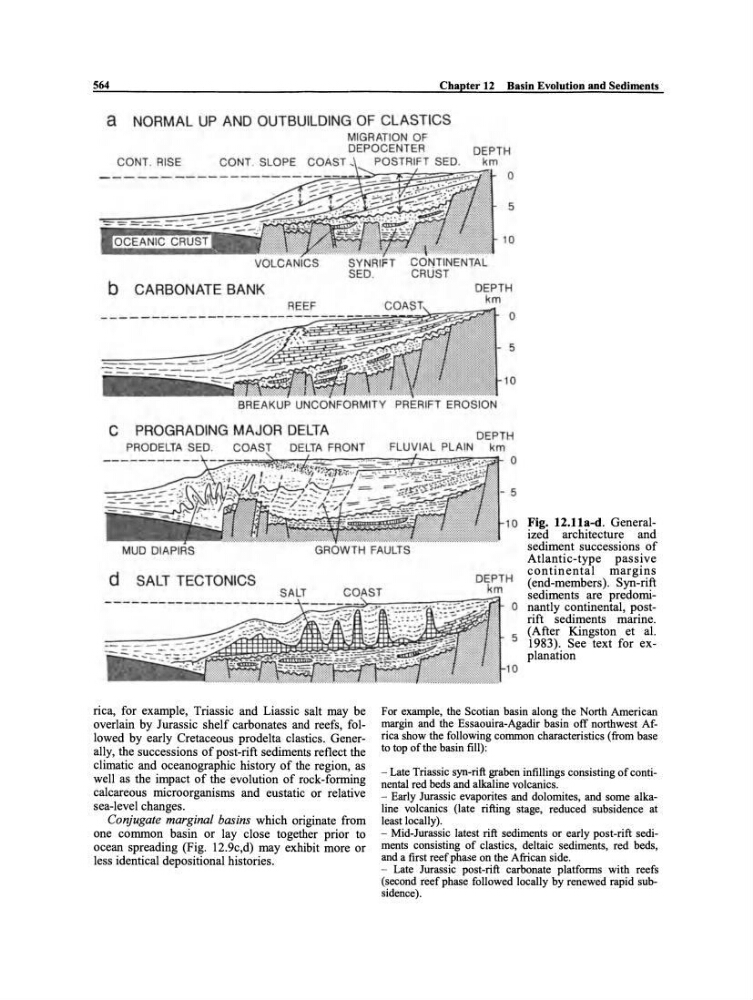
o Fig. 12.lla-d. Generalized architecture and
sediment successions of
Atlantic-type passive
d SALT TECTONICS
rica, for example, Triassie and Liassic salt may be
overlain by Jurassie shelf carbonates and reefs, followed by early Cretaceous prodelta elastics. GeneraIly, the successions of post-rift sediments reflect the
elimatic and oceanographic history of the region, as
weIl as the impact of the evolution of rock-forming
calcareous microorganisms and eustatic or relative
sea-level changes.
Conjugate marginal basins which originate from
one common basin or lay elose together prior to
ocean spreading (Fig. 12.9c,d) may exhibit more or
less identical depositional histories.
continental margins
(end-members). Syn-rift
sediments are predomio nantly continental, postrift sediments marine.
(After Kingston et al.
5 1983). See text for explanation
10
For example, the Scotian basin along the North American
margin and the Essaouira-Agadir basin off northwest Africa show the following common characteristics (from base
to top of the basin fill):
- Late Triassic syn-rift graben infillings consisting of continental red beds and alkaline volcanics.
- Early Jurassic evaporites and dolomites, and some alkaline volcanics (late rifting stage, reduced subsidence at
least locally).
- Mid-Jurassic latest rift sediments or early post-rift sediments consisting of clastics, deltaic sediments, red beds,
and a first reef phase on the African side.
- Late Jurassic post-rift carbonate platforms with reefs
(second reef phase followed locally by renewed rapid subsidence).
Chapter 12 Basin Evolution and Sediments
aNORMAL UP AND OUTBUILDING OF CLASTICS
MIGRATION OF
DEPOCENTER
CONT. RISE
CONT. SLOPE COAST
POSTRIFT SED.
b CARBONATE BANK
o
5
10
DEPTH
km
o
5
10
BREAKUP UNCONFORMITY PRERIFT EROSION
C PROGRADING MAJOR DELTA
DEPTH
DELTA FRONT
FLUVIAL PLAIN
km o
5
MUD DIAPIRS
GROWTH FAULTS
o Fig. 12.lla-d. Generalized architecture and
sediment successions of
Atlantic-type passive
d SALT TECTONICS
rica, for example, Triassie and Liassic salt may be
overlain by Jurassie shelf carbonates and reefs, followed by early Cretaceous prodelta elastics. GeneraIly, the successions of post-rift sediments reflect the
elimatic and oceanographic history of the region, as
weIl as the impact of the evolution of rock-forming
calcareous microorganisms and eustatic or relative
sea-level changes.
Conjugate marginal basins which originate from
one common basin or lay elose together prior to
ocean spreading (Fig. 12.9c,d) may exhibit more or
less identical depositional histories.
continental margins
(end-members). Syn-rift
sediments are predomio nantly continental, postrift sediments marine.
(After Kingston et al.
5 1983). See text for explanation
10
For example, the Scotian basin along the North American
margin and the Essaouira-Agadir basin off northwest Africa show the following common characteristics (from base
to top of the basin fill):
- Late Triassic syn-rift graben infillings consisting of continental red beds and alkaline volcanics.
- Early Jurassic evaporites and dolomites, and some alkaline volcanics (late rifting stage, reduced subsidence at
least locally).
- Mid-Jurassic latest rift sediments or early post-rift sediments consisting of clastics, deltaic sediments, red beds,
and a first reef phase on the African side.
- Late Jurassic post-rift carbonate platforms with reefs
(second reef phase followed locally by renewed rapid subsidence).