

562
Chapter 12 Basin Evolution and Sediments
NON-VOLCANIC MARGIN
a
SYNRIFT SEDIMENTS
100·300 km
I
•
+
.... + + + + + ...... + + + ..... + + + . + +
....... ++ ........... + .......... -t . . . . - t + + ..
+ + + ..... + + + + .... + + + + +
PRERIFT
SEDIMENTS
1
THINNED, SUBSIDED
_ _ >1< __ UNSTRETCHED
CONTIN. CRUST
1
CONTlNENTAL
VOLCANIC MARGIN
b
~ 5O·150km
50· 300 km
CRUST
POSTRIFT
SEDIMENTS
..... + +. . ... ... ...
... +- ......
. . ... ... ...
VOLCANIC SUCCESSION
CONTlNENTAL CRUST
AT CONTlNENT -OCEAN BOUNDARY
TRANSFORM MARGIN
C
r--- 50 - 100 km---;---- 100· 150 km- --t-- 50 • 150 km ----1
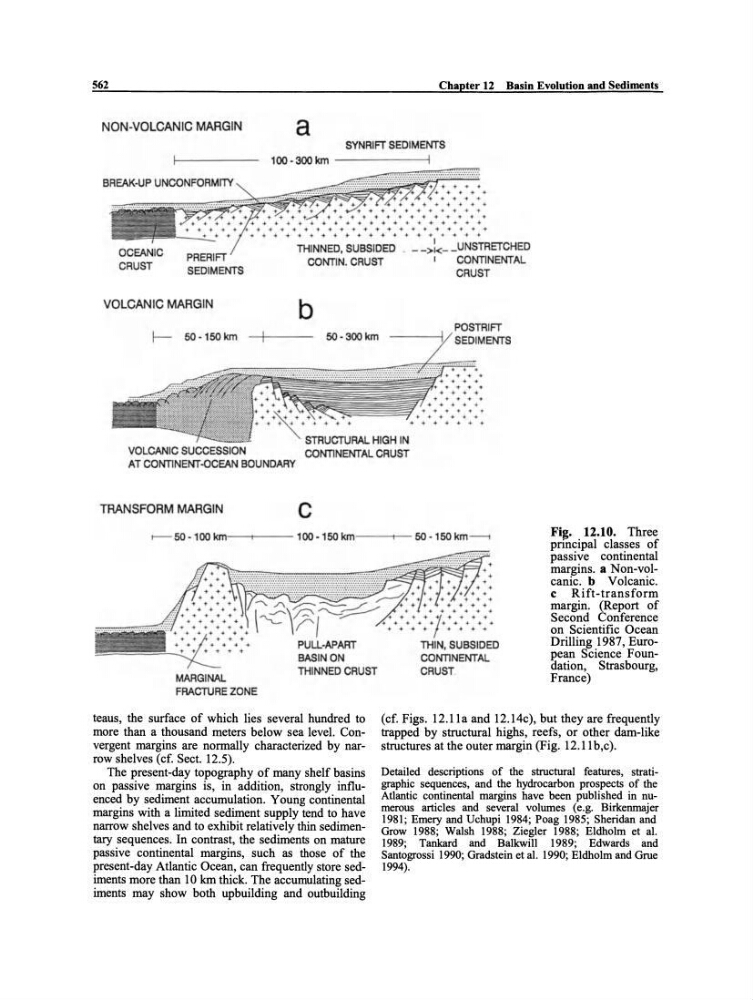
Fig. 12.10. Three
principal classes of
passive continental
margins. a Non-volcanic. b Volcanic.
c Rift-transform
margin. (Report of
Second Conference
on Scientific Ocean
Drilling 1987, European Science Foundation, Strasbourg,
France)
MARGINAL
FRACTURE ZONE
teaus, the surface of which lies several hundred to
more than a thousand meters below sea level. Convergent margins are normally characterized by narrow shelves (cf. Sect. 12.5).
The present-day topography of many shelf basins
on passive margins is, in addition, strongly influenced by sediment accumulation. Y oung continental
margins with a limited sediment supply tend to have
narrow shelves and to exhibit relatively thin sedimentary sequences. In contrast, the sediments on mature
passive continental margins, such as those of the
present-day Atlantic Ocean, can frequently store sediments more than 10 km thick. The accumulating sediments may show both upbuilding and outbuilding
THIN, SUBSIDED
CONTlNENTAL
CRUST.
(cf. Figs. 12.11a and 12.14c), but they are frequently
trapped by structural highs, reefs, or other dam-like
structures at the outer margin (Fig. 12.11b,c).
Detailed descriptions of the structural features, stratigraphie sequenees, and the hydroearbon prospects of the
Atlantic eontinental margins have been published in numerous articles and several volumes (e.g. Birkenmajer
1981; Emery and Uchupi 1984; Poag 1985; Sheridan and
Grow 1988; Walsh 1988; Ziegler 1988; Eldholm et al.
1989; Tankard and Balkwill 1989; Edwards and
Santogrossi 1990; Gradstein et al. 1990; Eldholm and Grue
1994).
Chapter 12 Basin Evolution and Sediments
NON-VOLCANIC MARGIN
a
SYNRIFT SEDIMENTS
100·300 km
I
•
+
.... + + + + + ...... + + + ..... + + + . + +
....... ++ ........... + .......... -t . . . . - t + + ..
+ + + ..... + + + + .... + + + + +
PRERIFT
SEDIMENTS
1
THINNED, SUBSIDED
_ _ >1< __ UNSTRETCHED
CONTIN. CRUST
1
CONTlNENTAL
VOLCANIC MARGIN
b
~ 5O·150km
50· 300 km
CRUST
POSTRIFT
SEDIMENTS
..... + +. . ... ... ...
... +- ......
. . ... ... ...
VOLCANIC SUCCESSION
CONTlNENTAL CRUST
AT CONTlNENT -OCEAN BOUNDARY
TRANSFORM MARGIN
C
r--- 50 - 100 km---;---- 100· 150 km- --t-- 50 • 150 km ----1
Fig. 12.10. Three
principal classes of
passive continental
margins. a Non-volcanic. b Volcanic.
c Rift-transform
margin. (Report of
Second Conference
on Scientific Ocean
Drilling 1987, European Science Foundation, Strasbourg,
France)
MARGINAL
FRACTURE ZONE
teaus, the surface of which lies several hundred to
more than a thousand meters below sea level. Convergent margins are normally characterized by narrow shelves (cf. Sect. 12.5).
The present-day topography of many shelf basins
on passive margins is, in addition, strongly influenced by sediment accumulation. Y oung continental
margins with a limited sediment supply tend to have
narrow shelves and to exhibit relatively thin sedimentary sequences. In contrast, the sediments on mature
passive continental margins, such as those of the
present-day Atlantic Ocean, can frequently store sediments more than 10 km thick. The accumulating sediments may show both upbuilding and outbuilding
THIN, SUBSIDED
CONTlNENTAL
CRUST.
(cf. Figs. 12.11a and 12.14c), but they are frequently
trapped by structural highs, reefs, or other dam-like
structures at the outer margin (Fig. 12.11b,c).
Detailed descriptions of the structural features, stratigraphie sequenees, and the hydroearbon prospects of the
Atlantic eontinental margins have been published in numerous articles and several volumes (e.g. Birkenmajer
1981; Emery and Uchupi 1984; Poag 1985; Sheridan and
Grow 1988; Walsh 1988; Ziegler 1988; Eldholm et al.
1989; Tankard and Balkwill 1989; Edwards and
Santogrossi 1990; Gradstein et al. 1990; Eldholm and Grue
1994).