

548
300
4\AFAR"' , ": " ... -'
ADDIS ABAB~) /
',. -./ ' ....
ETHIOPIAN DOME
f
QUATERNARY
Chapter 12 Basin Evolution and Sediments
a
EAST AFRICAN
RIFT SYSTEM
b
/"-.
\ ~~TURKANA
..g l.MOBUTU J,'
CALDERA VOLCANO
E
1fT
KENYAN DOME
L.EDWARD O'-V
f~
J ~o NAIROBI ./
fti..KIVU
I
.:
~
I \ .:..
. LATE PLIOCENE
~
l.VICTORIA (
MOMBASA
LAKE
:. ~
_~TRACHYTE'BASALT
TANGANYIKA DAR ES .
-r I , \ I
~.,.~ __ _
~ h SALAAM.,
~-r,0"
1 / .
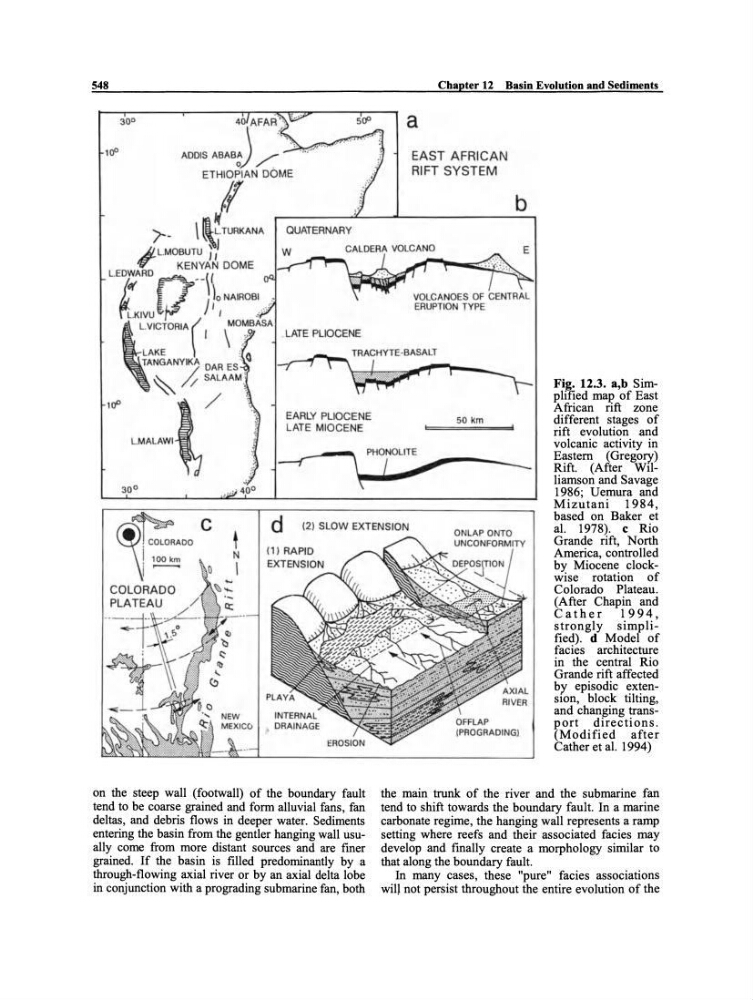
Fig. 12.3. a,b Simplified map of East
African rift zone
different stages of
rift evolution and
volcanic activity in
Eastem (Gregory)
Rift. (After W1Iliamson and Savage
1986; Uemura and
Mizutani 1984,
based on Baker et
al. 1978). c Rio
Grande rift, North
America, controlled
by Miocene clockwise rotation of
Colorado Plateau.
(After Chapin and
Cather 1994,
strongly simplified). d Model of
facies architecture
in the central Rio
Grande rift affected
by episodic extension, block tilting,
and changing transport directions .
(Modified after
Cather et al. 1994)
EARLY PLIOCE NE
LATE MIOCENE
50 km
l.MALAWI~
PHONOUTE
\ I ,
--c
d (2) SLOW EXTENSION
on the steep wall (footwall) of the boundary fault
tend to be coarse grained and form alluvial fans, fan
deltas, and debris flows in deeper water. Sediments
entering the basin from the gentler hanging wall usually come from more distant sources and are finer
grained. If the basin is filled predominantly by a
through-flowing axial river or by an axial delta lobe
in conjunction with a prograding submarine fan, both
the main trunk of the river and the submarine fan
tend to shift towards the boundary fault. In a marine
carbonate regime, the hanging wall represents a ramp
setting where reefs and their associated facies may
develop and finally create a morphology similar to
that along the boundary fault.
In rnany cases, these "pure" facies associations
will not persist throughout the entire evolution of the
300
4\AFAR"' , ": " ... -'
ADDIS ABAB~) /
',. -./ ' ....
ETHIOPIAN DOME
f
QUATERNARY
Chapter 12 Basin Evolution and Sediments
a
EAST AFRICAN
RIFT SYSTEM
b
/"-.
\ ~~TURKANA
..g l.MOBUTU J,'
CALDERA VOLCANO
E
1fT
KENYAN DOME
L.EDWARD O'-V
f~
J ~o NAIROBI ./
fti..KIVU
I
.:
~
I \ .:..
. LATE PLIOCENE
~
l.VICTORIA (
MOMBASA
LAKE
:. ~
_~TRACHYTE'BASALT
TANGANYIKA DAR ES .
-r I , \ I
~.,.~ __ _
~ h SALAAM.,
~-r,0"
1 / .
Fig. 12.3. a,b Simplified map of East
African rift zone
different stages of
rift evolution and
volcanic activity in
Eastem (Gregory)
Rift. (After W1Iliamson and Savage
1986; Uemura and
Mizutani 1984,
based on Baker et
al. 1978). c Rio
Grande rift, North
America, controlled
by Miocene clockwise rotation of
Colorado Plateau.
(After Chapin and
Cather 1994,
strongly simplified). d Model of
facies architecture
in the central Rio
Grande rift affected
by episodic extension, block tilting,
and changing transport directions .
(Modified after
Cather et al. 1994)
EARLY PLIOCE NE
LATE MIOCENE
50 km
l.MALAWI~
PHONOUTE
\ I ,
--c
d (2) SLOW EXTENSION
on the steep wall (footwall) of the boundary fault
tend to be coarse grained and form alluvial fans, fan
deltas, and debris flows in deeper water. Sediments
entering the basin from the gentler hanging wall usually come from more distant sources and are finer
grained. If the basin is filled predominantly by a
through-flowing axial river or by an axial delta lobe
in conjunction with a prograding submarine fan, both
the main trunk of the river and the submarine fan
tend to shift towards the boundary fault. In a marine
carbonate regime, the hanging wall represents a ramp
setting where reefs and their associated facies may
develop and finally create a morphology similar to
that along the boundary fault.
In rnany cases, these "pure" facies associations
will not persist throughout the entire evolution of the