

544
Chapter 12 Basin Evolution and Sediments
a PURE SHEAR
BR ITTlE
b SIMPLE SHEAR
DUCTllE ~ ~
STRETCHING- I I
AND INTRUSION
AlBIAN-APTIAN
o - r - - -_____
. . . . ~
E 30~--~--~--------~
:::.
CONVECTING
ASTHENOSPHERE
c
I
TUCANO BASIN
ATlANTIC
r- GABON BASIN----,
~
(BRAZll)
I
ATlANTIC
EASTERN
W
+COAST
o 0 ~-- - J-' - ~ " " " ~ D - " N I . : : - _ ~ = ~ ~ - ' : ! : , " =::-::::r~-- - __ -_-_-_- ...... __ :o= .~
~ -" -
O~ANIC -r~<,~
CRUST
POST- RIFT· ... -----'-SEDIMENTS
30~ - ~----~~-------d
HALF- GRABEN
HANGING WALL BASIN
SAG BASIN
S TYPE
e
A TYPE
EXTENSION = [ 6L/l (%)
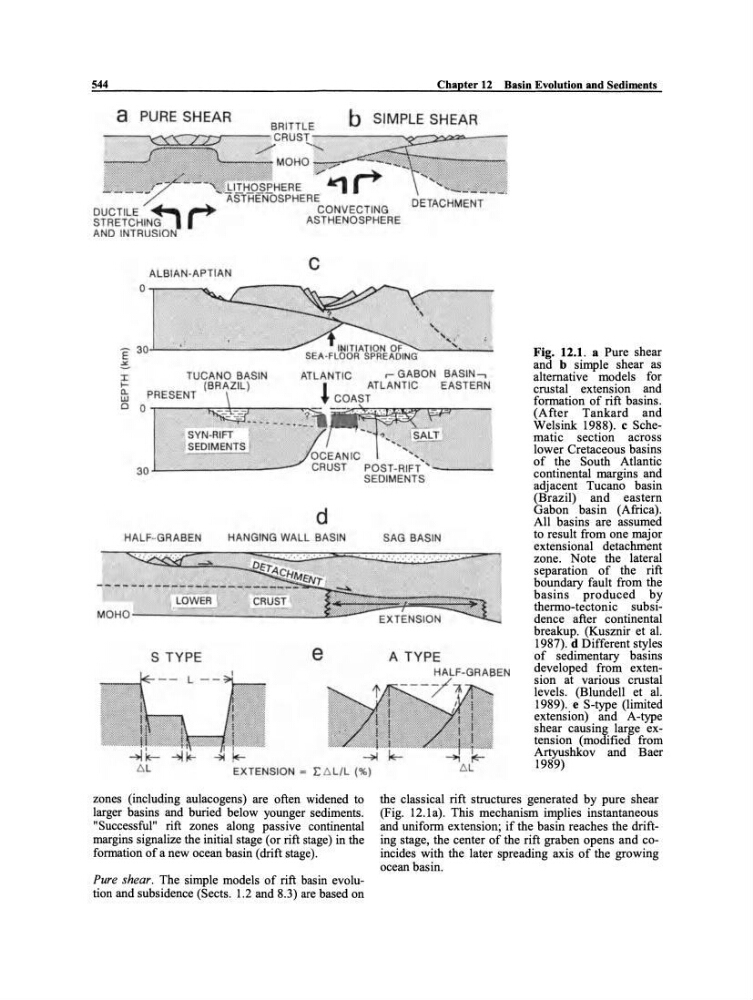
Fig. 12.1. a Pure shear
and b simple shear as
alternative models for
crustal extension and
formation of rift basins.
(After Tankard and
Welsink 1988). c Schematic section across
lower Cretaceous basins
of the South Atlantic
continental margins and
adjacent Tucano basin
(Brazil) and eastern
Gabon basin (Africa).
All basins are assumed
to result from one major
extensional detachment
zone. Note the lateral
separation of the rift
boundary fault from the
basins produced by
thermo-tectonic sub sidence after continental
breakup. (Kusznir et al.
1987). d Different styles
of sedimentary basins
developed from extension at various crustal
levels. (Blundell et al.
1989). eS-type (limited
extension) and A-type
shear causing large extension (modified from
Artyushkov and Baer
1989)
zones (including aulacogens) are often widened to
larger basins and buried below younger sediments.
"Successful" rift zones along passive continental
margins signalize the initial stage (or rift stage) in the
formation of a new ocean basin (drift stage).
the classical rift structures generated by pure shear
(Fig. 12.la). This mechanism implies instantaneous
and uniform extension; if the basin reaches the drifting stage, the center of the rift graben opens and coincides with the later spreading axis of the growing
ocean basin.
Pure shear. The simple models of rift basin evolution and subsidence (Sects. 1.2 and 8.3) are based on
Chapter 12 Basin Evolution and Sediments
a PURE SHEAR
BR ITTlE
b SIMPLE SHEAR
DUCTllE ~ ~
STRETCHING- I I
AND INTRUSION
AlBIAN-APTIAN
o - r - - -_____
. . . . ~
E 30~--~--~--------~
:::.
CONVECTING
ASTHENOSPHERE
c
I
TUCANO BASIN
ATlANTIC
r- GABON BASIN----,
~
(BRAZll)
I
ATlANTIC
EASTERN
W
+COAST
o 0 ~-- - J-' - ~ " " " ~ D - " N I . : : - _ ~ = ~ ~ - ' : ! : , " =::-::::r~-- - __ -_-_-_- ...... __ :o= .~
~ -" -
O~ANIC -r~<,~
CRUST
POST- RIFT· ... -----'-SEDIMENTS
30~ - ~----~~-------d
HALF- GRABEN
HANGING WALL BASIN
SAG BASIN
S TYPE
e
A TYPE
EXTENSION = [ 6L/l (%)
Fig. 12.1. a Pure shear
and b simple shear as
alternative models for
crustal extension and
formation of rift basins.
(After Tankard and
Welsink 1988). c Schematic section across
lower Cretaceous basins
of the South Atlantic
continental margins and
adjacent Tucano basin
(Brazil) and eastern
Gabon basin (Africa).
All basins are assumed
to result from one major
extensional detachment
zone. Note the lateral
separation of the rift
boundary fault from the
basins produced by
thermo-tectonic sub sidence after continental
breakup. (Kusznir et al.
1987). d Different styles
of sedimentary basins
developed from extension at various crustal
levels. (Blundell et al.
1989). eS-type (limited
extension) and A-type
shear causing large extension (modified from
Artyushkov and Baer
1989)
zones (including aulacogens) are often widened to
larger basins and buried below younger sediments.
"Successful" rift zones along passive continental
margins signalize the initial stage (or rift stage) in the
formation of a new ocean basin (drift stage).
the classical rift structures generated by pure shear
(Fig. 12.la). This mechanism implies instantaneous
and uniform extension; if the basin reaches the drifting stage, the center of the rift graben opens and coincides with the later spreading axis of the growing
ocean basin.
Pure shear. The simple models of rift basin evolution and subsidence (Sects. 1.2 and 8.3) are based on