

11.4 Chemical Sediments (Evaporites)
35
230
NaCt
CaS04
Mg C03
CaC03
BASALTS
DR = 10 m/ Ma
513
100
~ 50
4.
u
a:
Vl
0
GRANtTtC
OTHER SALTS
ROCKS
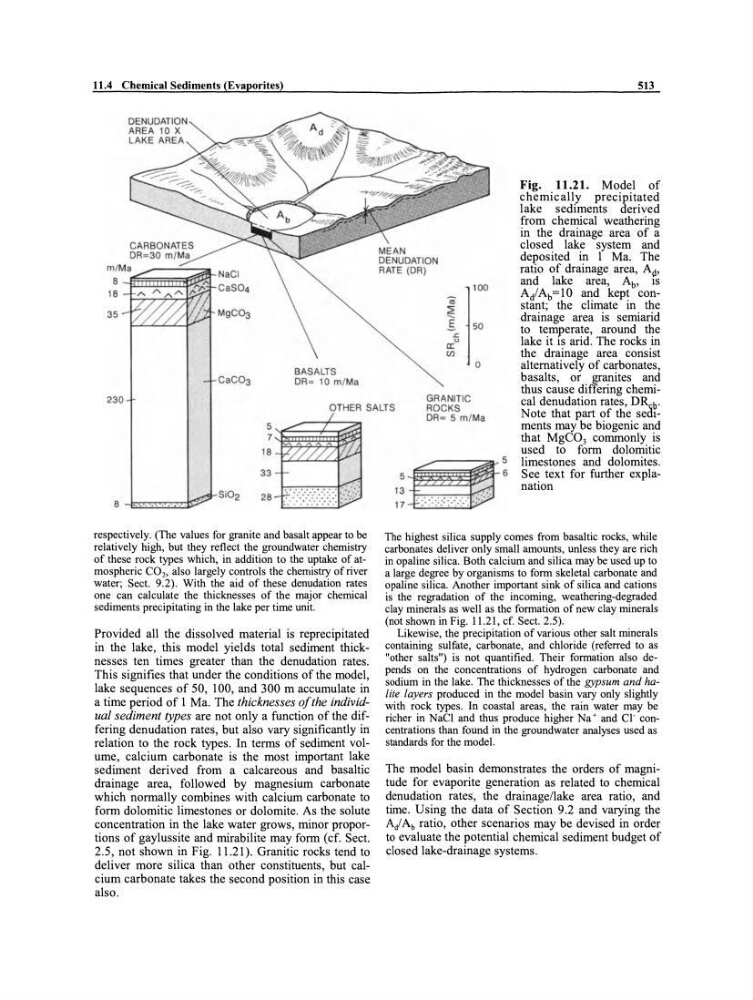
Fig. 11.21. Model of
chemically precipitated
lake sediments derived
from chemical weathering
in the drainage area of a
c10sed lake system and
deposited in 1 Ma. The
ratio of drainage area, All'
and lake area, Ab' lS
AiAb=lO and kept constant; the c1imate in the
drainage area is semiarid
to temperate, around the
lake it is arid. The rocks in
the drainage area consist
altematively of carbonates,
basalts, or granites and
thus cause differing chemical denudation rates, DRGI.t.
Note that part of the seOlments may be biogenic and
that MgC0 3 commonly is
used to form dolomitic
limes tones and dolomites.
See text for further explanation
5
7
18
33
Si02
28
8
...... . . .
respectively. (The values for granite and basalt appear to be
relatively high, but they reflect the groundwater chemistry
of these rock types which, in addition to the uptake of atmospheric CO2, also largely controls the chemistry of river
water; Sect. 9.2). With the aid of these denudation rates
one can calculate the thicknesses of the major chemical
sediments precipitating in the lake per time unit.
Provided all the dissolved material is reprecipitated
in the lake, this model yields total sediment thicknesses ten times greater than the denudation rates.
This signifies that under the conditions of the model,
lake sequences of 50, 100, and 300 m accumulate in
a time period of 1 Ma. The thicknesses ofthe individual sediment types are not only a function of the differing denudation rates, but also vary significantly in
relation to the rock types. In terms of sediment volurne, calcium carbonate is the most important lake
sediment derived from a calcareous and basaltic
drainage area, followed by magnesium carbonate
which normally combines with calcium carbonate to
form dolomitic limestones or dolomite. As the solute
concentration in the lake water grows, minor proportions of gaylussite and mirabilite may form (cf. Sect.
2.5, not shown in Fig. 11.21). Granitic rocks tend to
deliver more silica than other constituents, but calcium carbonate takes the second position in this case
also.
DR = 5 m/ Ma
The highest silica supply comes from basaltic rocks, while
carbonates deli ver only small amounts, unless they are rich
in opaline silica. Both calcium and silica may be used up to
a large degree by organisms to form skeletal carbonate and
opaline silica. Another important sink of silica and cations
is the regradation of the incoming, weathering-degraded
clay minerals as well as the formation of new clay minerals
(not shown in Fig. 11.21, cf. Sect. 2.5).
Likewise, the precipitation of various other salt minerals
containing sulfate, carbonate, and chloride (referred to as
"other salts") is not quantified. Their formation also depends on the concentrations of hydrogen carbonate and
sodium in the lake. The thicknesses of the gypsum and haUfe layers produced in the model basin vary only slightly
with rock types. In coastal areas, the rain water may be
richer in NaCI and thus produce higher Na + and Cl· concentrations than found in the groundwater analyses used as
standards for the model.
The model basin demonstrates the orders of magnitude for evaporite generation as related to chemical
denudation rates, the drainage/lake area ratio, and
time. U sing the data of Section 9.2 and varying the
Ai Ab ratio, other scenarios may be devised in order
to evaluate the potential chemical sediment budget of
closed lake-drainage systems.
35
230
NaCt
CaS04
Mg C03
CaC03
BASALTS
DR = 10 m/ Ma
513
100
~ 50
4.
u
a:
Vl
0
GRANtTtC
OTHER SALTS
ROCKS
Fig. 11.21. Model of
chemically precipitated
lake sediments derived
from chemical weathering
in the drainage area of a
c10sed lake system and
deposited in 1 Ma. The
ratio of drainage area, All'
and lake area, Ab' lS
AiAb=lO and kept constant; the c1imate in the
drainage area is semiarid
to temperate, around the
lake it is arid. The rocks in
the drainage area consist
altematively of carbonates,
basalts, or granites and
thus cause differing chemical denudation rates, DRGI.t.
Note that part of the seOlments may be biogenic and
that MgC0 3 commonly is
used to form dolomitic
limes tones and dolomites.
See text for further explanation
5
7
18
33
Si02
28
8
...... . . .
respectively. (The values for granite and basalt appear to be
relatively high, but they reflect the groundwater chemistry
of these rock types which, in addition to the uptake of atmospheric CO2, also largely controls the chemistry of river
water; Sect. 9.2). With the aid of these denudation rates
one can calculate the thicknesses of the major chemical
sediments precipitating in the lake per time unit.
Provided all the dissolved material is reprecipitated
in the lake, this model yields total sediment thicknesses ten times greater than the denudation rates.
This signifies that under the conditions of the model,
lake sequences of 50, 100, and 300 m accumulate in
a time period of 1 Ma. The thicknesses ofthe individual sediment types are not only a function of the differing denudation rates, but also vary significantly in
relation to the rock types. In terms of sediment volurne, calcium carbonate is the most important lake
sediment derived from a calcareous and basaltic
drainage area, followed by magnesium carbonate
which normally combines with calcium carbonate to
form dolomitic limestones or dolomite. As the solute
concentration in the lake water grows, minor proportions of gaylussite and mirabilite may form (cf. Sect.
2.5, not shown in Fig. 11.21). Granitic rocks tend to
deliver more silica than other constituents, but calcium carbonate takes the second position in this case
also.
DR = 5 m/ Ma
The highest silica supply comes from basaltic rocks, while
carbonates deli ver only small amounts, unless they are rich
in opaline silica. Both calcium and silica may be used up to
a large degree by organisms to form skeletal carbonate and
opaline silica. Another important sink of silica and cations
is the regradation of the incoming, weathering-degraded
clay minerals as well as the formation of new clay minerals
(not shown in Fig. 11.21, cf. Sect. 2.5).
Likewise, the precipitation of various other salt minerals
containing sulfate, carbonate, and chloride (referred to as
"other salts") is not quantified. Their formation also depends on the concentrations of hydrogen carbonate and
sodium in the lake. The thicknesses of the gypsum and haUfe layers produced in the model basin vary only slightly
with rock types. In coastal areas, the rain water may be
richer in NaCI and thus produce higher Na + and Cl· concentrations than found in the groundwater analyses used as
standards for the model.
The model basin demonstrates the orders of magnitude for evaporite generation as related to chemical
denudation rates, the drainage/lake area ratio, and
time. U sing the data of Section 9.2 and varying the
Ai Ab ratio, other scenarios may be devised in order
to evaluate the potential chemical sediment budget of
closed lake-drainage systems.