

488
a
Sem i~
Humid
arid 1
__ L ______ 1_ - - - - - -
1 Northem
I Central Alps
Calcareous 1
Alps
1
3000m 1 ____ • ____ • __ __ _ ,. __ ._. _
T -
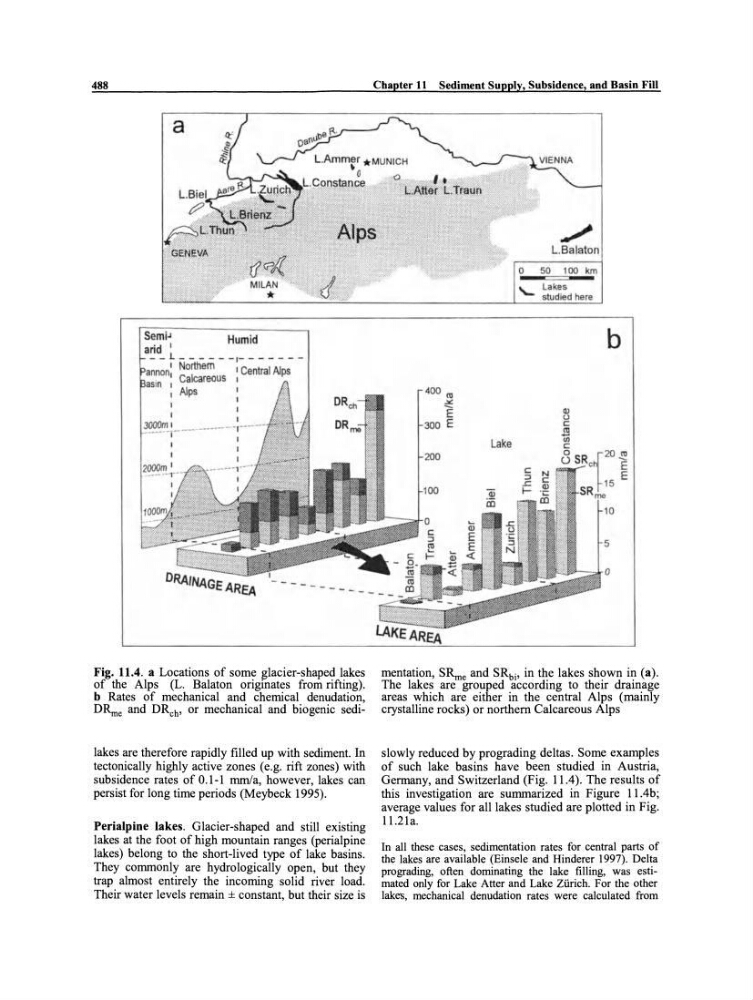
--- --Fig. 11.4. a Locations of some glacier-shaped lakes
of the Alps (L. Balaton originates from rifting).
b Rates of mechanical and chemical denudation,
D~e and DReh' or mechanical and biogenic sedilakes are therefore rapidly filled up with sediment In
tectonically highly active zones (e.g. rift zones) with
subsidence rates of 0.1-1 mmJa, however, lakes can
pers ist for long time periods (Meybeck 1995).
Perialpine lakes. Glacier-shaped and still existing
lakes at the foot of high mountain ranges (perialpine
lakes) belong to the short-lived type of lake basins.
They commonly are hydrologically open, but they
trap almost entirely the incoming solid river load.
Their water levels remain ± constant, but their size is
Chapter 11 Sediment Supply, Subsidence, and Basin Fill
400 1' 0
..><:
E
300 E
200
Lake
. /
L.Balaton
o 50 100 km
' - Lakes
studied here
b
201'0
10
5
o
E
E
mentation, S~e and SR bi , in the lakes shown in (a).
The lakes are grouped according to their drainage
areas which are either in the central Alps (mainly
crystalline rocks) or northem Calcareous Alps
slowly reduced by prograding deltas. Some examples
of such lake basins have been studied in Austria,
Germany, and Switzerland (Fig. 11.4). The results of
this investigation are summarized in Figure il.4b;
average values for alllakes studied are plotted in Fig.
11.21a.
In all these cases, sedimentation rates for central parts of
the lakes are available (Einseie and Hinderer 1997). Delta
prograding, often dominating the lake filling, was estimated only for Lake Atter and Lake Zürich. For the other
lake'S, mechanical denudation rates were calculated from
a
Sem i~
Humid
arid 1
__ L ______ 1_ - - - - - -
1 Northem
I Central Alps
Calcareous 1
Alps
1
3000m 1 ____ • ____ • __ __ _ ,. __ ._. _
T -
--- --Fig. 11.4. a Locations of some glacier-shaped lakes
of the Alps (L. Balaton originates from rifting).
b Rates of mechanical and chemical denudation,
D~e and DReh' or mechanical and biogenic sedilakes are therefore rapidly filled up with sediment In
tectonically highly active zones (e.g. rift zones) with
subsidence rates of 0.1-1 mmJa, however, lakes can
pers ist for long time periods (Meybeck 1995).
Perialpine lakes. Glacier-shaped and still existing
lakes at the foot of high mountain ranges (perialpine
lakes) belong to the short-lived type of lake basins.
They commonly are hydrologically open, but they
trap almost entirely the incoming solid river load.
Their water levels remain ± constant, but their size is
Chapter 11 Sediment Supply, Subsidence, and Basin Fill
400 1' 0
..><:
E
300 E
200
Lake
. /
L.Balaton
o 50 100 km
' - Lakes
studied here
b
201'0
10
5
o
E
E
mentation, S~e and SR bi , in the lakes shown in (a).
The lakes are grouped according to their drainage
areas which are either in the central Alps (mainly
crystalline rocks) or northem Calcareous Alps
slowly reduced by prograding deltas. Some examples
of such lake basins have been studied in Austria,
Germany, and Switzerland (Fig. 11.4). The results of
this investigation are summarized in Figure il.4b;
average values for alllakes studied are plotted in Fig.
11.21a.
In all these cases, sedimentation rates for central parts of
the lakes are available (Einseie and Hinderer 1997). Delta
prograding, often dominating the lake filling, was estimated only for Lake Atter and Lake Zürich. For the other
lake'S, mechanical denudation rates were calculated from