

476
10 1
tU
..:.: 10 0
" , .
E
u
-- Cl
UJ
-1
~ 10
a:
Z
o
~ 10- 2
-.J
::J
~
::J
o
o
«
C)
a:
o
PRESERVATION FACTOR
VARIOUS TROUGHS,
/
10%
BAYS, INLETS ~ 111J-H1
IIj}m I 1%
BLACK SEA / /
/ /
~~
/
0.1%
MARGINAL
/ - /
DEEP-SEA
.:::::::: /
BASINS, '-.......
?~
OCEANIC
' "
. ~:.
RISES
/
7
n.o 1%
///
/ / /
0.001%
DEEP SEA
~
/
(CENTRAL ~ /
PACIFIC)
% /
/
10 2
10 3
PRIMARY PRODUCTION RATE gC/(m 2 .a)
[1gG/(m 2 • a) = 0.1 gC/(cm 2 ·ka}]
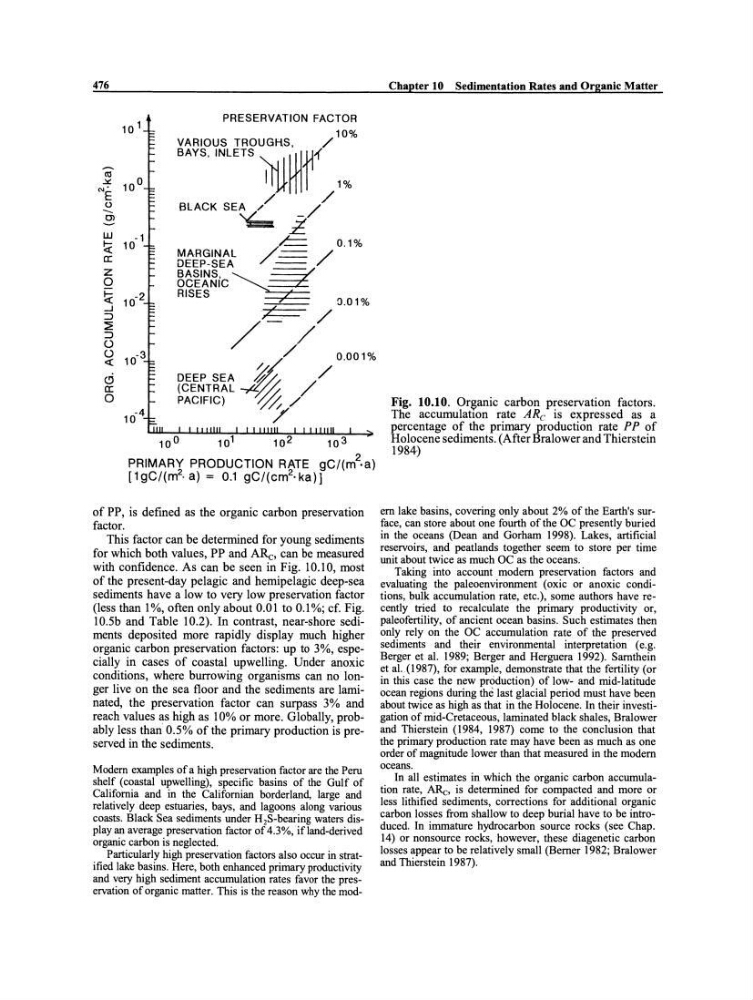
of PP, is defined as the organic carbon preservation
factor.
This factor can be deterrnined for young sediments
for which both values, pp and ARe, can be measured
with confidence. As can be seen in Fig. 10.10, most
of the present-day pelagic and hemipelagic deep-sea
sediments have a low to very low preservation factor
(less than 1 %, often only about 0.01 to 0.1 %; cf. Fig.
1O.5b and Table 10.2). In contrast, near-shore sediments deposited more rapidly display much higher
organic carbon preservation factors: up to 3%, especially in cases of coastal upwelling. Under anoxic
conditions, where burrowing organisrns can no longer live on the sea floor and the sediments are laminated, the preservation factor can surpass 3 % and
reach values as high as 10% or more. Globally, probably less than 0.5% of the primary production is preserved in the sediments.
Modem examples of a high preservation factor are the Peru
shelf (coastal upwelling), specific basins of the Gulf of
Califomia and in the Califomian borderland, large and
relatively deep estuaries, bays, and lagoons along various
coasts. Black Sea sediments under H2S-bearing waters displayan average preservation factor of 4.3%, ifland-derived
organic carbon is neglected.
Particularly high preservation factors also occur in stratified lake basins. Here, both enhanced primary productivity
and very high sediment accumulation rates favor the preservation of organic matter. This is the reason why the modChapter 10 Sedimentation Rates and Organic Matter
Fig. 10.10. Orsanic carbon preservation factors.
The accumulatlOn rate ARe is expressed as a
percentage of the primary production rate PP of
Holocene sediments. (After Bralower and Thierstein
1984)
em lake basins, covering only about 2% of the Earth's surface, can store about one fourth ofthe OC presently buried
in the oceans (Dean and Gorham 1998). Lakes, artificial
reservoirs, and peatlands together seem to store per time
unit about twice as mueh OC as the oceans.
Taking into account modem preservation factors and
evaluating the paleoenvironment (oxie or anoxic conditions, bulk aecumulation rate, ete.), some authors have recently tried to reealeulate the primary productivity or,
paleofertility, of ancient ocean basins. Such estimates then
only rely on the OC accumulation rate of the preserved
sediments and their environmental interpretation (e.g.
Berger et al. 1989; Berger and Herguera 1992). Samthein
et al.(l987), for example, demonstrate that the fertility (or
in this case the new production) of low- and mid-latitude
ocean regions during the last glacial period must have been
about twice as high as that in the Holocene. In their investigation of mid-Cretaceous, laminated black shales, Bralower
and Thierstein (1984, 1987) come to the conclusion that
the primary produetion rate may have been as much as one
order of magnitude lower than that measured in the modern
oceans.
In all estirnates in which the organic carbon accumulation rate, ARe, is determined for compacted and more or
less lithified sediments, correetions foradditional organic
carbon losses from shallow to deep burial have to be introduced. In immature hydroearbon source rocks (see Chap.
14) or nonsouree rocks, however, these diagenetic carbon
los ses appear to be relatively small (Berner 1982; Bralower
and Thierstein 1987).
10 1
tU
..:.: 10 0
" , .
E
u
-- Cl
UJ
-1
~ 10
a:
Z
o
~ 10- 2
-.J
::J
~
::J
o
o
«
C)
a:
o
PRESERVATION FACTOR
VARIOUS TROUGHS,
/
10%
BAYS, INLETS ~ 111J-H1
IIj}m I 1%
BLACK SEA / /
/ /
~~
/
0.1%
MARGINAL
/ - /
DEEP-SEA
.:::::::: /
BASINS, '-.......
?~
OCEANIC
' "
. ~:.
RISES
/
7
n.o 1%
///
/ / /
0.001%
DEEP SEA
~
/
(CENTRAL ~ /
PACIFIC)
% /
/
10 2
10 3
PRIMARY PRODUCTION RATE gC/(m 2 .a)
[1gG/(m 2 • a) = 0.1 gC/(cm 2 ·ka}]
of PP, is defined as the organic carbon preservation
factor.
This factor can be deterrnined for young sediments
for which both values, pp and ARe, can be measured
with confidence. As can be seen in Fig. 10.10, most
of the present-day pelagic and hemipelagic deep-sea
sediments have a low to very low preservation factor
(less than 1 %, often only about 0.01 to 0.1 %; cf. Fig.
1O.5b and Table 10.2). In contrast, near-shore sediments deposited more rapidly display much higher
organic carbon preservation factors: up to 3%, especially in cases of coastal upwelling. Under anoxic
conditions, where burrowing organisrns can no longer live on the sea floor and the sediments are laminated, the preservation factor can surpass 3 % and
reach values as high as 10% or more. Globally, probably less than 0.5% of the primary production is preserved in the sediments.
Modem examples of a high preservation factor are the Peru
shelf (coastal upwelling), specific basins of the Gulf of
Califomia and in the Califomian borderland, large and
relatively deep estuaries, bays, and lagoons along various
coasts. Black Sea sediments under H2S-bearing waters displayan average preservation factor of 4.3%, ifland-derived
organic carbon is neglected.
Particularly high preservation factors also occur in stratified lake basins. Here, both enhanced primary productivity
and very high sediment accumulation rates favor the preservation of organic matter. This is the reason why the modChapter 10 Sedimentation Rates and Organic Matter
Fig. 10.10. Orsanic carbon preservation factors.
The accumulatlOn rate ARe is expressed as a
percentage of the primary production rate PP of
Holocene sediments. (After Bralower and Thierstein
1984)
em lake basins, covering only about 2% of the Earth's surface, can store about one fourth ofthe OC presently buried
in the oceans (Dean and Gorham 1998). Lakes, artificial
reservoirs, and peatlands together seem to store per time
unit about twice as mueh OC as the oceans.
Taking into account modem preservation factors and
evaluating the paleoenvironment (oxie or anoxic conditions, bulk aecumulation rate, ete.), some authors have recently tried to reealeulate the primary productivity or,
paleofertility, of ancient ocean basins. Such estimates then
only rely on the OC accumulation rate of the preserved
sediments and their environmental interpretation (e.g.
Berger et al. 1989; Berger and Herguera 1992). Samthein
et al.(l987), for example, demonstrate that the fertility (or
in this case the new production) of low- and mid-latitude
ocean regions during the last glacial period must have been
about twice as high as that in the Holocene. In their investigation of mid-Cretaceous, laminated black shales, Bralower
and Thierstein (1984, 1987) come to the conclusion that
the primary produetion rate may have been as much as one
order of magnitude lower than that measured in the modern
oceans.
In all estirnates in which the organic carbon accumulation rate, ARe, is determined for compacted and more or
less lithified sediments, correetions foradditional organic
carbon losses from shallow to deep burial have to be introduced. In immature hydroearbon source rocks (see Chap.
14) or nonsouree rocks, however, these diagenetic carbon
los ses appear to be relatively small (Berner 1982; Bralower
and Thierstein 1987).