

452
...«3
~ 40
E
CI:
Cl
20
"0
C
«3
CI:
::)
0
...«3
E 1,0
E
;0,8
l.L.
t o
a
EQUILIBRIUM
~ . .L
~-~
._'-;:oor-- -~" I
1
I
I
I
I
I
I
I
t, t 2 t e
t 3 Time
c
HUMID
TEr-.wERATE
~
er 0,6 TROPICAL
::J
CLiMATE
__
l.L. 0,4
\1
1
I'
ARID TO
~ 0,2
11 111
.. ; ; : . ~SEMI-ARID
f-«
I I~II_~ ........ .
~.;:.:.::::.::::::.::::::·:AB"QVE BASE LEVEL
CI:
O~~+=~--r--,---.~
o 1000 2000 3000 4000
SUM OF UPLIFT
-
g2
Z
0
~
>
1
W
.....J
w 0
0
Chapter 9 Denudation and Mass Transport
UPLIFT
WITHOUT.
/
/
b
LOW DR
~I- -
- - - - -
.." -
1
"" .,
MEDIUM DR
"" ..,,-,_.:-._./ .
I
,HIGH OR
d
10 Ma
A"- .....
/1
.....
/ I
..........
/
)
/ los
MEAN SLOPE DENUDATION D= +(0 5 + Oe)
e
ARID TO SEMI-ARID
E
3
RELIEF ABOVE BASE LEVEL
(SUMMIT ELEVATION)
/
c
TR:ICS
/'
\PENEPLAIN)
.::%:.
CLiMATE-CONTROLLED
-.--z.:_~~LANDFORMS ~
Z
2
0
~
> 1
w
.....J
W
0 0
20
40
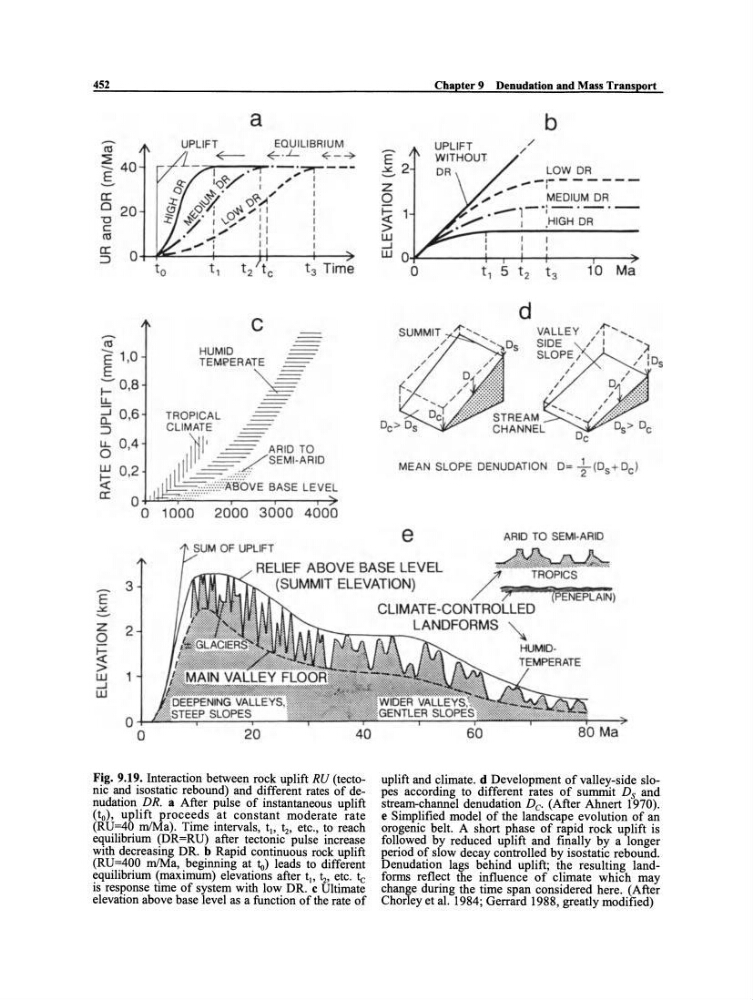
Fig. 9.19. Interaction between rock uplift RU (teetonic and isostatic rebound) and different rates of denudation DR. a After pulse of instantaneous uplift
(t o ), uplift proceeds at constant moderate rate
(RU=40 m1Ma). Time intervals, t" ~, etc., to reach
equilibrium (DR=RU) after tectonic pulse increase
with decreasing DR. b Rapid continuous rock uplift
(RU=400 m1Ma, beginning at 10) leads to different
equilibrium (maximum) elevations after t 1 , ~, etc. tc
is response time of system with low DR. c Ultimate
elevation above base level as a function of the rate of
60
80 Ma
uplift and climate. d Development of valley-side slopes according to different rates of summit D s and
stream-channel denudation D e . (After Ahnert 1970).
e Simplified model of the landscape evolution of an
orogenic belt. A short phase of rapid rock uplift is
followed by reduced uplift and finally by a longer
period of slow decay controlled by isostatic rebound.
Denudation lags behind uplift; the resulting landforms reflect the influence of climate which may
change during the time span considered here. (After
Chorleyet al. 1984; Gerrard 1988, greatly modified)
...«3
~ 40
E
CI:
Cl
20
"0
C
«3
CI:
::)
0
...«3
E 1,0
E
;0,8
l.L.
t o
a
EQUILIBRIUM
~ . .L
~-~
._'-;:oor-- -~" I
1
I
I
I
I
I
I
I
t, t 2 t e
t 3 Time
c
HUMID
TEr-.wERATE
~
er 0,6 TROPICAL
::J
CLiMATE
__
l.L. 0,4
\1
1
I'
ARID TO
~ 0,2
11 111
.. ; ; : . ~SEMI-ARID
f-«
I I~II_~ ........ .
~.;:.:.::::.::::::.::::::·:AB"QVE BASE LEVEL
CI:
O~~+=~--r--,---.~
o 1000 2000 3000 4000
SUM OF UPLIFT
-
g2
Z
0
~
>
1
W
.....J
w 0
0
Chapter 9 Denudation and Mass Transport
UPLIFT
WITHOUT.
/
/
b
LOW DR
~I- -
- - - - -
.." -
1
"" .,
MEDIUM DR
"" ..,,-,_.:-._./ .
I
,HIGH OR
d
10 Ma
A"- .....
/1
.....
/ I
..........
/
)
/ los
MEAN SLOPE DENUDATION D= +(0 5 + Oe)
e
ARID TO SEMI-ARID
E
3
RELIEF ABOVE BASE LEVEL
(SUMMIT ELEVATION)
/
c
TR:ICS
/'
\PENEPLAIN)
.::%:.
CLiMATE-CONTROLLED
-.--z.:_~~LANDFORMS ~
Z
2
0
~
> 1
w
.....J
W
0 0
20
40
Fig. 9.19. Interaction between rock uplift RU (teetonic and isostatic rebound) and different rates of denudation DR. a After pulse of instantaneous uplift
(t o ), uplift proceeds at constant moderate rate
(RU=40 m1Ma). Time intervals, t" ~, etc., to reach
equilibrium (DR=RU) after tectonic pulse increase
with decreasing DR. b Rapid continuous rock uplift
(RU=400 m1Ma, beginning at 10) leads to different
equilibrium (maximum) elevations after t 1 , ~, etc. tc
is response time of system with low DR. c Ultimate
elevation above base level as a function of the rate of
60
80 Ma
uplift and climate. d Development of valley-side slopes according to different rates of summit D s and
stream-channel denudation D e . (After Ahnert 1970).
e Simplified model of the landscape evolution of an
orogenic belt. A short phase of rapid rock uplift is
followed by reduced uplift and finally by a longer
period of slow decay controlled by isostatic rebound.
Denudation lags behind uplift; the resulting landforms reflect the influence of climate which may
change during the time span considered here. (After
Chorleyet al. 1984; Gerrard 1988, greatly modified)