

450
a:
o
~
----~
---- "
-,_"'\"
Chapter 9 Denudation and Mass Transport
------- - ---a
....
....
.,,....
\
, /
' v /
DENUDATION RATE, DR
;'
./
/
TECTONIC PULSES
fu..
TU = TECTONIC UPLIFT
:::i
Q..
::>
u..
o
UJ
f« a:
IR = ISOSTATIC REBOUND
D = DENUDATION
z
o
(= E, EXHUMATION)
i=
«
> UJ
.....J
UJ
DandiR ~
. - ' - ' - ' - ' .
fu..
b CONTINUOUS UPLIFT OR SUBSIDENCE
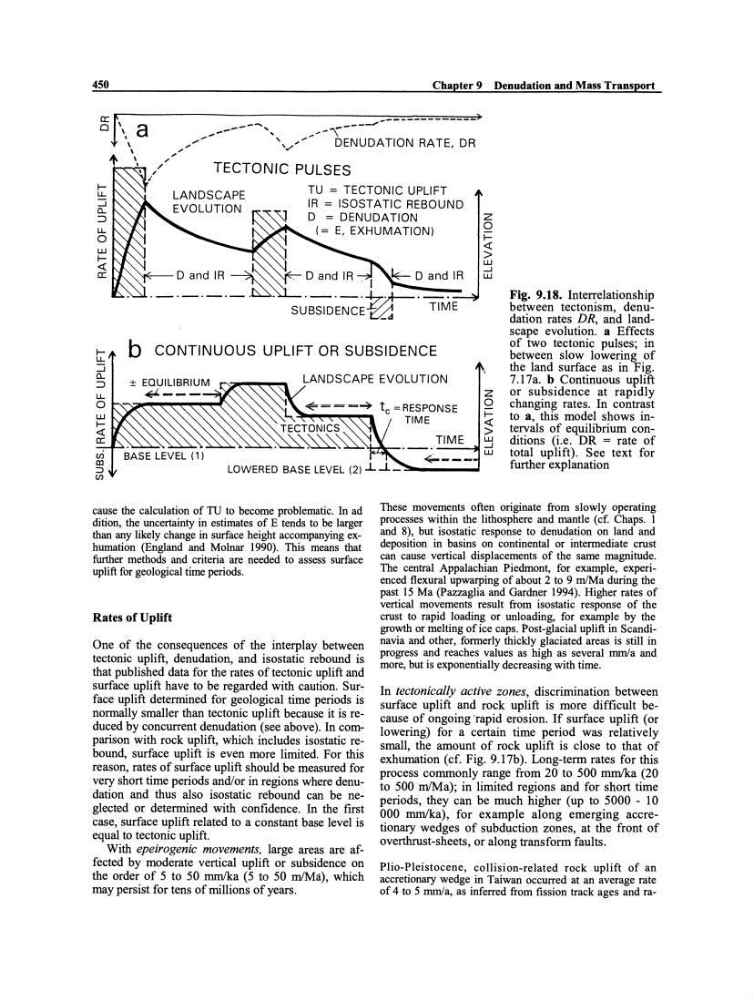
Fig. 9.18. Interrelationship
between tectonism, denudation rates DR, and landscape evolution. a Effects
of two tectonic pulses; in
between slow lowering of
the land surface as in Fig.
7.17 a. b Continuous ul'lift
or subsidence at rapld1y
changing rates. In contrast
to a, this model shows intervals of equilibrium conditions (i.e. DR = rate of
total uplift). See text for
further explanation
.....J
Q..
::>
LANDSCAPE EVOLUTION
o ~~,~~~~~~~
~==-~ t c =RESPONSE
z
o
i=
«
> UJ
.....J
UJ
UJ
f«
a:
Cf)
OJ
:::>
Cf)
cause the ca1culation of TU to become problematic. In ad
dition the uncertainty in estimates of E tends to be larger
than ;ny likely change in surface height accompanying exhumation (England and Molnar 1990). This means that
further methods and criteria are needed to assess surface
uplift for geological time periods.
Rates of Uplift
One of the consequences of the interplay between
tectonic uplift, denudation, and isostatic rebound is
that published data for the rates of tectonic uplift and
surface uplift have to be regarded with caution. Surface uplift determined for geological time periods is
normally smaller than tectonic uplift because it is reduced by concurrent denudation (see above). In comparison with rock uplift, which ineludes isostatic r~bound, surface uplift is even more limited. For thlS
reason, rates of surface uplift should be measured for
very short time periods andlor in regions where denudation and thus also isostatic rebound can be neglected or determined with confidence. In the fir~t
case, surface uplift related to a constant base level IS
equal to tectonic uplift.
With epeirogenic movements, large areas are affected by moderate vertical uplift or subsidence on
the order of 5 to 50 mmlka (5 to 50 mlMa), which
may persist for tens of millions of years.
I TIME
TIME
4---These movements often originate from slowly operating
processes within the lithosphere and man~le (cf. Chaps. 1
and 8), but isostatic response to denu~tlon on .land and
deposition in basins on continental or mtermedlate .crust
can cause vertical displacements of the same magllltud~.
The central Appalachian Piedmont, for example, ~xpenenced flexural upwarping of about 2 to 9 mlMa dunng the
past 15 Ma (Pazzaglia and Gardn~r 199~). Higher rates of
vertical movements result from lsostatlc response of the
crust to rapid loading or unloading, for eJrn?l~le by th~
growth or melting of ice caps. Post-glacial uphft l~ Sc~n~lnavia and other, formerly thickly glaciated areas lS stIlI m
progress and reaches values as high as several mmla and
more, but is exponentially decreasing with time.
In tectonically active zones, discrimination between
surface uplift and rock uplift is more diffic~1t because of ongoing 'rapid erosion. If surface uph~t (or
lowering) for a certain time period was relatlvely
small the amount of rock uplift is elose to that of
exhu~ation (cf. Fig. 9.17b). Long-term rates for this
process commonly range from 20 to 500 mmlka .(20
to 500 mlMa); in limited regions and for short tIme
periods, they can be much higher (up to .5000 - 10
000 mmlka) , for example along emergmg accretionary wedges of subduction zones, at the front of
overthrust-sheets, or along transform faults.
Plio-Pleistocene, collision-related rock uplift of an
accretionary wedge in Taiwan occurred at an average rate
of 4 to 5 mmla, as inferred from fission track ages and ra-
a:
o
~
----~
---- "
-,_"'\"
Chapter 9 Denudation and Mass Transport
------- - ---a
....
....
.,,....
\
, /
' v /
DENUDATION RATE, DR
;'
./
/
TECTONIC PULSES
fu..
TU = TECTONIC UPLIFT
:::i
Q..
::>
u..
o
UJ
f« a:
IR = ISOSTATIC REBOUND
D = DENUDATION
z
o
(= E, EXHUMATION)
i=
«
> UJ
.....J
UJ
DandiR ~
. - ' - ' - ' - ' .
fu..
b CONTINUOUS UPLIFT OR SUBSIDENCE
Fig. 9.18. Interrelationship
between tectonism, denudation rates DR, and landscape evolution. a Effects
of two tectonic pulses; in
between slow lowering of
the land surface as in Fig.
7.17 a. b Continuous ul'lift
or subsidence at rapld1y
changing rates. In contrast
to a, this model shows intervals of equilibrium conditions (i.e. DR = rate of
total uplift). See text for
further explanation
.....J
Q..
::>
LANDSCAPE EVOLUTION
o ~~,~~~~~~~
~==-~ t c =RESPONSE
z
o
i=
«
> UJ
.....J
UJ
UJ
f«
a:
Cf)
OJ
:::>
Cf)
cause the ca1culation of TU to become problematic. In ad
dition the uncertainty in estimates of E tends to be larger
than ;ny likely change in surface height accompanying exhumation (England and Molnar 1990). This means that
further methods and criteria are needed to assess surface
uplift for geological time periods.
Rates of Uplift
One of the consequences of the interplay between
tectonic uplift, denudation, and isostatic rebound is
that published data for the rates of tectonic uplift and
surface uplift have to be regarded with caution. Surface uplift determined for geological time periods is
normally smaller than tectonic uplift because it is reduced by concurrent denudation (see above). In comparison with rock uplift, which ineludes isostatic r~bound, surface uplift is even more limited. For thlS
reason, rates of surface uplift should be measured for
very short time periods andlor in regions where denudation and thus also isostatic rebound can be neglected or determined with confidence. In the fir~t
case, surface uplift related to a constant base level IS
equal to tectonic uplift.
With epeirogenic movements, large areas are affected by moderate vertical uplift or subsidence on
the order of 5 to 50 mmlka (5 to 50 mlMa), which
may persist for tens of millions of years.
I TIME
TIME
4---These movements often originate from slowly operating
processes within the lithosphere and man~le (cf. Chaps. 1
and 8), but isostatic response to denu~tlon on .land and
deposition in basins on continental or mtermedlate .crust
can cause vertical displacements of the same magllltud~.
The central Appalachian Piedmont, for example, ~xpenenced flexural upwarping of about 2 to 9 mlMa dunng the
past 15 Ma (Pazzaglia and Gardn~r 199~). Higher rates of
vertical movements result from lsostatlc response of the
crust to rapid loading or unloading, for eJrn?l~le by th~
growth or melting of ice caps. Post-glacial uphft l~ Sc~n~lnavia and other, formerly thickly glaciated areas lS stIlI m
progress and reaches values as high as several mmla and
more, but is exponentially decreasing with time.
In tectonically active zones, discrimination between
surface uplift and rock uplift is more diffic~1t because of ongoing 'rapid erosion. If surface uph~t (or
lowering) for a certain time period was relatlvely
small the amount of rock uplift is elose to that of
exhu~ation (cf. Fig. 9.17b). Long-term rates for this
process commonly range from 20 to 500 mmlka .(20
to 500 mlMa); in limited regions and for short tIme
periods, they can be much higher (up to .5000 - 10
000 mmlka) , for example along emergmg accretionary wedges of subduction zones, at the front of
overthrust-sheets, or along transform faults.
Plio-Pleistocene, collision-related rock uplift of an
accretionary wedge in Taiwan occurred at an average rate
of 4 to 5 mmla, as inferred from fission track ages and ra-