

9.6 Steady State and Dynamic Denudation Systems
447
o
100
200
300
UPPER INDUS RIVER
-illllt~JIIIII
(T ARBELA RESERVOIR)
ENTIRE HIMALAYAS
RIVERS OF N IRAN
AND CAUCASUS ---nWWß~WiW1mW
S CASPIAN SEA
BLACK
SEA
I
1
ENTERING RIVS~'O 1
HOLOCENE SED.40 I
I
SED. OF LAST
DEGLACIATION
100
1
MISSIS- MODERN RIVER
SIPPI
DEEP-SEA FAN
I
I
I
1
48 1
I
I
1
MODERN VS. LONGTERM MECHANICAL
DENUDATION RATES
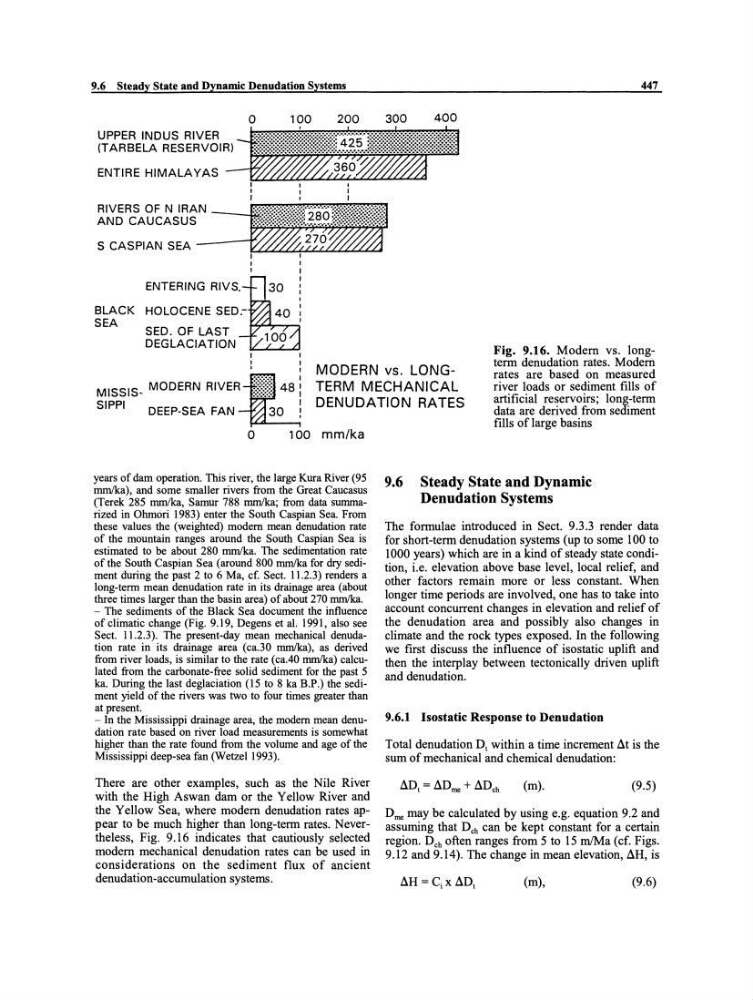
Fig. 9.16 .. Modem vs. longterm denudation rates. Modem
rates are based on measured
river loads or sediment fills of
artificial reservoirs; long-term
data are derived from sediment
fills of large basins
.
o
100 mm/ka
years of dam operation. This river, the large Kura River (95
mmlka), and some smaller rivers from the Great Caucasus
(Terek 285 mmIka, Samur 788 mmIka; from data summarized in Ohmori 1983) enter the South Caspian Sea. From
these values the (weighted) modern mean denudation rate
of the mountain ranges around the South Caspian Sea is
estimated to be about 280 mm/ka. The sedimentation rate
ofthe South Caspian Sea (around 800 mmIka for dry sediment during the past 2 to 6 Ma, cf. Sect. 11.2.3) renders a
long-term mean denudation rate in its drainage area (about
three times 1arger than the basin area) of about 270 mmlka.
- The sediments of the Black Sea document the influence
ofclimatic change (Fig. 9.19, Degens et al. 1991, also see
Sect. 11.2.3). The present-day mean mechanica1 denudation rate in its drainage area (ca.30 mmlka), as derived
from river loads, is simi1ar to the rate (ca.40 mmlka) ca1culated from the carbonate-free solid sediment for the past 5
ka. During the last deglaciation (15 to 8 ka B.P.) the sediment yield of the rivers was two to four times greater than
at present.
- In the Mississippi drainage area, the modem mean denudation rate based on river load measurements is somewhat
higher than the rate found from the volume and age of the
Mississippi deep-sea fan (Wetzel1993).
There are other examples, such as the Nile River
with the High Aswan dam or the Yellow River and
the Yellow Sea, where modem denudation rates appear to be much higher than long-term rates. Nevertheless, Fig. 9.16 indicates that cautiously selected
modem mechanical denudation rates can be used in
considerations on the sediment flux of ancient
denudation-accumulation systems.
9.6 Steady State and Dynamic
Denudation Systems
The formulae introduced in Sect. 9.3.3 render data
for short-term denudation systems (up to some 100 to
1000 years) which are in a kind of steady state condition, i.e. elevation above base level, local relief, and
other factors remain more or less constant. When
longer time periods are involved, one has to take into
account concurrent changes in elevation and relief of
the denudation area and possibly also changes in
climate and the rock types exposed. In the following
we first discuss the influence of isostatic uplift and
then the interplay between tectonically driven uplift
and denudation.
9.6.1 Isostatic Response to Denudation
Total denudation D, within a time increment at is the
sum of mechanical and chemical denudation:
(m).
(9.5)
Dm. may be calculated by using e.g. equation 9.2 and
assuming that D ch can be kept constant for a certain
region. D ch often ranges from 5 to 15 rnIMa (cf. Figs.
9.12 and 9.14). The change in mean elevation, aH, is
(m),
(9.6)
447
o
100
200
300
UPPER INDUS RIVER
-illllt~JIIIII
(T ARBELA RESERVOIR)
ENTIRE HIMALAYAS
RIVERS OF N IRAN
AND CAUCASUS ---nWWß~WiW1mW
S CASPIAN SEA
BLACK
SEA
I
1
ENTERING RIVS~'O 1
HOLOCENE SED.40 I
I
SED. OF LAST
DEGLACIATION
100
1
MISSIS- MODERN RIVER
SIPPI
DEEP-SEA FAN
I
I
I
1
48 1
I
I
1
MODERN VS. LONGTERM MECHANICAL
DENUDATION RATES
Fig. 9.16 .. Modem vs. longterm denudation rates. Modem
rates are based on measured
river loads or sediment fills of
artificial reservoirs; long-term
data are derived from sediment
fills of large basins
.
o
100 mm/ka
years of dam operation. This river, the large Kura River (95
mmlka), and some smaller rivers from the Great Caucasus
(Terek 285 mmIka, Samur 788 mmIka; from data summarized in Ohmori 1983) enter the South Caspian Sea. From
these values the (weighted) modern mean denudation rate
of the mountain ranges around the South Caspian Sea is
estimated to be about 280 mm/ka. The sedimentation rate
ofthe South Caspian Sea (around 800 mmIka for dry sediment during the past 2 to 6 Ma, cf. Sect. 11.2.3) renders a
long-term mean denudation rate in its drainage area (about
three times 1arger than the basin area) of about 270 mmlka.
- The sediments of the Black Sea document the influence
ofclimatic change (Fig. 9.19, Degens et al. 1991, also see
Sect. 11.2.3). The present-day mean mechanica1 denudation rate in its drainage area (ca.30 mmlka), as derived
from river loads, is simi1ar to the rate (ca.40 mmlka) ca1culated from the carbonate-free solid sediment for the past 5
ka. During the last deglaciation (15 to 8 ka B.P.) the sediment yield of the rivers was two to four times greater than
at present.
- In the Mississippi drainage area, the modem mean denudation rate based on river load measurements is somewhat
higher than the rate found from the volume and age of the
Mississippi deep-sea fan (Wetzel1993).
There are other examples, such as the Nile River
with the High Aswan dam or the Yellow River and
the Yellow Sea, where modem denudation rates appear to be much higher than long-term rates. Nevertheless, Fig. 9.16 indicates that cautiously selected
modem mechanical denudation rates can be used in
considerations on the sediment flux of ancient
denudation-accumulation systems.
9.6 Steady State and Dynamic
Denudation Systems
The formulae introduced in Sect. 9.3.3 render data
for short-term denudation systems (up to some 100 to
1000 years) which are in a kind of steady state condition, i.e. elevation above base level, local relief, and
other factors remain more or less constant. When
longer time periods are involved, one has to take into
account concurrent changes in elevation and relief of
the denudation area and possibly also changes in
climate and the rock types exposed. In the following
we first discuss the influence of isostatic uplift and
then the interplay between tectonically driven uplift
and denudation.
9.6.1 Isostatic Response to Denudation
Total denudation D, within a time increment at is the
sum of mechanical and chemical denudation:
(m).
(9.5)
Dm. may be calculated by using e.g. equation 9.2 and
assuming that D ch can be kept constant for a certain
region. D ch often ranges from 5 to 15 rnIMa (cf. Figs.
9.12 and 9.14). The change in mean elevation, aH, is
(m),
(9.6)