

440
PRECIPITATION
TROPICAL
CLiMA TE BEL T
(LATITUDE)
- --------,
SUBTROPICAL I
/
- Ä"Riö-TOi
SEMI- I
--MEDI-I ARID :
TERRAN- :
I
EAN I
I
--HUMIDI
I
I
TEMP.
I
:
-sus---1 1r
. . t oo:sb
ARCTIC i
I
TO
ARCTIC .1 100~O
Chapter 9 Denudation and Mass Transport
MECHANICAL
DENUDATION
(m /Ma or
mm/ka)
CHEMICAL
DENUDATION
(m /Ma)
./ GLACIATED AREAS
,,/'
/
' "
/ /
LOWLANDS AND
MOUNTAIN
UPLANDS WITH
RANGES
INLAND ICE
200-2000
RIVERS
DRAINING
AREAS OF
VERY HIGH
RELIEF
LARGE RNERS
°W' · ·
MOUNTAIN
RIVERS
PLAINS
RIVERS
DRAINING AREAS OF
DIFFERENT RELIEF AND CLiMATE
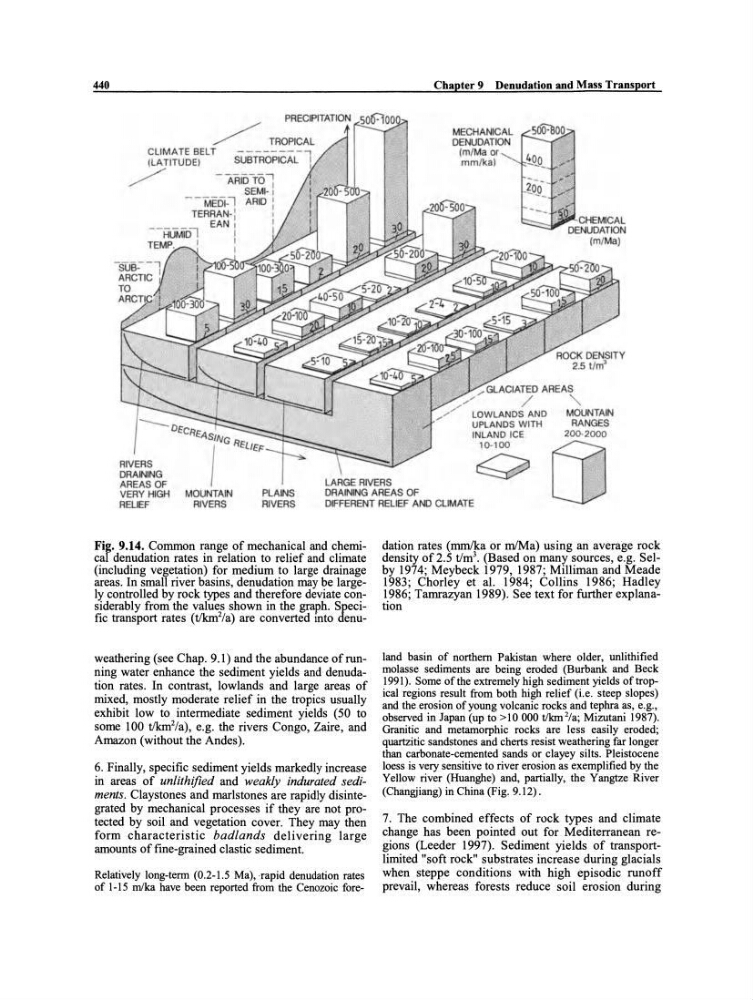
Fig. 9.14. Common range of mechanical and chemicaf denudation rates in relation to relief and climate
(including vegetation) for medium to large drainage
areas. In small river basins, denudation may be largely controlled by rock types and therefore deviate considerably from the v.alues shown in the graph. Specific transport rates (tlkm 2 /a) are converted into denuweathering (see Chap. 9.1) and the abundance of running water enhance the sediment yields and denudation rates. In contrast, lowlands and large areas of
mixed, mostly moderate relief in the tropics usually
exhibit low to intermediate sediment yields (50 to
some 100 tlkrn 2 /a), e.g. the rivers Congo, Zaire, and
Amazon (without the Andes).
6. Finally, specific sediment yields markedly increase
in areas of unlithified and weakly indurated sediments. Claystones and marlstones are rapidly disintegrated by mechanical processes if they are not protected by soil and vegetation cover. They may then
form characteristic badlands delivering large
amounts of fine-grained clastic sediment.
Relatively long-tenn (0.2-1.5 Ma),rapid denudation rates
of 1-15 mika have been reported from the Cenozoic foredation rates (mmlka or rnIMa) using an average rock
density of 2.5 tlm 3 • (Based on many sources, e.g. Selby 1974; Meybeck 1979, 1987; Milliman and Meade
1983; Chorley et al. 1984; Collins 1986; Radley
1986; Tarnrazyan 1989). See text for further explanation
land basin of northern Pakistan where older, unlithified
molasse sediments are being eroded (Burbank and Beck
1991). Some ofthe extremely high sediment yields oftropical regions result from both high relief (i.e. steep slopes)
and the erosion ofyoung volcanic rocks and tephra as, e.g.,
observed in Japan (up to >10 000 tlkm 2 /a; Mizutani 1987).
Granitic and metamorphic rocks are less easily eroded;
quartzitic sandstones and cherts resist weathering far longer
than carbonate-cemented sands or clayey silts. Pleistocene
loess is very sensitive to river erosion as exemplified by the
Yellow river (Huanghe) and, partially, the Yangtze River
(Changjiang) in China (Fig. 9.12) .
7. The combined effects of rock types and climate
change has been pointed out for Mediterranean regions (Leeder 1997). Sediment yields of transportlimited "soft rock" substrates increase during glacials
when steppe conditions with high episodic runoff
prevail, whereas forests reduce soil erosion during
PRECIPITATION
TROPICAL
CLiMA TE BEL T
(LATITUDE)
- --------,
SUBTROPICAL I
/
- Ä"Riö-TOi
SEMI- I
--MEDI-I ARID :
TERRAN- :
I
EAN I
I
--HUMIDI
I
I
TEMP.
I
:
-sus---1 1r
. . t oo:sb
ARCTIC i
I
TO
ARCTIC .1 100~O
Chapter 9 Denudation and Mass Transport
MECHANICAL
DENUDATION
(m /Ma or
mm/ka)
CHEMICAL
DENUDATION
(m /Ma)
./ GLACIATED AREAS
,,/'
/
' "
/ /
LOWLANDS AND
MOUNTAIN
UPLANDS WITH
RANGES
INLAND ICE
200-2000
RIVERS
DRAINING
AREAS OF
VERY HIGH
RELIEF
LARGE RNERS
°W' · ·
MOUNTAIN
RIVERS
PLAINS
RIVERS
DRAINING AREAS OF
DIFFERENT RELIEF AND CLiMATE
Fig. 9.14. Common range of mechanical and chemicaf denudation rates in relation to relief and climate
(including vegetation) for medium to large drainage
areas. In small river basins, denudation may be largely controlled by rock types and therefore deviate considerably from the v.alues shown in the graph. Specific transport rates (tlkm 2 /a) are converted into denuweathering (see Chap. 9.1) and the abundance of running water enhance the sediment yields and denudation rates. In contrast, lowlands and large areas of
mixed, mostly moderate relief in the tropics usually
exhibit low to intermediate sediment yields (50 to
some 100 tlkrn 2 /a), e.g. the rivers Congo, Zaire, and
Amazon (without the Andes).
6. Finally, specific sediment yields markedly increase
in areas of unlithified and weakly indurated sediments. Claystones and marlstones are rapidly disintegrated by mechanical processes if they are not protected by soil and vegetation cover. They may then
form characteristic badlands delivering large
amounts of fine-grained clastic sediment.
Relatively long-tenn (0.2-1.5 Ma),rapid denudation rates
of 1-15 mika have been reported from the Cenozoic foredation rates (mmlka or rnIMa) using an average rock
density of 2.5 tlm 3 • (Based on many sources, e.g. Selby 1974; Meybeck 1979, 1987; Milliman and Meade
1983; Chorley et al. 1984; Collins 1986; Radley
1986; Tarnrazyan 1989). See text for further explanation
land basin of northern Pakistan where older, unlithified
molasse sediments are being eroded (Burbank and Beck
1991). Some ofthe extremely high sediment yields oftropical regions result from both high relief (i.e. steep slopes)
and the erosion ofyoung volcanic rocks and tephra as, e.g.,
observed in Japan (up to >10 000 tlkm 2 /a; Mizutani 1987).
Granitic and metamorphic rocks are less easily eroded;
quartzitic sandstones and cherts resist weathering far longer
than carbonate-cemented sands or clayey silts. Pleistocene
loess is very sensitive to river erosion as exemplified by the
Yellow river (Huanghe) and, partially, the Yangtze River
(Changjiang) in China (Fig. 9.12) .
7. The combined effects of rock types and climate
change has been pointed out for Mediterranean regions (Leeder 1997). Sediment yields of transportlimited "soft rock" substrates increase during glacials
when steppe conditions with high episodic runoff
prevail, whereas forests reduce soil erosion during