

9.1 Weathering and Suspended River Loads
421
a NON-DEPOSITION
C EROSION
ORIGINAL
INCREASED
TRUNCREFORMED
PROFILE
MATURITY
ATION
PROFILE
~-~ ~~~
l\~
CH~NGE IN
d CONTINUOUS SLOW
C~\ i:~
POLYGENETIC \
CUMULATE
PROFILE
SOlL
e RAPID EPISODIC SEDIMENTATION
COMPOSITE r-r-r-r-,.,
SOlL SET
rro A or B
~ BorC
COMPOUND
COMPOUND
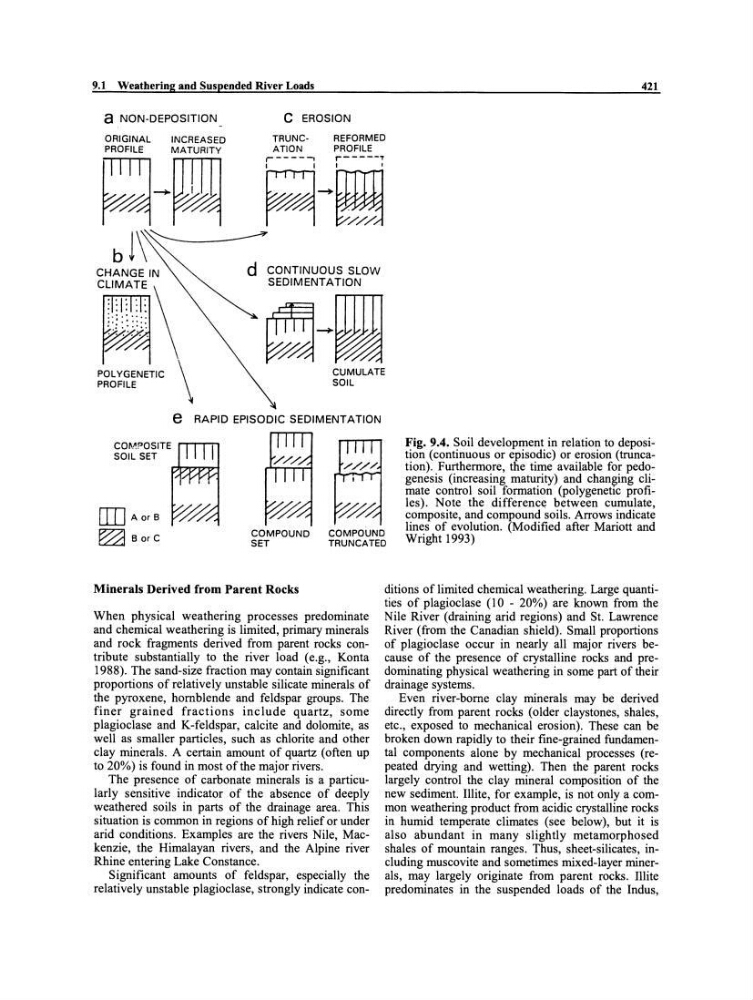
Fig. 9.4. Soil development in relation to deposition (continuous or episodic) or erosion (truncation). Furthermore, the time available for pedogenesis (increasing maturity) and changing climate control soil formation (polygenetic profiles). Note the difference between cumulate,
composite, and compound soils. Arrows indicate
lines of evolution. (Modified after Mariott and
Wright 1993)
SET
TRUNCATED
Minerals Derived from Parent Rocks
When physical weathering processes predominate
and chemical weathering is limited, primary minerals
and rock fragments derived from parent rocks contribute substantially to the river load (e.g., Konta
1988). The sand-size fraction rnay contain significant
proportions of relatively unstable silicate minerals of
the pyroxene, hornblende and feldspar groups. The
finer grained fractions include quartz, some
plagioclase and K-feldspar, calcite and dolomite, as
well as smaller particles, such as chlorite and other
clay minerals. A certain amount of quartz (often up
to 20%) is found in most ofthe major rivers.
The presence of carbonate minerals is a particularly sensitive indicator of the absence of deeply
weathered soils in parts of the drainage area. This
situation is common in regions of high relief or under
arid conditions. Examples are the rivers Nile, Mackenzie, the Himalayan rivers, and the Alpine river
Rhine entering Lake Constance.
Significant amounts of feldspar, especially the
relatively unstable plagioclase, strongly indicate conditions of limited chemical weathering. Large quantities of plagioclase (10 - 20%) are known from the
Nile River (draining arid regions) and St. Lawrence
River (from the Canadian shield). Srnall proportions
of plagioclase occur in nearly all major rivers because of the presence of crystalline rocks and predominating physical weathering in some part of their
drainage systems.
Even river-borne clay minerals may be derived
directly from parent rocks (older claystones, shales,
etc., exposed to mechanical erosion). These can be
broken down rapidly to their fine-grained fundamental components alone by mechanical processes (repeated drying and wetting). Then the parent rocks
largely control the clay mineral composition of the
new sediment. Illite, for example, is not only a common weathering product from acidic crystalline rocks
in humid temperate clirnates (see below), but it is
also abundant in many slightly metamorphosed
shales of mountain ranges. Thus, sheet-silicates, including muscovite and sometimes mixed-Iayer minerals, may largely originate from parent rocks. Illite
predominates in the suspended loads of the Indus,
421
a NON-DEPOSITION
C EROSION
ORIGINAL
INCREASED
TRUNCREFORMED
PROFILE
MATURITY
ATION
PROFILE
~-~ ~~~
l\~
CH~NGE IN
d CONTINUOUS SLOW
C~\ i:~
POLYGENETIC \
CUMULATE
PROFILE
SOlL
e RAPID EPISODIC SEDIMENTATION
COMPOSITE r-r-r-r-,.,
SOlL SET
rro A or B
~ BorC
COMPOUND
COMPOUND
Fig. 9.4. Soil development in relation to deposition (continuous or episodic) or erosion (truncation). Furthermore, the time available for pedogenesis (increasing maturity) and changing climate control soil formation (polygenetic profiles). Note the difference between cumulate,
composite, and compound soils. Arrows indicate
lines of evolution. (Modified after Mariott and
Wright 1993)
SET
TRUNCATED
Minerals Derived from Parent Rocks
When physical weathering processes predominate
and chemical weathering is limited, primary minerals
and rock fragments derived from parent rocks contribute substantially to the river load (e.g., Konta
1988). The sand-size fraction rnay contain significant
proportions of relatively unstable silicate minerals of
the pyroxene, hornblende and feldspar groups. The
finer grained fractions include quartz, some
plagioclase and K-feldspar, calcite and dolomite, as
well as smaller particles, such as chlorite and other
clay minerals. A certain amount of quartz (often up
to 20%) is found in most ofthe major rivers.
The presence of carbonate minerals is a particularly sensitive indicator of the absence of deeply
weathered soils in parts of the drainage area. This
situation is common in regions of high relief or under
arid conditions. Examples are the rivers Nile, Mackenzie, the Himalayan rivers, and the Alpine river
Rhine entering Lake Constance.
Significant amounts of feldspar, especially the
relatively unstable plagioclase, strongly indicate conditions of limited chemical weathering. Large quantities of plagioclase (10 - 20%) are known from the
Nile River (draining arid regions) and St. Lawrence
River (from the Canadian shield). Srnall proportions
of plagioclase occur in nearly all major rivers because of the presence of crystalline rocks and predominating physical weathering in some part of their
drainage systems.
Even river-borne clay minerals may be derived
directly from parent rocks (older claystones, shales,
etc., exposed to mechanical erosion). These can be
broken down rapidly to their fine-grained fundamental components alone by mechanical processes (repeated drying and wetting). Then the parent rocks
largely control the clay mineral composition of the
new sediment. Illite, for example, is not only a common weathering product from acidic crystalline rocks
in humid temperate clirnates (see below), but it is
also abundant in many slightly metamorphosed
shales of mountain ranges. Thus, sheet-silicates, including muscovite and sometimes mixed-Iayer minerals, may largely originate from parent rocks. Illite
predominates in the suspended loads of the Indus,