

412
Chapter 8 Subsidence
a
OMa
r--....J,;;.~~"";:::;:"'-::-'::-~.- . . ~:.J..~ .... _- ... _.= ... _. ::::
.. _=_::::;.~:=:..;::~:_=- .. :~- .. '_.-. _-._-. .L.. __ -._-._-._-._-._ . .J.._f--E-N-VE..J.R-B-A-S-IN--+ B.P
........
_._.-._->-,.
300
200
100
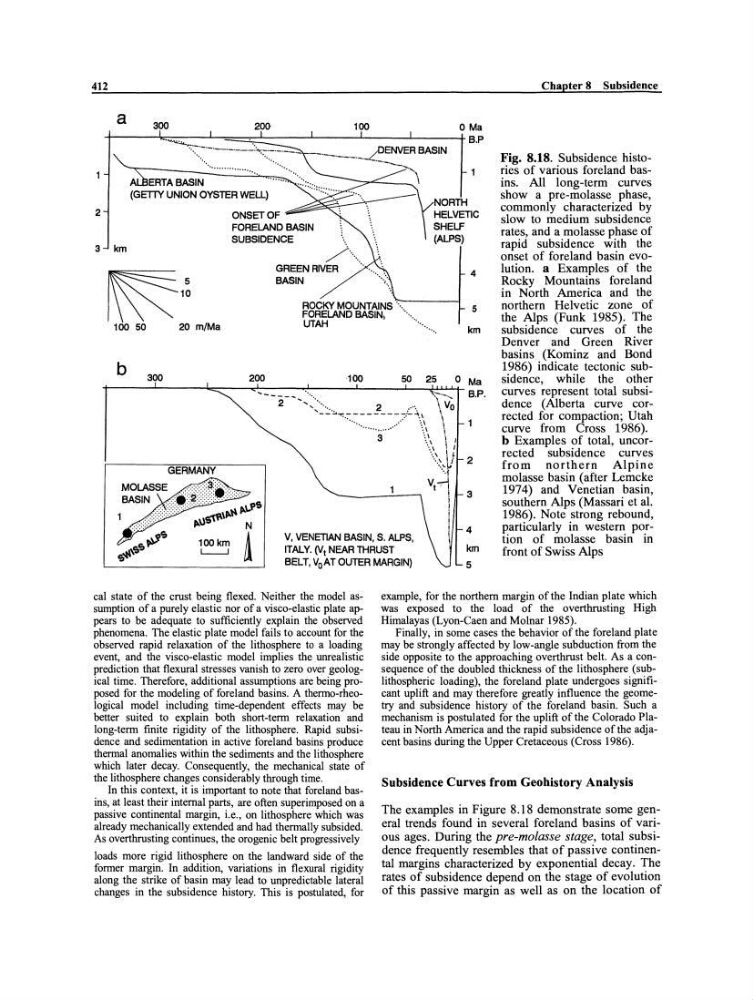
Fig. 8.18. Subsidence histories of various foreland basins. All long-term curves
show apre-molasse phase,
commonly characterized by
slow to medium subsidence
rates, and a molasse phase of
rapid subsidence with the
onset of fore land basin evolution. a Examples of the
Rocky Mountains foreland
in North America and the
northern Helvetic zone of
the Alps (Funk 1985). The
subsidence curves of the
Denver and Green River
basins (Kominz and Bond
1986) indicate tectonic subsidence, while the other
curves represent total subsidence (Alberta curve corrected for compaction; Utah
curve from Cross 1986).
b Examples of total, uncorrected subsidence curves
from northern Alpine
molasse basin (after Lemcke
1974) and Venetian basin,
southern Alps (Massari et al.
1986). Note strong rebound,
particularly in western portion of molasse basin in
front of Swiss Alps
A ERTABASIN
--""::7"'::::" _ _ \
2
3 km
(GETTY UNION OYSTER WELL)
ONSETOF
FORElAND BASIN
SUBSIOENCE
/ ...... .
GREEN RIVER
'.
BASIN
NORTH
HELVETIC
SHELF
(ALPS)
4
~'~
ROCKY MOUNTAINS "':.
5
FORElAND BASIN,
.....
UTAH
.......... .
100 50
20 m/Ma
km
b 300
200
100
50
25
0 Ma
'--_
. . . . . .......
'~~._.....
B.P.
2-. V
'"........
2
:.....
\ 0
--~~.::.~.~.~.~,~.~.~.::.- ... \ \
3
\\ \ I
.... \ \;
".\ \ I 2
···~r
VI-;--j
I
3
--------~--\
I
100 km
L--...J
V, VENETIAN BASIN, S. ALPS,
ITALY. (VI NEAR THRUST
BEL T, VoAT OUTER MARGIN)
4
km
5
eal state of the ernst being flexed. Neither the model assumption of a purely elastie nor of a viseo-elastie plate appears to be adequate to suffieiently explain the observed
phenomena. The elastie plate model fails to aeeount for the
observed rapid relaxation of the lithosphere to a loading
event, and the viseo-elastie model implies the. unrealistie
predietion that flexural stresses vanish to zero over geologieal time. Therefore, additional assumptions are being proposed for the modeling of foreland basins. A thermo-rheologieal model induding time-dependent effeets may be
better suited to explain both short-term relaxation and
long-term finite rigidity of the lithosphere. Rapid subsidenee and sedimentation in active foreland basins produce
thermal anomalies within the sediments and the lithosphere
which later decay. Consequently, the mechanieal state of
the lithosphere changes considerably through time.
In this context, it is important to note that foreland basins, at least their internal parts, are often superimposed on a
passive continental rnargin, i.e., on lithosphere which was
already mechanically extended and had therrnally subsided.
As overthrusting continues, the orogenie belt progressively
loads more rigid lithosphere on the landward side of the
former margin. In addition, variations in flexural rigidity
along the strike of basin may lead to unpredietable lateral
changes in the subsidence history. This is postulated, for
example, for the northern margin of the Indian plate which
was exposed to the load of the overthrusting High
Himalayas (Lyon-Caen and Molnar 1985).
Finally, in some cases the behavior of the foreland plate
may be strongly affected by low-angle subduction from the
side opposite to the approaching overthrust belt. As a consequenee of the doubled thickness of the lithosphere (sublithospheric loading), the foreland plate undergoes significant uplift and may therefore greatly influence the geometry and subsidence history of the foreland basin. Such a
mechanism is postulated for the uplift of the Colorado Plateau in North America and the rapid subsidence of the adjacent basins during the Upper Cretaceous (Cross 1986).
Subsidence Curves from Geohistory Analysis
The examples in Figure 8.18 demonstrate some general trends found in several fore land basins of various ages. During the pre-molasse stage, total subsidence frequently resembles that of passive continental margins characterized by exponential decay. The
rates of subsidence depend on the stage of evolution
of this passive margin as weIl as on the location of
Chapter 8 Subsidence
a
OMa
r--....J,;;.~~"";:::;:"'-::-'::-~.- . . ~:.J..~ .... _- ... _.= ... _. ::::
.. _=_::::;.~:=:..;::~:_=- .. :~- .. '_.-. _-._-. .L.. __ -._-._-._-._-._ . .J.._f--E-N-VE..J.R-B-A-S-IN--+ B.P
........
_._.-._->-,.
300
200
100
Fig. 8.18. Subsidence histories of various foreland basins. All long-term curves
show apre-molasse phase,
commonly characterized by
slow to medium subsidence
rates, and a molasse phase of
rapid subsidence with the
onset of fore land basin evolution. a Examples of the
Rocky Mountains foreland
in North America and the
northern Helvetic zone of
the Alps (Funk 1985). The
subsidence curves of the
Denver and Green River
basins (Kominz and Bond
1986) indicate tectonic subsidence, while the other
curves represent total subsidence (Alberta curve corrected for compaction; Utah
curve from Cross 1986).
b Examples of total, uncorrected subsidence curves
from northern Alpine
molasse basin (after Lemcke
1974) and Venetian basin,
southern Alps (Massari et al.
1986). Note strong rebound,
particularly in western portion of molasse basin in
front of Swiss Alps
A ERTABASIN
--""::7"'::::" _ _ \
2
3 km
(GETTY UNION OYSTER WELL)
ONSETOF
FORElAND BASIN
SUBSIOENCE
/ ...... .
GREEN RIVER
'.
BASIN
NORTH
HELVETIC
SHELF
(ALPS)
4
~'~
ROCKY MOUNTAINS "':.
5
FORElAND BASIN,
.....
UTAH
.......... .
100 50
20 m/Ma
km
b 300
200
100
50
25
0 Ma
'--_
. . . . . .......
'~~._.....
B.P.
2-. V
'"........
2
:.....
\ 0
--~~.::.~.~.~.~,~.~.~.::.- ... \ \
3
\\ \ I
.... \ \;
".\ \ I 2
···~r
VI-;--j
I
3
--------~--\
I
100 km
L--...J
V, VENETIAN BASIN, S. ALPS,
ITALY. (VI NEAR THRUST
BEL T, VoAT OUTER MARGIN)
4
km
5
eal state of the ernst being flexed. Neither the model assumption of a purely elastie nor of a viseo-elastie plate appears to be adequate to suffieiently explain the observed
phenomena. The elastie plate model fails to aeeount for the
observed rapid relaxation of the lithosphere to a loading
event, and the viseo-elastie model implies the. unrealistie
predietion that flexural stresses vanish to zero over geologieal time. Therefore, additional assumptions are being proposed for the modeling of foreland basins. A thermo-rheologieal model induding time-dependent effeets may be
better suited to explain both short-term relaxation and
long-term finite rigidity of the lithosphere. Rapid subsidenee and sedimentation in active foreland basins produce
thermal anomalies within the sediments and the lithosphere
which later decay. Consequently, the mechanieal state of
the lithosphere changes considerably through time.
In this context, it is important to note that foreland basins, at least their internal parts, are often superimposed on a
passive continental rnargin, i.e., on lithosphere which was
already mechanically extended and had therrnally subsided.
As overthrusting continues, the orogenie belt progressively
loads more rigid lithosphere on the landward side of the
former margin. In addition, variations in flexural rigidity
along the strike of basin may lead to unpredietable lateral
changes in the subsidence history. This is postulated, for
example, for the northern margin of the Indian plate which
was exposed to the load of the overthrusting High
Himalayas (Lyon-Caen and Molnar 1985).
Finally, in some cases the behavior of the foreland plate
may be strongly affected by low-angle subduction from the
side opposite to the approaching overthrust belt. As a consequenee of the doubled thickness of the lithosphere (sublithospheric loading), the foreland plate undergoes significant uplift and may therefore greatly influence the geometry and subsidence history of the foreland basin. Such a
mechanism is postulated for the uplift of the Colorado Plateau in North America and the rapid subsidence of the adjacent basins during the Upper Cretaceous (Cross 1986).
Subsidence Curves from Geohistory Analysis
The examples in Figure 8.18 demonstrate some general trends found in several fore land basins of various ages. During the pre-molasse stage, total subsidence frequently resembles that of passive continental margins characterized by exponential decay. The
rates of subsidence depend on the stage of evolution
of this passive margin as weIl as on the location of