

8.2 Methods for Determining Subsidence
395
PRESENT -DA Y
SEDIMENT UNITS,
COM
UNIT A
ISOSTATICALLY
REMOVED
UNITS A AND B
ISOSTATICALLY
REMOVED
TIME~
t o t 1 t2 t 3
t4
UNIT A RESTORED
TO INITIAL THICKNESS AND POROSITY
(DENSITYI
U
B RESTORED
TO INITIAL STATE,
UNiT A PARTL Y
COMPACTED
can be determined by using the simple Airy model
for local isostasy or another approach taking into account a flexural response of the crust to loading.
Generally, this method implies that the loads of the
various sediment units are removed in order to find
the tectonic or thermo-tectonic subsidence of the basin which would have taken place without the sediment load.
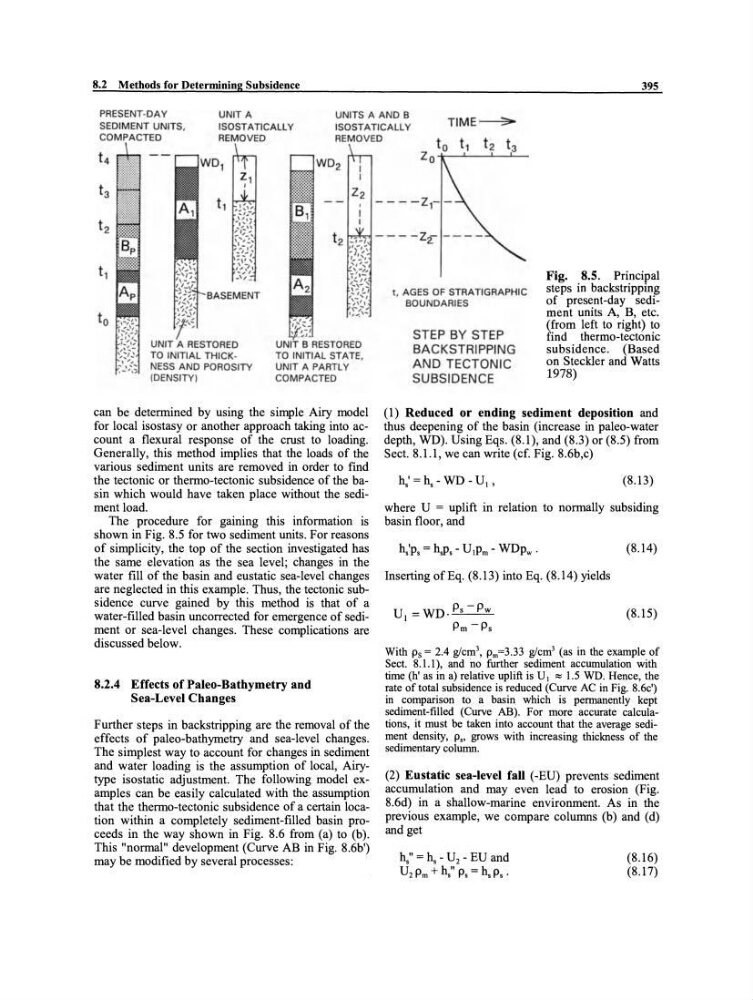
The procedure for gaining this information is
shown in Fig. 8.5 for two sediment units. For reasons
of simplicity, the top of the section investigated has
the same elevation as the sea level; changes in the
water fill of the basin and eustatic sea-level changes
are neglected in this example. Thus, the tectonic subsidence curve gained by this method is that of a
water-filled basin uncorrected for emergence of sediment or sea-level changes. These complications are
discussed below.
8.2.4 Effects of Paleo-Bathymetry and
Sea-Level Changes
Further steps in backstripping are the removal of the
effects of paleo-bathymetry and sea-Ievel changes.
The simplest way to account for changes in sediment
and water loading is the assumption of local, Airytype isostatic adjustment. The following model examples can be easily ealculated with the assumption
that the thermo-tectonic subsidenee of a eertain loeation within a eompletely sediment-filled basin proeeeds in the way shown in Fig. 8.6 from (a) to (b).
This "normal" development (Curve AB in Fig. 8.6b')
may be modified by several proeesses:
Zo
----Zl-- - - - Z2.- - - - -
t, AG ES OF STRATIGRAPHIC
BOUNDARIES
STEP BY STEP
BACKSTRIPPING
AND TECTONIC
SUBSIDENCE
Fig. 8.5. Prineipal
steps in baekstripping
of present-day sediment units A, B, ete.
(from left to right) to
find thermo-teetonie
subsidenee. (Based
on Steekler and Watts
1978)
(1) Reduced or ending sediment deposition and
thus deepening of the basin (inerease in paleo-water
depth, WD). Using Eqs. (8.1), and (8.3) or (8.5) from
Sect. 8.1.1, we ean write (cf. Fig. 8.6b,c)
h,' = h s - WD - U I ,
(8.13)
where U = uplift in relation to normally subsiding
basin floor, and
h,'ps = hsPs - U IPm - WDpw .
Inserting ofEq. (8.13) into Eq. (8.14) yields
U I = WD. Ps -Pw
Pm -Ps
(8.14)
(8.15)
With Ps = 2.4 glem 3 , Pm=3.33 glem 3 (as in the example of
Seet. 8.1.1), and uo further sediment aeeumulation with
time (h' as in a) relative uplift is VI "" 1.5 WD. Henee, the
rate of total subsidence is redueed (Curve AC in Fig. 8.6e')
in comparison to a basin whieh is perrnanently kept
sediment-fi1led (Curve AB). For more accurate ealeulations, it must be taken into aeeount that the average sediment density, p" grows with inereasing thiekness of the
sedimentary eolumn.
(2) Eustatic sea-Ievel fall (-EU) prevents sediment
accumulation and rnay even lead to erosion (Fig.
8.6d) in a shallow-marine environment. As in the
previous example, we compare colurnns (b) and (d)
and get
h s " = h s - U2 - EU and
U2 Pm + h," Ps = hs Ps'
(8.16)
(8.17)
395
PRESENT -DA Y
SEDIMENT UNITS,
COM
UNIT A
ISOSTATICALLY
REMOVED
UNITS A AND B
ISOSTATICALLY
REMOVED
TIME~
t o t 1 t2 t 3
t4
UNIT A RESTORED
TO INITIAL THICKNESS AND POROSITY
(DENSITYI
U
B RESTORED
TO INITIAL STATE,
UNiT A PARTL Y
COMPACTED
can be determined by using the simple Airy model
for local isostasy or another approach taking into account a flexural response of the crust to loading.
Generally, this method implies that the loads of the
various sediment units are removed in order to find
the tectonic or thermo-tectonic subsidence of the basin which would have taken place without the sediment load.
The procedure for gaining this information is
shown in Fig. 8.5 for two sediment units. For reasons
of simplicity, the top of the section investigated has
the same elevation as the sea level; changes in the
water fill of the basin and eustatic sea-level changes
are neglected in this example. Thus, the tectonic subsidence curve gained by this method is that of a
water-filled basin uncorrected for emergence of sediment or sea-level changes. These complications are
discussed below.
8.2.4 Effects of Paleo-Bathymetry and
Sea-Level Changes
Further steps in backstripping are the removal of the
effects of paleo-bathymetry and sea-Ievel changes.
The simplest way to account for changes in sediment
and water loading is the assumption of local, Airytype isostatic adjustment. The following model examples can be easily ealculated with the assumption
that the thermo-tectonic subsidenee of a eertain loeation within a eompletely sediment-filled basin proeeeds in the way shown in Fig. 8.6 from (a) to (b).
This "normal" development (Curve AB in Fig. 8.6b')
may be modified by several proeesses:
Zo
----Zl-- - - - Z2.- - - - -
t, AG ES OF STRATIGRAPHIC
BOUNDARIES
STEP BY STEP
BACKSTRIPPING
AND TECTONIC
SUBSIDENCE
Fig. 8.5. Prineipal
steps in baekstripping
of present-day sediment units A, B, ete.
(from left to right) to
find thermo-teetonie
subsidenee. (Based
on Steekler and Watts
1978)
(1) Reduced or ending sediment deposition and
thus deepening of the basin (inerease in paleo-water
depth, WD). Using Eqs. (8.1), and (8.3) or (8.5) from
Sect. 8.1.1, we ean write (cf. Fig. 8.6b,c)
h,' = h s - WD - U I ,
(8.13)
where U = uplift in relation to normally subsiding
basin floor, and
h,'ps = hsPs - U IPm - WDpw .
Inserting ofEq. (8.13) into Eq. (8.14) yields
U I = WD. Ps -Pw
Pm -Ps
(8.14)
(8.15)
With Ps = 2.4 glem 3 , Pm=3.33 glem 3 (as in the example of
Seet. 8.1.1), and uo further sediment aeeumulation with
time (h' as in a) relative uplift is VI "" 1.5 WD. Henee, the
rate of total subsidence is redueed (Curve AC in Fig. 8.6e')
in comparison to a basin whieh is perrnanently kept
sediment-fi1led (Curve AB). For more accurate ealeulations, it must be taken into aeeount that the average sediment density, p" grows with inereasing thiekness of the
sedimentary eolumn.
(2) Eustatic sea-Ievel fall (-EU) prevents sediment
accumulation and rnay even lead to erosion (Fig.
8.6d) in a shallow-marine environment. As in the
previous example, we compare colurnns (b) and (d)
and get
h s " = h s - U2 - EU and
U2 Pm + h," Ps = hs Ps'
(8.16)
(8.17)