

388
Chapter 8 Subsidence
a
b
c
SEDIMENT SEA WATER DENSITY (g/cnf)
.03
-1-" __
lOCAl ISOSTASY
LOAD
SEA
LEVEL
~;""""';:':';'~..,..j (2.4) :
;:::>~·~;~;::~.A14~444l
(2 .8) :
LlTHOSPHERE
100
km
d
FlEXURAl RESPONSE OF
CRUST
DATUM
UNE
(3.33)
\ MODEL
PARA·
METERS
(REDUCED LOCAL SUBSIDENCE)
BULGE
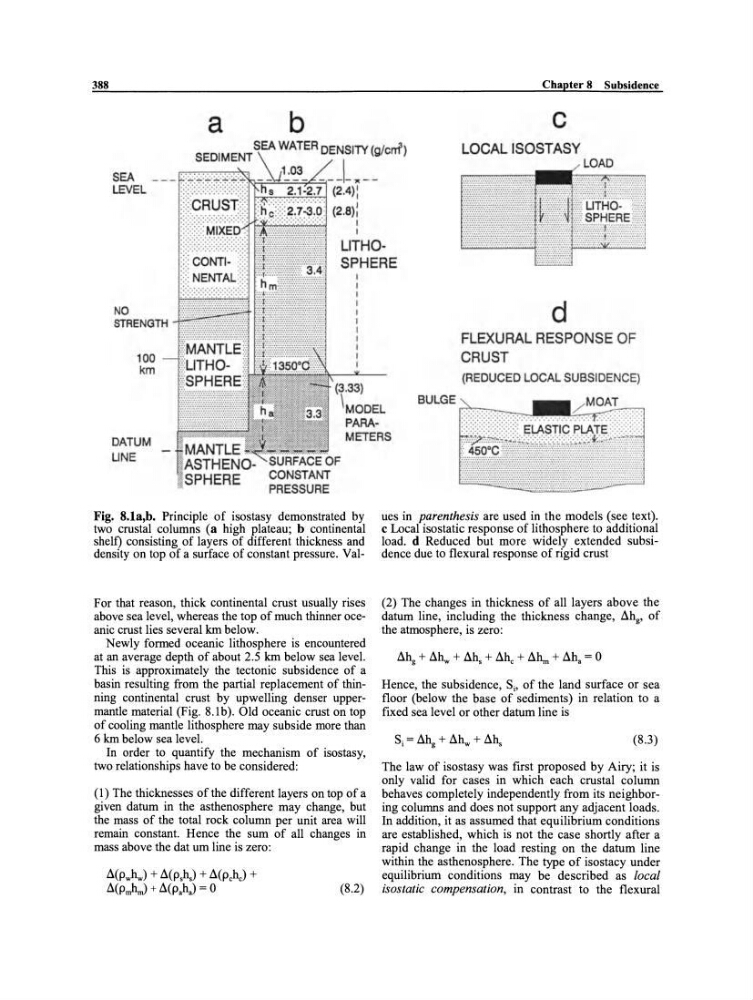
Fig. 8.1a,b. Principle of isostasy demonstrated by
two crustal columns (a high plateau; b continental
shelt) consisting of layers of different thickness and
density on top of a surface of constant pressure. ValFor that reason, thick continental crust usually rises
above sea level, whereas the top of much thinner oceanic crust lies several km below.
Newly formed oceanic lithosphere is encountered
at an average depth of about 2.5 km below sea level.
This is approximately the tectonic subsidence of a
basin resulting from the partial replacement of thinning continental crust by upweBing denser uppermantle material (Fig. 8.1b). Old oceanic crust on top
of cooling rnantle lithosphcre may subside more than
6 km below sea level.
In order to quantify the mechanism of isostasy,
two relationships have to be considered:
(I) The thicknesses of the different layers on top of a
given datum in the asthenosphere may change, but
the mass of the total rock column per unit area will
remain constant. Hence the sum of aB changes in
mass above the dat um line is zero:
(8.2)
ues in parenthesis are used in the models (see text).
c Local isostatic response of lithosphere to additional
load. d Reduced but more widely extended subsidence due to flexural response of rigid crust
(2) The changes in thickness of all layers above the
datum line, including the thickness change, Ähg, of
the atmosphere, is zero:
Hence, the subsidence, Si' of the land surface or sea
floor (below the base of sediments) in relation to a
fixed sea level or other datum line is
(8.3)
The law of isostasy was first proposed by Airy; it is
only valid for cases in which each crustal column
behaves completely independently from its neighboring columns and does not support any adjacent loads.
In addition, it as assumed that equilibrium conditions
are established, which is not the case shortly after a
rapid change in the load resting on the datum line
within the asthenosphere. The type of isostacy under
equilibrium conditions may be described as loeal
isostatie eompensation, in contrast to the flexural
Chapter 8 Subsidence
a
b
c
SEDIMENT SEA WATER DENSITY (g/cnf)
.03
-1-" __
lOCAl ISOSTASY
LOAD
SEA
LEVEL
~;""""';:':';'~..,..j (2.4) :
;:::>~·~;~;::~.A14~444l
(2 .8) :
LlTHOSPHERE
100
km
d
FlEXURAl RESPONSE OF
CRUST
DATUM
UNE
(3.33)
\ MODEL
PARA·
METERS
(REDUCED LOCAL SUBSIDENCE)
BULGE
Fig. 8.1a,b. Principle of isostasy demonstrated by
two crustal columns (a high plateau; b continental
shelt) consisting of layers of different thickness and
density on top of a surface of constant pressure. ValFor that reason, thick continental crust usually rises
above sea level, whereas the top of much thinner oceanic crust lies several km below.
Newly formed oceanic lithosphere is encountered
at an average depth of about 2.5 km below sea level.
This is approximately the tectonic subsidence of a
basin resulting from the partial replacement of thinning continental crust by upweBing denser uppermantle material (Fig. 8.1b). Old oceanic crust on top
of cooling rnantle lithosphcre may subside more than
6 km below sea level.
In order to quantify the mechanism of isostasy,
two relationships have to be considered:
(I) The thicknesses of the different layers on top of a
given datum in the asthenosphere may change, but
the mass of the total rock column per unit area will
remain constant. Hence the sum of aB changes in
mass above the dat um line is zero:
(8.2)
ues in parenthesis are used in the models (see text).
c Local isostatic response of lithosphere to additional
load. d Reduced but more widely extended subsidence due to flexural response of rigid crust
(2) The changes in thickness of all layers above the
datum line, including the thickness change, Ähg, of
the atmosphere, is zero:
Hence, the subsidence, Si' of the land surface or sea
floor (below the base of sediments) in relation to a
fixed sea level or other datum line is
(8.3)
The law of isostasy was first proposed by Airy; it is
only valid for cases in which each crustal column
behaves completely independently from its neighboring columns and does not support any adjacent loads.
In addition, it as assumed that equilibrium conditions
are established, which is not the case shortly after a
rapid change in the load resting on the datum line
within the asthenosphere. The type of isostacy under
equilibrium conditions may be described as loeal
isostatie eompensation, in contrast to the flexural