

7.6 Transitional Systems
C EPISODIC DEPOSITION
~C' : ~; ' : ':~ . " ' .. :'. ':. :: ' ..
;;;??:
~
,..
. _ 6 .
. . . .
. .
BURIED SURFACES
WEAKl Y DEVElDPED SOllS
o
NOT FLOODED
DURING HST
SINUOUS R.
SB1
i i , I I 111111111111
0'
BRAIDED R.. POORl Y
DEVELOPED SOlLS
---)~ INCREASING SOll MA TURITY
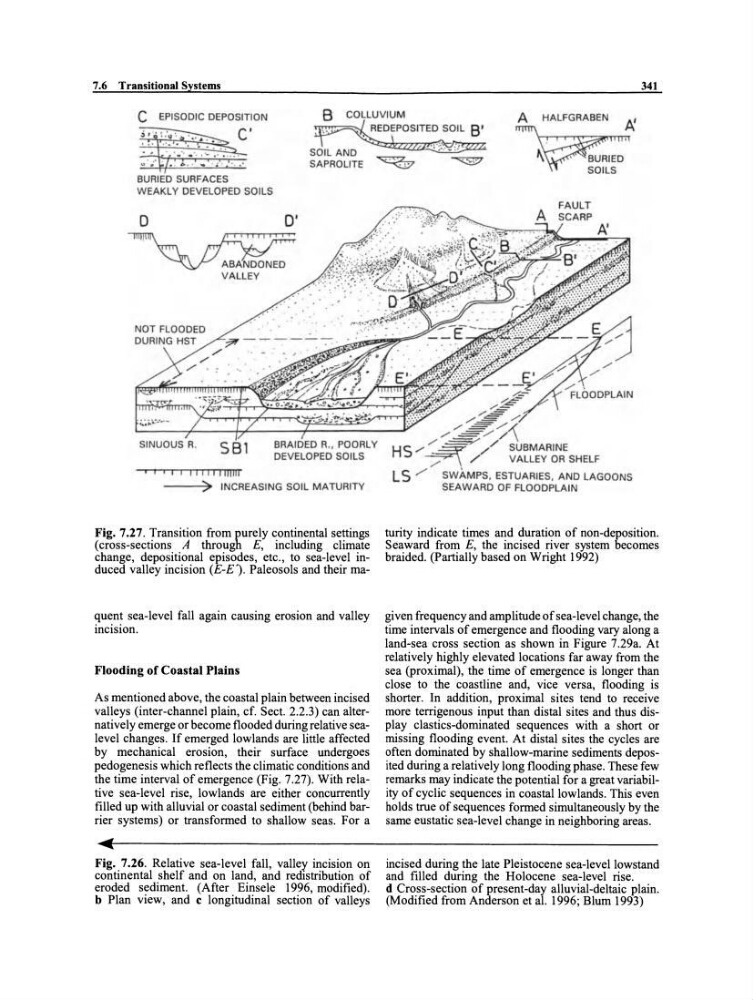
Fig. 7.27. Transition from purely continental settings
(cross-sections A through E, including climate
change, depositional episodes, etc., to sea-level induced valley incision (E-El Paleosols and their maquent sea-level fall again causing erosion and valley
incision.
Flooding of Coastal Plains
As mentioned above, the coastal plain between incised
valleys (inter-channel plain, cf. Sect. 2.2.3) can alternatively emerge or become flooded during relative sealevel changes. If emerged lowlands are little affected
by mechanical erosion, their surface undergoes
pedogenesis which reflects the climatic conditions and
the time interval of emergence (Fig. 7.27). With relative sea-level rise, lowlands are either concurrently
filled up with alluvial or coastal sediment (behind barrier systems) or transformed to shallow seas. For a
Fig. 7.26. Relative sea-level fall, valley incision on
continental shelf and on land, and redistribution of
eroded sediment. (After Einseie 1996, modified).
b Plan view, and c longitudinal section of valleys
341
~ HALFGRABEN
N
~I~~"
SOllS
turity indicate times and duration of non-deposition.
Seaward from E, the incised river system becomes
braided. (Partially based on Wright 1992)
given frequency and amplitude of sea-level change, the
time intervals of emergence and flooding vary along a
land-sea cross section as shown in Figure 7.29a. At
relatively highly elevated locations far away from the
sea (proximal), the time of emergence is longer than
dose to the coastline and, vice versa, flooding is
shorter. In addition, proximal sites tend to receive
more terrigenous input than distal sites and thus display clastics-dorninated sequences with a short or
missing flooding event. At distal sites the cycles are
often dorninated by shallow-marine sediments deposited during a relatively long flooding phase. These few
remarks may indicate the potential for a great variability of cyclic sequences in coastallowlands. This even
holds true of sequences formed simultaneously by the
same eustatic sea-level change in neighboring areas.
incised during the late Pleistocene sea-levellowstand
and filled during the Holocene sea-level rise.
d Cross-section of present-day alluvial-deltaic plain.
(Modified from Anderson et al. 1996; Blum 1993)
C EPISODIC DEPOSITION
~C' : ~; ' : ':~ . " ' .. :'. ':. :: ' ..
;;;??:
~
,..
. _ 6 .
. . . .
. .
BURIED SURFACES
WEAKl Y DEVElDPED SOllS
o
NOT FLOODED
DURING HST
SINUOUS R.
SB1
i i , I I 111111111111
0'
BRAIDED R.. POORl Y
DEVELOPED SOlLS
---)~ INCREASING SOll MA TURITY
Fig. 7.27. Transition from purely continental settings
(cross-sections A through E, including climate
change, depositional episodes, etc., to sea-level induced valley incision (E-El Paleosols and their maquent sea-level fall again causing erosion and valley
incision.
Flooding of Coastal Plains
As mentioned above, the coastal plain between incised
valleys (inter-channel plain, cf. Sect. 2.2.3) can alternatively emerge or become flooded during relative sealevel changes. If emerged lowlands are little affected
by mechanical erosion, their surface undergoes
pedogenesis which reflects the climatic conditions and
the time interval of emergence (Fig. 7.27). With relative sea-level rise, lowlands are either concurrently
filled up with alluvial or coastal sediment (behind barrier systems) or transformed to shallow seas. For a
Fig. 7.26. Relative sea-level fall, valley incision on
continental shelf and on land, and redistribution of
eroded sediment. (After Einseie 1996, modified).
b Plan view, and c longitudinal section of valleys
341
~ HALFGRABEN
N
~I~~"
SOllS
turity indicate times and duration of non-deposition.
Seaward from E, the incised river system becomes
braided. (Partially based on Wright 1992)
given frequency and amplitude of sea-level change, the
time intervals of emergence and flooding vary along a
land-sea cross section as shown in Figure 7.29a. At
relatively highly elevated locations far away from the
sea (proximal), the time of emergence is longer than
dose to the coastline and, vice versa, flooding is
shorter. In addition, proximal sites tend to receive
more terrigenous input than distal sites and thus display clastics-dorninated sequences with a short or
missing flooding event. At distal sites the cycles are
often dorninated by shallow-marine sediments deposited during a relatively long flooding phase. These few
remarks may indicate the potential for a great variability of cyclic sequences in coastallowlands. This even
holds true of sequences formed simultaneously by the
same eustatic sea-level change in neighboring areas.
incised during the late Pleistocene sea-levellowstand
and filled during the Holocene sea-level rise.
d Cross-section of present-day alluvial-deltaic plain.
(Modified from Anderson et al. 1996; Blum 1993)