

1.4 Basin Morphology
13
a MARINE DELTAS
SEA LEVEL
~": :~i; ~ q?~ ' ! i ; i ~ ;~;!! : ~m~ UH;i ~ : : ! : i ~ H;!h : · ~ \ - ; ~ ~· ~~~~~~~~~-iiii - i.ii -~-::- - - - L __ - -- - - - -FLOODPLAIN WITH LAKES, SWAMPS,
TIDAL AREAS, LAGOONS
b MARINE DEPOSITIONAL AREAS
C DEEP MARINE,
(SHELF NARROW OR MISSING)
~=~
d DEEP MARINE
WITH WIDE SHELF
(CONT.)RISE
DEEP·SEA
FAN
:tSPECIAL
SHELF BASIN(S)
DEEp·SEA
BASIN
(BASIN PLAIN)
MARINE TROUGHS AND RIDGES
OCEANIC R1DGES, ETC.
SEA MOUNTS
FRACTURE
TROUGH
DEEP SEA TRENCH
'I
e
9
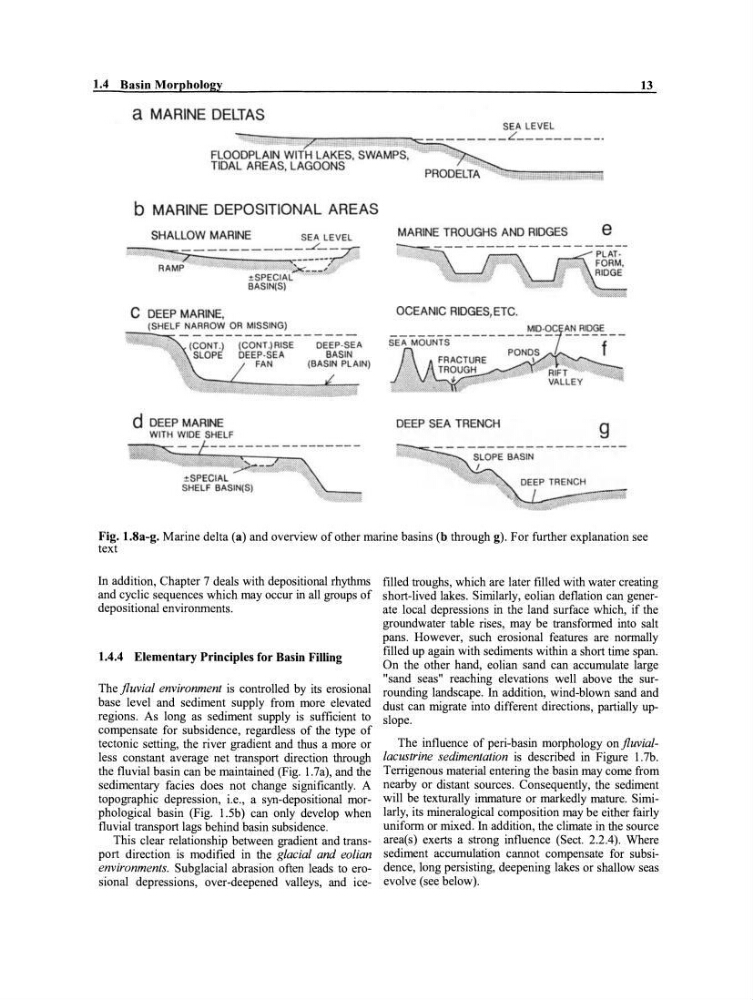
Fig. 1.8a-g. Marine delta (a) and overview of other marine basins (b through g). For further explanation see
text
In addition, Chapter 7 deals with depositional rhythms
and cyclic sequences which may occur in all groups of
depositional environments.
1.4.4 Elementary Principles for Basin Filling
The jluvial environment is controlled by its erosional
base level and sediment supply from more elevated
regions. As long as sediment supply is sufficient to
compensate for subsidence, regardless of the type of
tectonic setting, the river gradient and thus a more or
less constant average net transport direction through
the fluvial basin can be maintained (Fig. I.7a), and the
sedimentary facies does not change significantly. A
topographie depression, i.e., a syn-depositional morphological basin (Fig. I .5b) can only develop when
fluvial transport lags behind basin subsidence.
This clear relationship between gradient and transport direction is modified in the glacial and eolian
environments. Subglacial abrasion often leads to erosional depressions, over-deepened valleys, and icefilled troughs, which are later filled with water creating
short-lived lakes. Similarly, eolian deflation can generate local depressions in the land surface which, if the
groundwater table rises, may be transformed into salt
pans. However, such erosional features are normally
filled up again with sediments within a short time span.
On the other hand, eolian sand can accumulate large
"sand seas" reaching elevations well above the surrounding landscape. In addition, wind-blown sand and
dust can migrate into different directions, partially upslope.
The influence of peri-basin morphology on fluviallacustrine sedimentation is described in Figure 1.7b.
Terrigenous material entering the basin may come from
nearby or distant sourees. Consequently, the sediment
will be texturally immature or markedly mature. Similarly, its mineralogical composition may be either fairly
uniform or mixed. In addition, the climate in the source
area(s) exerts a strong influence (Sect. 2.2.4). Where
sediment accumulation cannot compensate for subsidence, long persisting, deepening lakes or shallow seas
evolve (see below).
13
a MARINE DELTAS
SEA LEVEL
~": :~i; ~ q?~ ' ! i ; i ~ ;~;!! : ~m~ UH;i ~ : : ! : i ~ H;!h : · ~ \ - ; ~ ~· ~~~~~~~~~-iiii - i.ii -~-::- - - - L __ - -- - - - -FLOODPLAIN WITH LAKES, SWAMPS,
TIDAL AREAS, LAGOONS
b MARINE DEPOSITIONAL AREAS
C DEEP MARINE,
(SHELF NARROW OR MISSING)
~=~
d DEEP MARINE
WITH WIDE SHELF
(CONT.)RISE
DEEP·SEA
FAN
:tSPECIAL
SHELF BASIN(S)
DEEp·SEA
BASIN
(BASIN PLAIN)
MARINE TROUGHS AND RIDGES
OCEANIC R1DGES, ETC.
SEA MOUNTS
FRACTURE
TROUGH
DEEP SEA TRENCH
'I
e
9
Fig. 1.8a-g. Marine delta (a) and overview of other marine basins (b through g). For further explanation see
text
In addition, Chapter 7 deals with depositional rhythms
and cyclic sequences which may occur in all groups of
depositional environments.
1.4.4 Elementary Principles for Basin Filling
The jluvial environment is controlled by its erosional
base level and sediment supply from more elevated
regions. As long as sediment supply is sufficient to
compensate for subsidence, regardless of the type of
tectonic setting, the river gradient and thus a more or
less constant average net transport direction through
the fluvial basin can be maintained (Fig. I.7a), and the
sedimentary facies does not change significantly. A
topographie depression, i.e., a syn-depositional morphological basin (Fig. I .5b) can only develop when
fluvial transport lags behind basin subsidence.
This clear relationship between gradient and transport direction is modified in the glacial and eolian
environments. Subglacial abrasion often leads to erosional depressions, over-deepened valleys, and icefilled troughs, which are later filled with water creating
short-lived lakes. Similarly, eolian deflation can generate local depressions in the land surface which, if the
groundwater table rises, may be transformed into salt
pans. However, such erosional features are normally
filled up again with sediments within a short time span.
On the other hand, eolian sand can accumulate large
"sand seas" reaching elevations well above the surrounding landscape. In addition, wind-blown sand and
dust can migrate into different directions, partially upslope.
The influence of peri-basin morphology on fluviallacustrine sedimentation is described in Figure 1.7b.
Terrigenous material entering the basin may come from
nearby or distant sourees. Consequently, the sediment
will be texturally immature or markedly mature. Similarly, its mineralogical composition may be either fairly
uniform or mixed. In addition, the climate in the source
area(s) exerts a strong influence (Sect. 2.2.4). Where
sediment accumulation cannot compensate for subsidence, long persisting, deepening lakes or shallow seas
evolve (see below).