

1.4 Basin Morphology
SEDIMENT
UMIT FOR THE BUILDUP OF SEDIMENT
INFLUX
FLUVIAL
11
SEDIMENTS
{}
SUBSIDENCE
0, 1,2 . ISOCHRONES
LOCAL
OUTBUlLDING
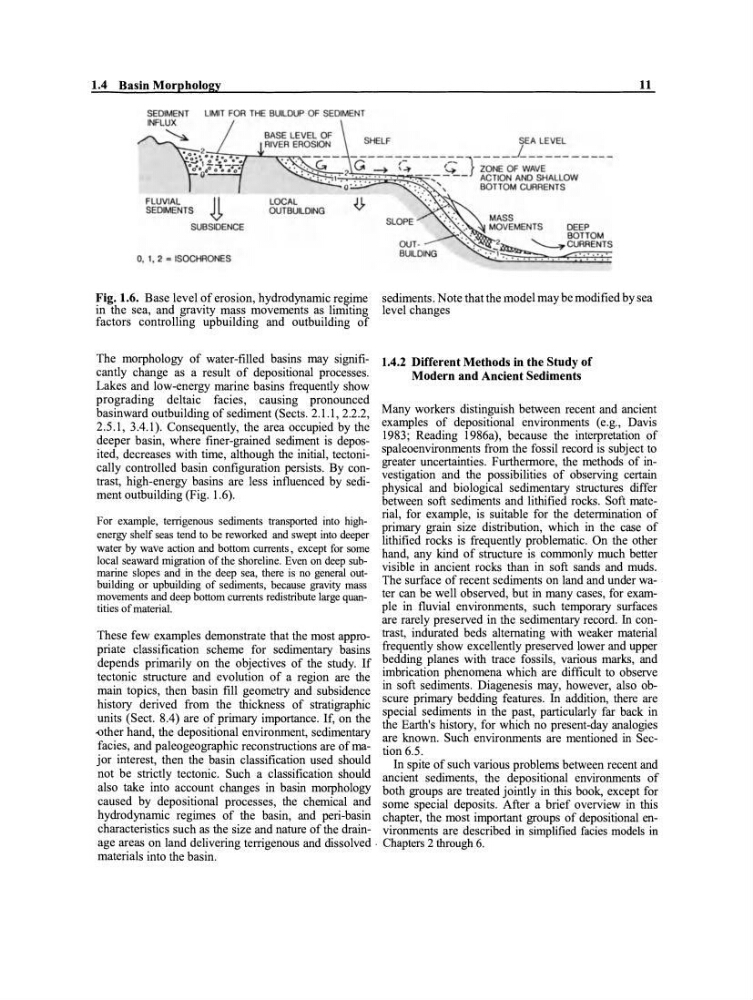
Fig. 1.6. Base level in the sea, and gravIty mas~ movements a~ h.mItmg
factors controlling upbuildmg and outbUlldmg of
The morphology of water-filled basins may significantly change as a result of depositional processes.
Lakes and low-energy marine basins frequently show
prograding deltaic facies, causing pronounced
basinward outbuilding of sediment (Sects. 2.1.1, 2.2.2,
2.5.l, 3.4.l). Consequently, the area occupied by the
deeper basin, where finer-grained sediment is deposited, decreases with time, although the initial, tectonically controlled basin configuration persists. By co~trast, high-energy basins are less influenced by sedIment outbuilding (Fig. 1.6).
For example, terrigenous sediments transported into highenergy shelf seas tend to be reworked and swept into deeper
water by wave action and bottom eurrents, exeept for some
loeal seaward migration of the shoreline. Even on deep submarine slopes and in the deep sea, there is no general outbuilding or upbuilding of sediments, because gravlty mass
movements and deep bottom currents redistribute large quantities of material.
OUT ·
BUILDING
MASS
MOVEMENTS
DEEP
.
BOHOM
" . ; .. . . _~~ ~C~~~~~, T. S
. .... ..... . < ....
11
sediments. Note that the model may be modified by sea
level changes
1.4.2 Different Methods in the Study of
Modern and Ancient Sediments
Many workers distinguish between recent and anciel~.t
examples of depositional environme~ts (e.g., pavIs
1983' Reading 1986a), because the mterpretatIOn of
spale~environments from the fossil record is subject. to
greater uncertainties. Furthermore, the met~ods of IJ?-vestigation and the possibilities of observmg ce~am
physical and biological sedimentary structures dlffer
between soft sediments and lithified rocks. Soft material, for example, is suitable for the determination of
primary grain size distribution, whic~ in the case of
lithified rocks is frequently problematIc. On the other
hand, any kind of structure is commonly much better
visible in ancient rocks than in soft sands and muds.
The surface of recent sediments on land and under water can be well observed, but in many cases, for exampie in fluvial environments, such temporary surfaces
are rarely preserved in the sedimen~ry record. In co.ntrast, indurated beds altemating Wlth weaker matenal
These few examples demonstrate that the most appro- frequently show exceUently preserved lower and upper
priate c1assification scheme for sedimentary basins bedding planes with trace fossils, various marks, and
depends primarily on the objectives of the study. If imbrication phenomena which are difficult to observe
tectonic structure and evolution of a region are the in soft sediments. Diagenesis may, however, also obmain topics, then basin fiU geometry and subsidence scure primary bedding features. In. addition, there a: e
history derived from the thickness of stratigraphic special sediments in the past, partIcularly far back. m
units (Sect. 8.4) are of primary importance. If, on the the Earth's his tory, for which no present-day analogles
-{)ther hand, the depositional environment, sedimentary are known. Such environments are mentioned in Secfacies, and paleogeographic reconstructions are ofma- tion 6.5.
jor interest, then the basin c1assification used should
In spite of such various problems between recent and
not be strictly tectonic. Such a c1assification should ancient sediments, the depositional environments of
also take into ac count changes in basin morphology both groups are treated jointly in this book, except for
caused by depositional processes, the chemical and some special deposits. After a brief overvi~~ in this
hydrodynmnic regimes of the basin, and peri-ba~in c~apter, the most im~orta~t ~oup~ of de~OSItIonal e~characteristics such as the size and nature of the dram- vIronments are descnbed In sImphfied facles models m
age areas on land delivering terrigenous and dissolved . Chapters 2 through 6.
materials into the basin.
SEDIMENT
UMIT FOR THE BUILDUP OF SEDIMENT
INFLUX
FLUVIAL
11
SEDIMENTS
{}
SUBSIDENCE
0, 1,2 . ISOCHRONES
LOCAL
OUTBUlLDING
Fig. 1.6. Base level in the sea, and gravIty mas~ movements a~ h.mItmg
factors controlling upbuildmg and outbUlldmg of
The morphology of water-filled basins may significantly change as a result of depositional processes.
Lakes and low-energy marine basins frequently show
prograding deltaic facies, causing pronounced
basinward outbuilding of sediment (Sects. 2.1.1, 2.2.2,
2.5.l, 3.4.l). Consequently, the area occupied by the
deeper basin, where finer-grained sediment is deposited, decreases with time, although the initial, tectonically controlled basin configuration persists. By co~trast, high-energy basins are less influenced by sedIment outbuilding (Fig. 1.6).
For example, terrigenous sediments transported into highenergy shelf seas tend to be reworked and swept into deeper
water by wave action and bottom eurrents, exeept for some
loeal seaward migration of the shoreline. Even on deep submarine slopes and in the deep sea, there is no general outbuilding or upbuilding of sediments, because gravlty mass
movements and deep bottom currents redistribute large quantities of material.
OUT ·
BUILDING
MASS
MOVEMENTS
DEEP
.
BOHOM
" . ; .. . . _~~ ~C~~~~~, T. S
. .... ..... . < ....
11
sediments. Note that the model may be modified by sea
level changes
1.4.2 Different Methods in the Study of
Modern and Ancient Sediments
Many workers distinguish between recent and anciel~.t
examples of depositional environme~ts (e.g., pavIs
1983' Reading 1986a), because the mterpretatIOn of
spale~environments from the fossil record is subject. to
greater uncertainties. Furthermore, the met~ods of IJ?-vestigation and the possibilities of observmg ce~am
physical and biological sedimentary structures dlffer
between soft sediments and lithified rocks. Soft material, for example, is suitable for the determination of
primary grain size distribution, whic~ in the case of
lithified rocks is frequently problematIc. On the other
hand, any kind of structure is commonly much better
visible in ancient rocks than in soft sands and muds.
The surface of recent sediments on land and under water can be well observed, but in many cases, for exampie in fluvial environments, such temporary surfaces
are rarely preserved in the sedimen~ry record. In co.ntrast, indurated beds altemating Wlth weaker matenal
These few examples demonstrate that the most appro- frequently show exceUently preserved lower and upper
priate c1assification scheme for sedimentary basins bedding planes with trace fossils, various marks, and
depends primarily on the objectives of the study. If imbrication phenomena which are difficult to observe
tectonic structure and evolution of a region are the in soft sediments. Diagenesis may, however, also obmain topics, then basin fiU geometry and subsidence scure primary bedding features. In. addition, there a: e
history derived from the thickness of stratigraphic special sediments in the past, partIcularly far back. m
units (Sect. 8.4) are of primary importance. If, on the the Earth's his tory, for which no present-day analogles
-{)ther hand, the depositional environment, sedimentary are known. Such environments are mentioned in Secfacies, and paleogeographic reconstructions are ofma- tion 6.5.
jor interest, then the basin c1assification used should
In spite of such various problems between recent and
not be strictly tectonic. Such a c1assification should ancient sediments, the depositional environments of
also take into ac count changes in basin morphology both groups are treated jointly in this book, except for
caused by depositional processes, the chemical and some special deposits. After a brief overvi~~ in this
hydrodynmnic regimes of the basin, and peri-ba~in c~apter, the most im~orta~t ~oup~ of de~OSItIonal e~characteristics such as the size and nature of the dram- vIronments are descnbed In sImphfied facles models m
age areas on land delivering terrigenous and dissolved . Chapters 2 through 6.
materials into the basin.