

4
In reeent years, several authors have summarized our eurrent
knowledge on the interaction of plate tectonics and sedimentation (e.g., Diekinson in Diekinson and Yarborough 1976;
Kingston et al. 1983; MiaU 1984; MiteheU and Reading 1986;
Foster and Beaurnont 1987; Klein 1987; Perrodon 1988) and
proposed basin classifieation systems. Although basieaUy
identieal, these systems differ somewhat and do not use exaetly the same terms. In this text we essentiaUy use the system
deseribed by MiteheU and Reading, but add some minor modifieatiollS.
The different types of sedimentary basins can be
grouped into seven categories, which in turn may be
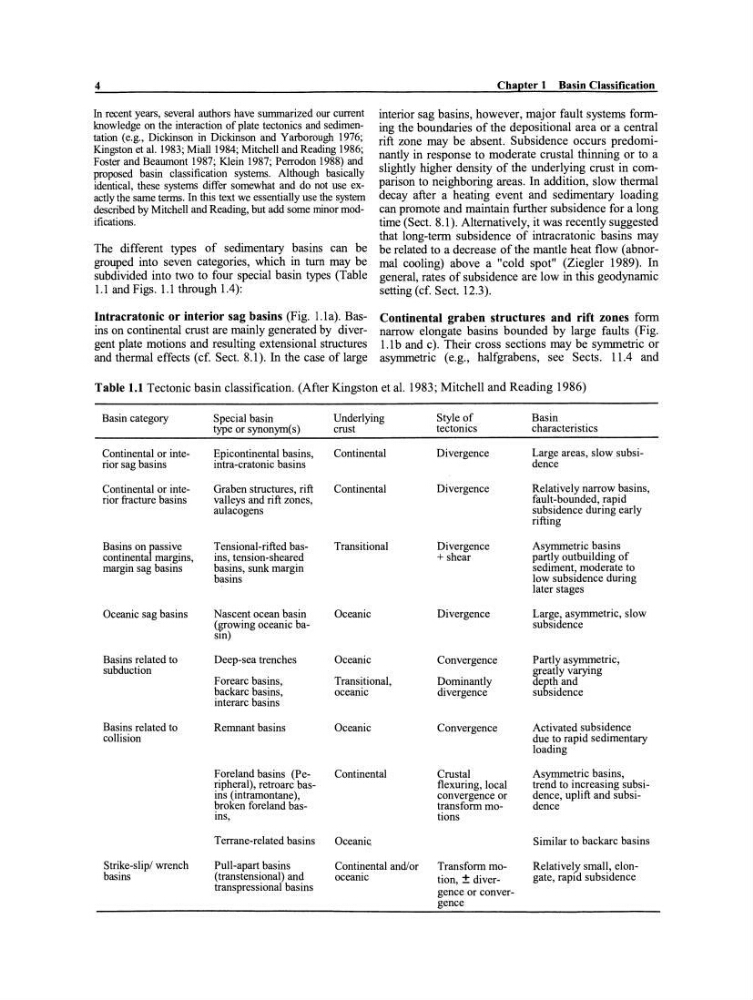
subdivided into two to four special basin types (Table
1.1 and Figs. 1.1 through 104):
Intracratonic or interior sag basins (Fig. l.la). Basins on continental crust are mainly generated by divergent plate motions and resulting extensional structures
and thermal effects (cf. Sect. 8.1). In the case of large
Chapter 1 Basin Classification
interior sag basins, however, major fault systems fonning the boundaries of the depositional area or a central
rift zone rnay be absent. Subsidenee occurs predominandy in response to moderate crustal thinning or to a
slightly higher density of the underlying erust in comparison to neighboring areas. In addition, slow thermal
decay after a heating event and sedimentary loading
can promote and maintain further subsidenee for a long
time (Sect. 8.1). Altematively, it was recently suggested
that long-tenn subsidenee of intracratonie basins may
be related to a decrease ofthe mantle heat flow (abnormal cooling) above a "cold spot" (Ziegler 1989). In
general, rates of subsidence are low in this geodynarnie
setting (cf. Sect. 12.3).
Continental graben structures and rift zones fonn
narrow elongate basins bounded by large faults (Fig.
l.1b and c). Their cross seetions rnay be symmetrie or
asymmetrie (e.g., halfgrabens, see Sects. 11.4 and
Table 1.1 Tectonic basin classification. (After Kingston et al. 1983; Mitchell and Reading 1986)
Basin eategory
Special basin
Underlying
Style Basin
type or synonymes)
erust
teetomes
eharaeteristies
Continental or inteEpieontinental basins,
rior sag basins
intra-eratonie basins
Continental
Divergenee
Large areas, slow subsidenee
Continental or inteGraben struetures, rift
Continental
Divergenee
Relatively narrow basins,
rior fraeture basins
valleys and rift zones,
fault-bounded, rapid
aulaeogens
subsidenee during early
rifting
Basins on rassive
Tensional-rifted basTransitional
Divergenee
Asymmetrie basins
eontinenta margins,
ins, tension-sheared
+ shear
partly outbuilding of
margin sag basins
basins, sunk margin
sediment, moderate to
basins
low subsidenee during
1ater stages
Oeeanie sag basins
Naseent oeean basin
Oeeanie
Divergenee
Large, asymmetrie, slow
(growing oeeanie basubsidenee
sm)
Basins re1ated to
Deep-sea trenehes
Oeeanie
Convergenee
Partlyasymmetrie,
subduction
greatly varying
Foreare basins,
Transitional,
Dominantly
degth and
backare basins,
oeeanie
divergenee
su sidenee
interare basins
Basins related to
Remnant basins
Oeeanie
Convergenee
Aetivated subsidence
eollision
due to rapid sedimentary
10ading
Foreland basins (PeContinental
Crustal
Asymmetrie basins,
riphera1), retroarc basflexuring, loca1
trend to increasing subsiins (intramontane),
convergence or
dence, up1ift and subsibroken foreland bastransforrn modence
ins,
tions
Terrane-re1ated basins
Oeeanic.
Simi1ar to backare basins
Strike-slip/ wreneh
Pull-apart basins
Continental andlor
Transforrn moRelatively smalI, elonbasins
(transtensional) and
oeeanic
tion, ± divergate, rapid subsidenee
transpressional basins
gence or eonvergence
In reeent years, several authors have summarized our eurrent
knowledge on the interaction of plate tectonics and sedimentation (e.g., Diekinson in Diekinson and Yarborough 1976;
Kingston et al. 1983; MiaU 1984; MiteheU and Reading 1986;
Foster and Beaurnont 1987; Klein 1987; Perrodon 1988) and
proposed basin classifieation systems. Although basieaUy
identieal, these systems differ somewhat and do not use exaetly the same terms. In this text we essentiaUy use the system
deseribed by MiteheU and Reading, but add some minor modifieatiollS.
The different types of sedimentary basins can be
grouped into seven categories, which in turn may be
subdivided into two to four special basin types (Table
1.1 and Figs. 1.1 through 104):
Intracratonic or interior sag basins (Fig. l.la). Basins on continental crust are mainly generated by divergent plate motions and resulting extensional structures
and thermal effects (cf. Sect. 8.1). In the case of large
Chapter 1 Basin Classification
interior sag basins, however, major fault systems fonning the boundaries of the depositional area or a central
rift zone rnay be absent. Subsidenee occurs predominandy in response to moderate crustal thinning or to a
slightly higher density of the underlying erust in comparison to neighboring areas. In addition, slow thermal
decay after a heating event and sedimentary loading
can promote and maintain further subsidenee for a long
time (Sect. 8.1). Altematively, it was recently suggested
that long-tenn subsidenee of intracratonie basins may
be related to a decrease ofthe mantle heat flow (abnormal cooling) above a "cold spot" (Ziegler 1989). In
general, rates of subsidence are low in this geodynarnie
setting (cf. Sect. 12.3).
Continental graben structures and rift zones fonn
narrow elongate basins bounded by large faults (Fig.
l.1b and c). Their cross seetions rnay be symmetrie or
asymmetrie (e.g., halfgrabens, see Sects. 11.4 and
Table 1.1 Tectonic basin classification. (After Kingston et al. 1983; Mitchell and Reading 1986)
Basin eategory
Special basin
Underlying
Style Basin
type or synonymes)
erust
teetomes
eharaeteristies
Continental or inteEpieontinental basins,
rior sag basins
intra-eratonie basins
Continental
Divergenee
Large areas, slow subsidenee
Continental or inteGraben struetures, rift
Continental
Divergenee
Relatively narrow basins,
rior fraeture basins
valleys and rift zones,
fault-bounded, rapid
aulaeogens
subsidenee during early
rifting
Basins on rassive
Tensional-rifted basTransitional
Divergenee
Asymmetrie basins
eontinenta margins,
ins, tension-sheared
+ shear
partly outbuilding of
margin sag basins
basins, sunk margin
sediment, moderate to
basins
low subsidenee during
1ater stages
Oeeanie sag basins
Naseent oeean basin
Oeeanie
Divergenee
Large, asymmetrie, slow
(growing oeeanie basubsidenee
sm)
Basins re1ated to
Deep-sea trenehes
Oeeanie
Convergenee
Partlyasymmetrie,
subduction
greatly varying
Foreare basins,
Transitional,
Dominantly
degth and
backare basins,
oeeanie
divergenee
su sidenee
interare basins
Basins related to
Remnant basins
Oeeanie
Convergenee
Aetivated subsidence
eollision
due to rapid sedimentary
10ading
Foreland basins (PeContinental
Crustal
Asymmetrie basins,
riphera1), retroarc basflexuring, loca1
trend to increasing subsiins (intramontane),
convergence or
dence, up1ift and subsibroken foreland bastransforrn modence
ins,
tions
Terrane-re1ated basins
Oeeanic.
Simi1ar to backare basins
Strike-slip/ wreneh
Pull-apart basins
Continental andlor
Transforrn moRelatively smalI, elonbasins
(transtensional) and
oeeanic
tion, ± divergate, rapid subsidenee
transpressional basins
gence or eonvergence