

126
Chapter 3 Coastal and Shallow Sea Sediments
MODERATE TlDES _
EPICONTIAND STORM WAVES
NENTAL SEAS
TlDEDOMINA TED
SHELF SEA
STORM-DOMIN.
SHELF SEA
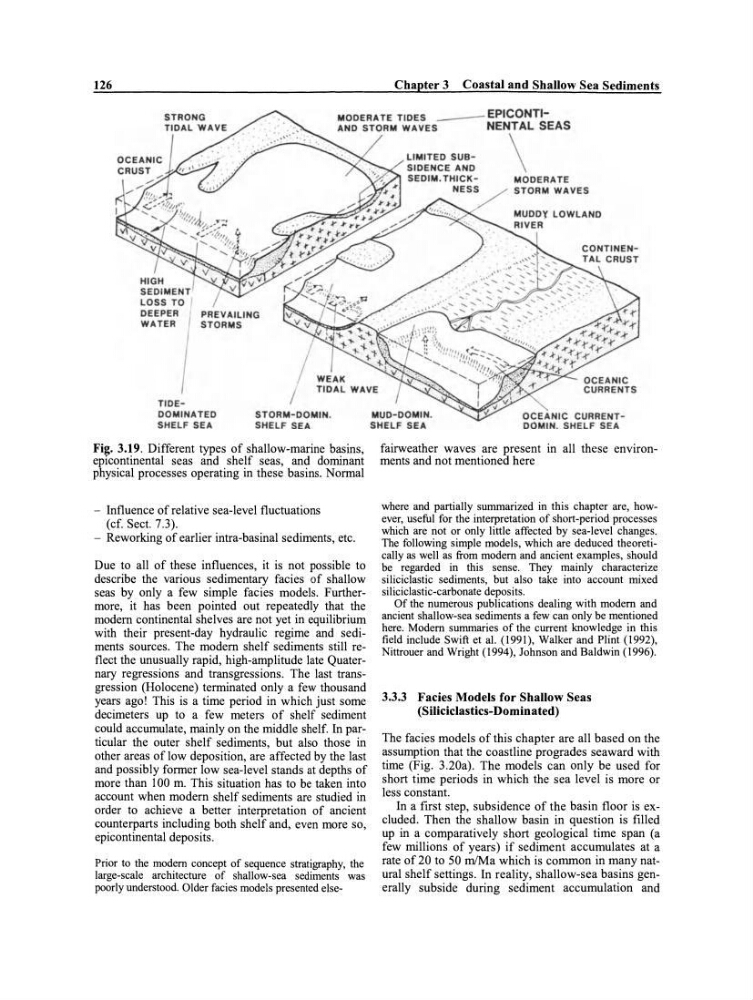
Fi~. 3.~9. Different types of shallow-marine basins,
eplcontmental seas and shelf seas, and dominant
physical processes operating in these basins. Normal
- Influence of relative sea-Ievel fluctuations
(cf. Sect. 7.3).
- Reworking of earlier intra-basinal sediments, etc.
Due to all of these influences, it is not possible to
describe the various sedimentary facies of shallow
seas by only a few simple facies models. Furthermore, it has been pointed out repeatedly that the
modem continental shelves are not yet in equilibrium
with their present-day hydraulic regime and sediments sources. The modem shelf sediments still reflect the unusually rapid, high-amplitude late Quaternary regressions and transgressions. The last transgression (Holocene) terminated only a few thousand
years ago! This is a time period in wh ich just some
decimeters up to a few meters of shelf sediment
could accumulate, mainly on the middle shelf. In particular the outer shelf sediments, but also those in
other areas of low deposition, are affected by the last
and possibly former low sea-Ievel stands at depths of
more than 100 m. This situation has to be taken into
account when modern shelf sediments are studied in
order to achieve a better interpretation of ancient
counterparts including both shelf and, even more so,
epicontinental deposits.
Prior to the modern concept of sequence stratigraphy, the
large-scale architecture of shallow-sea sediments was
poorly understood. Older facies models presented elseLlMITED SUBSIDENCE AND
SEDIM. THICKMUD-DOMIN.
SHELF SEA
NESS
\
MODERATE
STORM WAVES
OCEANIC CURRENTDOMIN. SHELF SEA
fairweather waves are present in all these environments and not mentioned here
where and partially sumrnarized in this chapter are, however, useful for the interpretation of short-period processes
which are not or only little affected by sea-Ievel changes.
The following simple models, which are deduced theoretically as well as from modern and ancient examples, should
be regarded in this sense. They mainly characterize
siliciclastic sediments, but also take into account mixed
siliciclastic-carbonate deposits.
Of the numerous publications dealing with modem and
aneient shallow-sea sediments a few can only be mentioned
here. Modem summaries of the current knowledge in this
field include Swift et al. (1991), Walker and Plint (1992),
Nittrouer and Wright (1994), Johnson and Baldwin (1996).
3.3.3 Facies Models for Shallow Seas
(Siliciclastics-Dominated)
The facies models of this chapter are all based on the
assumption that the coastline progrades seaward with
time (Fig. 3.20a). The models can only be used for
short time periods in which the sea level is more or
less constant.
In a first step, subsidence of the basin floor is excluded. Then the shallow basin in question is filled
up in a comparatively short geological time span (a
few millions of years) if sediment accumulates at a
rate of 20 to 50 mlMa which is common in many natural shelf settings. In reality, shallow-sea basins generally subside during sediment accumulation and
Chapter 3 Coastal and Shallow Sea Sediments
MODERATE TlDES _
EPICONTIAND STORM WAVES
NENTAL SEAS
TlDEDOMINA TED
SHELF SEA
STORM-DOMIN.
SHELF SEA
Fi~. 3.~9. Different types of shallow-marine basins,
eplcontmental seas and shelf seas, and dominant
physical processes operating in these basins. Normal
- Influence of relative sea-Ievel fluctuations
(cf. Sect. 7.3).
- Reworking of earlier intra-basinal sediments, etc.
Due to all of these influences, it is not possible to
describe the various sedimentary facies of shallow
seas by only a few simple facies models. Furthermore, it has been pointed out repeatedly that the
modem continental shelves are not yet in equilibrium
with their present-day hydraulic regime and sediments sources. The modem shelf sediments still reflect the unusually rapid, high-amplitude late Quaternary regressions and transgressions. The last transgression (Holocene) terminated only a few thousand
years ago! This is a time period in wh ich just some
decimeters up to a few meters of shelf sediment
could accumulate, mainly on the middle shelf. In particular the outer shelf sediments, but also those in
other areas of low deposition, are affected by the last
and possibly former low sea-Ievel stands at depths of
more than 100 m. This situation has to be taken into
account when modern shelf sediments are studied in
order to achieve a better interpretation of ancient
counterparts including both shelf and, even more so,
epicontinental deposits.
Prior to the modern concept of sequence stratigraphy, the
large-scale architecture of shallow-sea sediments was
poorly understood. Older facies models presented elseLlMITED SUBSIDENCE AND
SEDIM. THICKMUD-DOMIN.
SHELF SEA
NESS
\
MODERATE
STORM WAVES
OCEANIC CURRENTDOMIN. SHELF SEA
fairweather waves are present in all these environments and not mentioned here
where and partially sumrnarized in this chapter are, however, useful for the interpretation of short-period processes
which are not or only little affected by sea-Ievel changes.
The following simple models, which are deduced theoretically as well as from modern and ancient examples, should
be regarded in this sense. They mainly characterize
siliciclastic sediments, but also take into account mixed
siliciclastic-carbonate deposits.
Of the numerous publications dealing with modem and
aneient shallow-sea sediments a few can only be mentioned
here. Modem summaries of the current knowledge in this
field include Swift et al. (1991), Walker and Plint (1992),
Nittrouer and Wright (1994), Johnson and Baldwin (1996).
3.3.3 Facies Models for Shallow Seas
(Siliciclastics-Dominated)
The facies models of this chapter are all based on the
assumption that the coastline progrades seaward with
time (Fig. 3.20a). The models can only be used for
short time periods in which the sea level is more or
less constant.
In a first step, subsidence of the basin floor is excluded. Then the shallow basin in question is filled
up in a comparatively short geological time span (a
few millions of years) if sediment accumulates at a
rate of 20 to 50 mlMa which is common in many natural shelf settings. In reality, shallow-sea basins generally subside during sediment accumulation and