

3.2 Tidal Flats
BARRIER
ISLAND
>
...
ö
o
..J
W
>
•
w E 100
e u
...
Q
o
50
o ..J u..
b
MUD FLATS
HIGH TIDE
_/ \ -
/ \
/'
/
\
I
I
\
I
,
\
I
I
\
I
~ I MUO FLAr
~
I
a
COASTAL
PLAIN
\
\
\
- - 0
o ~, ~FlOW I
0
it A
::::"':!. B itl--~~-->c: I
\
>
...
Ö
50
0
..J
w.
> -...
e 100
w u
0
~
ffi I
\
lJ I
\
/
\
I
/
\
I
/
\ /
"
~'-111
111
W
o
5
10
15
20
25
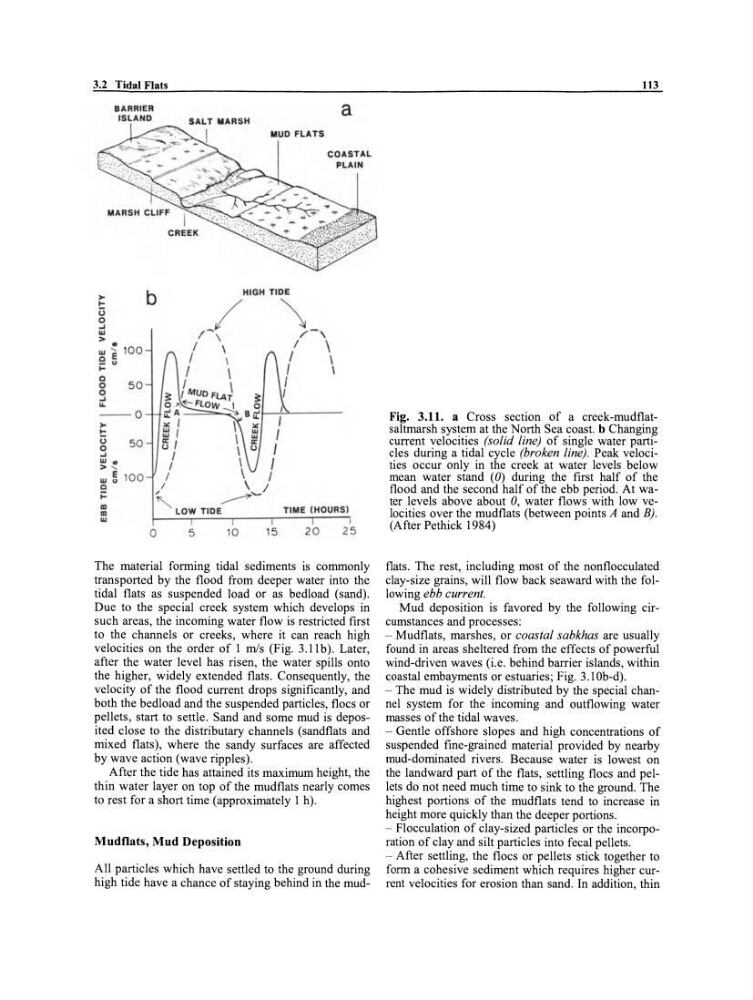
The material forming tidal sediments is commonly
transported by the flood from deeper water into the
tidal flats as suspended load or as bedload (sand).
Due to the special creek system wh ich develops in
such areas, the incoming water flow is restricted first
to the channels or creeks, where it can reach high
velocities on the order of 1 m/s (Fig. 3.11 b). Later,
after the water level has risen, the water spills onto
the higher, widely extended flats. Consequently, the
velocity of the flood current drops significantly, and
both the bedload and the suspended particles, flocs or
pellets, start to settle. Sand and some mud is deposited c10se to the distributary channels (sandflats and
mixed flats), where the sandy surfaces are affected
by wave action (wave ripples).
After the tide has attained its maximum height, the
thin water layer on top of the mudflats nearly comes
to rest for a short time (approximately I h).
Mudflats, Mud Deposition
All partic1es which have settled to the ground during
high tide have a chance of staying behind in the mud113
Fig. 3.11. a Cross section of a creek-mudflatsaltmarsh system at the North Sea coast. b Changing
current velocities (solid fine) of single water particles during a tidal cycle (broken line). Peak velocities occur only in the creek at water levels below
mean water stand (0) during the first half of the
flood and the second half of the ebb period. At water levels above about 0, water flows with low velocities over the mudflats (between points A and B).
(After Pethick 1984)
flats. The rest, including most of the nonflocculated
clay-size grains, will flow back seaward with the following ebb current.
Mud deposition is favored by the following circumstances and processes:
~ Mudflats, marshes, or coastal sabkhas are usually
found in areas sheltered from the effects of powerful
wind-driven waves (i.e. behind barrier islands, within
coastal embayments or estuaries; Fig. 3.1 Ob-d).
~ The mud is widely distributed by the special channel system for the incorning and outflowing water
masses of the tidal waves.
- Gentle offshore slopes and high concentrations of
suspended fine-grained material provided by nearby
mud-dorninated rivers. Because water is lowest on
the landward part of the flats, settling flocs and pellets do not need much time to sink to the ground. The
highest portions of the mudflats te nd to increase in
height more quickly than the deeper portions.
- Flocculation of clay-sized particles or the incorporation of c1ay and silt particles into fecal pellets.
- After settling, the flocs or pellets stick together to
form a cohesive sediment which requires higher current velocities for erosion than sand. In addition, thin
BARRIER
ISLAND
>
...
ö
o
..J
W
>
•
w E 100
e u
...
Q
o
50
o ..J u..
b
MUD FLATS
HIGH TIDE
_/ \ -
/ \
/'
/
\
I
I
\
I
,
\
I
I
\
I
~ I MUO FLAr
~
I
a
COASTAL
PLAIN
\
\
\
- - 0
o ~, ~FlOW I
0
it A
::::"':!. B itl--~~-->c: I
\
>
...
Ö
50
0
..J
w.
> -...
e 100
w u
0
~
ffi I
\
lJ I
\
/
\
I
/
\
I
/
\ /
"
~'-111
111
W
o
5
10
15
20
25
The material forming tidal sediments is commonly
transported by the flood from deeper water into the
tidal flats as suspended load or as bedload (sand).
Due to the special creek system wh ich develops in
such areas, the incoming water flow is restricted first
to the channels or creeks, where it can reach high
velocities on the order of 1 m/s (Fig. 3.11 b). Later,
after the water level has risen, the water spills onto
the higher, widely extended flats. Consequently, the
velocity of the flood current drops significantly, and
both the bedload and the suspended particles, flocs or
pellets, start to settle. Sand and some mud is deposited c10se to the distributary channels (sandflats and
mixed flats), where the sandy surfaces are affected
by wave action (wave ripples).
After the tide has attained its maximum height, the
thin water layer on top of the mudflats nearly comes
to rest for a short time (approximately I h).
Mudflats, Mud Deposition
All partic1es which have settled to the ground during
high tide have a chance of staying behind in the mud113
Fig. 3.11. a Cross section of a creek-mudflatsaltmarsh system at the North Sea coast. b Changing
current velocities (solid fine) of single water particles during a tidal cycle (broken line). Peak velocities occur only in the creek at water levels below
mean water stand (0) during the first half of the
flood and the second half of the ebb period. At water levels above about 0, water flows with low velocities over the mudflats (between points A and B).
(After Pethick 1984)
flats. The rest, including most of the nonflocculated
clay-size grains, will flow back seaward with the following ebb current.
Mud deposition is favored by the following circumstances and processes:
~ Mudflats, marshes, or coastal sabkhas are usually
found in areas sheltered from the effects of powerful
wind-driven waves (i.e. behind barrier islands, within
coastal embayments or estuaries; Fig. 3.1 Ob-d).
~ The mud is widely distributed by the special channel system for the incorning and outflowing water
masses of the tidal waves.
- Gentle offshore slopes and high concentrations of
suspended fine-grained material provided by nearby
mud-dorninated rivers. Because water is lowest on
the landward part of the flats, settling flocs and pellets do not need much time to sink to the ground. The
highest portions of the mudflats te nd to increase in
height more quickly than the deeper portions.
- Flocculation of clay-sized particles or the incorporation of c1ay and silt particles into fecal pellets.
- After settling, the flocs or pellets stick together to
form a cohesive sediment which requires higher current velocities for erosion than sand. In addition, thin