

3 On Moral Failures in Dealing with Environmental Issues: The Europipe Experience
19
3.2.4
Second Moral Failure of Politics
The political decision of routing the pipeline through the intertidal flats by tunnelling
must be seen as an act of appeasement towards the environmentalists. The construction of a 2.6-km-Iong tunnel was justified by the argument that it would leave the intertidal ecosystem undisturbed. No such ecological concerns were expressed when it became clear that the planned route required the installation of 48 anchor piles along the
channel margins followed by trenching over more than twice that distance through the
subtidal channel and ebb delta system. In addition, the available tunnelling method
had up to that time never been applied over distances greater than about 1.5 km; The
risk and consequences of failure were evidently ignored or played down. Fortunately,
the expensive tunnelling procedure (by a factor of 8 more costly than trenching) proved
successful. It did not, however, achieve its main purpose, namely to leave the intertidal
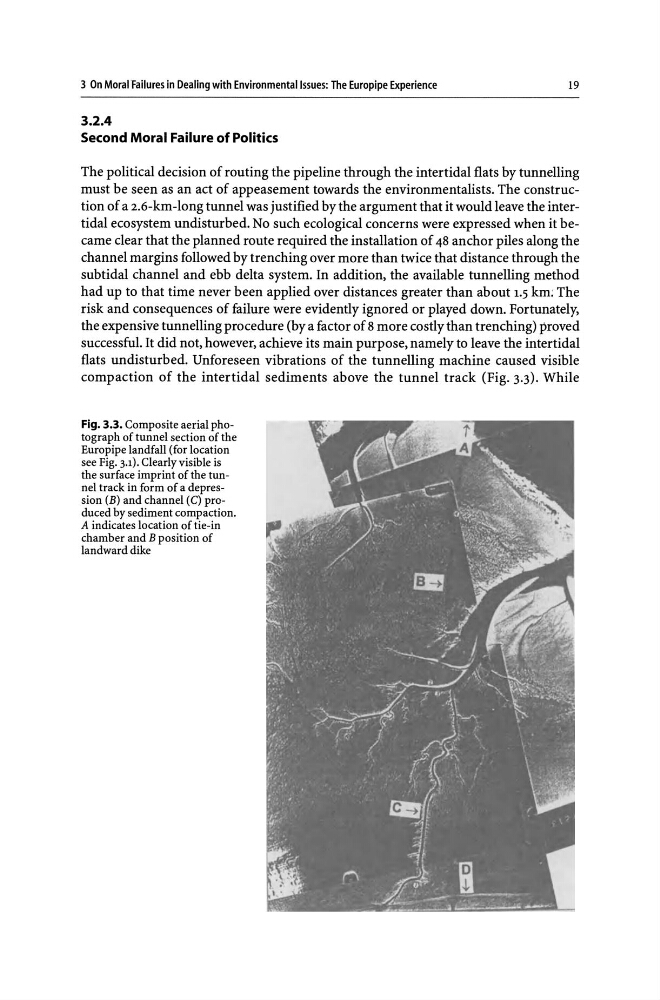
flats undisturbed. Unforeseen vibrations of the tunnelling machine caused visible
compaction of the intertidal sediments above the tunnel track (Fig. 3.3). While
Fig. 3.3. Composite aerial photograph of tunnel section of the
Europipe landfall (for location
see Fig. 3.1). Clearly visible is
the surface imprint of the tunnel track in form of a depression (B) and channel (C) produced by sediment compaction.
A indicates location of tie-in
chamber and B position of
landward dike
19
3.2.4
Second Moral Failure of Politics
The political decision of routing the pipeline through the intertidal flats by tunnelling
must be seen as an act of appeasement towards the environmentalists. The construction of a 2.6-km-Iong tunnel was justified by the argument that it would leave the intertidal ecosystem undisturbed. No such ecological concerns were expressed when it became clear that the planned route required the installation of 48 anchor piles along the
channel margins followed by trenching over more than twice that distance through the
subtidal channel and ebb delta system. In addition, the available tunnelling method
had up to that time never been applied over distances greater than about 1.5 km; The
risk and consequences of failure were evidently ignored or played down. Fortunately,
the expensive tunnelling procedure (by a factor of 8 more costly than trenching) proved
successful. It did not, however, achieve its main purpose, namely to leave the intertidal
flats undisturbed. Unforeseen vibrations of the tunnelling machine caused visible
compaction of the intertidal sediments above the tunnel track (Fig. 3.3). While
Fig. 3.3. Composite aerial photograph of tunnel section of the
Europipe landfall (for location
see Fig. 3.1). Clearly visible is
the surface imprint of the tunnel track in form of a depression (B) and channel (C) produced by sediment compaction.
A indicates location of tie-in
chamber and B position of
landward dike