

110
H.Karup
400000
350000
- - Accumulated spillage,budget
f- - - Accumulated spillage, measured
V
/"'
/
~
/
/
~
V
It
,../
/'
/
/
.....
.....
-
300000
250000
c:
S 200000
150000
100000
50000
~
-~
.-::o
Oct. -95
Dec. -95
Feb. -96
Apr. -96
Jun. -96
Aug. -96 Oct. -96
Dec. -96
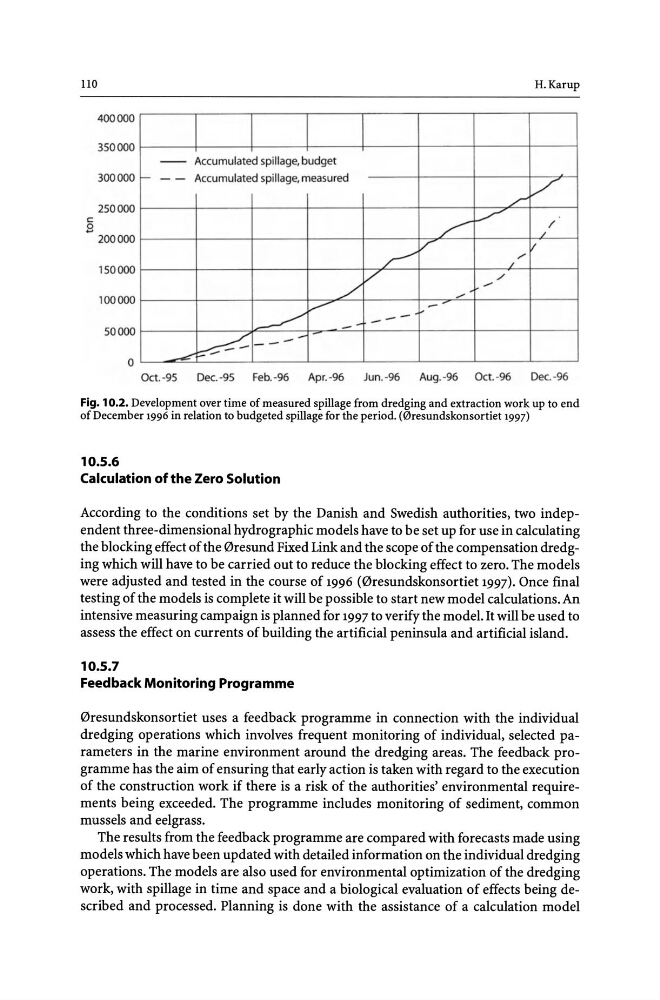
Fig. 10.2. Development over time of measured spillage from dredging and extraction work up to end
of December 1996 in relation to budgeted spillage for the period. (0resundskonsortiet 1997)
10.5.6
Calculation of the Zero Solution
According to the conditions set by the Danish and Swedish authorities, two independent three-dimensional hydrographic models have to be set up for use in calculating
the blocking effect of the 0resund Fixed Link and the scope of the compensation dredging which will have to be carried out to reduce the blocking effect to zero. The models
were adjusted and tested in the course of 1996 (0resundskonsortiet 1997). Once final
testing of the models is complete it will be possible to start new model calculations. An
intensive measuring campaign is planned for 1997 to verify the model. It will be used to
assess the effect on currents of building the artificial peninsula and artificial island.
10.5.7
Feedback Monitoring Programme
0resundskonsortiet uses a feedback programme in connection with the individual
dredging operations which involves frequent monitoring of individual, selected parameters in the marine environment around the dredging areas. The feedback programme has the aim of ensuring that early action is taken with regard to the execution
of the construction work if there is a risk of the authorities' environmental requirements being exceeded. The programme includes monitoring of sediment, common
mussels and eelgrass.
The results from the feedback programme are compared with forecasts made using
models which have been updated with detailed information on the individual dredging
operations. The models are also used for environmental optimization of the dredging
work, with spillage in time and space and a biological evaluation of effects being described and processed. Planning is done with the assistance of a calculation model
H.Karup
400000
350000
- - Accumulated spillage,budget
f- - - Accumulated spillage, measured
V
/"'
/
~
/
/
~
V
It
,../
/'
/
/
.....
.....
-
300000
250000
c:
S 200000
150000
100000
50000
~
-~
.-::o
Oct. -95
Dec. -95
Feb. -96
Apr. -96
Jun. -96
Aug. -96 Oct. -96
Dec. -96
Fig. 10.2. Development over time of measured spillage from dredging and extraction work up to end
of December 1996 in relation to budgeted spillage for the period. (0resundskonsortiet 1997)
10.5.6
Calculation of the Zero Solution
According to the conditions set by the Danish and Swedish authorities, two independent three-dimensional hydrographic models have to be set up for use in calculating
the blocking effect of the 0resund Fixed Link and the scope of the compensation dredging which will have to be carried out to reduce the blocking effect to zero. The models
were adjusted and tested in the course of 1996 (0resundskonsortiet 1997). Once final
testing of the models is complete it will be possible to start new model calculations. An
intensive measuring campaign is planned for 1997 to verify the model. It will be used to
assess the effect on currents of building the artificial peninsula and artificial island.
10.5.7
Feedback Monitoring Programme
0resundskonsortiet uses a feedback programme in connection with the individual
dredging operations which involves frequent monitoring of individual, selected parameters in the marine environment around the dredging areas. The feedback programme has the aim of ensuring that early action is taken with regard to the execution
of the construction work if there is a risk of the authorities' environmental requirements being exceeded. The programme includes monitoring of sediment, common
mussels and eelgrass.
The results from the feedback programme are compared with forecasts made using
models which have been updated with detailed information on the individual dredging
operations. The models are also used for environmental optimization of the dredging
work, with spillage in time and space and a biological evaluation of effects being described and processed. Planning is done with the assistance of a calculation model