

96
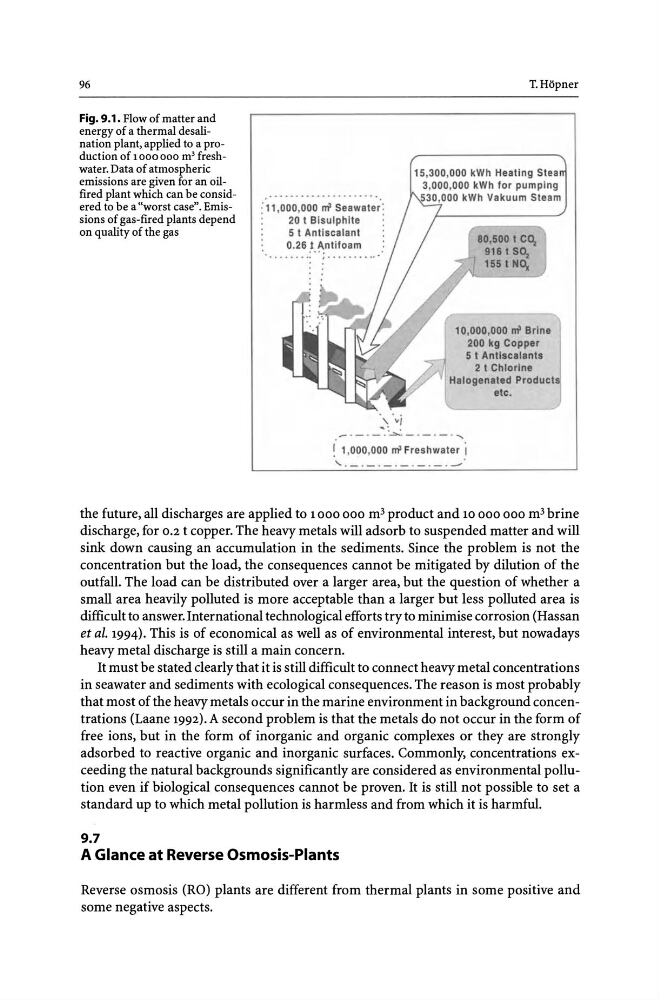
Fig. 9.1. Flow of matter and
energy of a thermal desalination plant, applied to a production of! 000 000 m' freshwater. Data of atmospheric
emissions are given for an oilfired plant which can be considered to be a "worst case". Emissions of gas-fired plants depend
on quality of the gas
11 ,000,000 m' Seawater :
20 t Bisulphlte
.
5 t Antisealant
0.26 ~.~ntifoam
" 'vi
"' : .
T.Hiipner
15,300,000 kWh Heating
3,000,000 kWh for pumping
000 kWh Vakuum Steam
80,500 t CCl.t
916 t SO~
155 t N~
10,000,000 m' Brine
200 kg Copper
5 t Antlseslsnts
2 t Chlorine
- . - . -.~-.-.- ........
! 1,000 ,000 m' Freshwater i
'.-.- . - . - . - .-. ~
the future, all discharges are applied to 1000 000 m 3 product and 10 000 000 m 3 brine
discharge, for 0 .2 t copper. The heavy metals will adsorb to suspended matter and will
sink down causing an accumulation in the sediments. Since the problem is not the
concentration but the load, the consequences cannot be mitigated by dilution of the
outfall. The load can be distributed over a larger area, but the question of whether a
small area heavily polluted is more acceptable than a larger but less polluted area is
difficult to answer. International technological efforts try to minimise corrosion (Hassan
et al. 1994). This is of economical as well as of environmental interest, but nowadays
heavy metal discharge is still a main concern.
It must be stated dearly that it is still difficult to connect heavy metal concentrations
in seawater and sediments with ecological consequences. The reason is most probably
that most of the heavy metals occur in the marine environment in background concentrations (Laane 1992). A second problem is that the metals do not occur in the form of
free ions, but in the form of inorganic and organic complexes or they are strongly
adsorbed to reactive organic and inorganic surfaces. Commonly, concentrations exceeding the natural backgrounds significantly are considered as environmental pollution even if biological consequences cannot be proven. It is still not possible to set a
standard up to which metal pollution is harmless and from which it is harmful.
9.7
A Glance at Reverse Osmosis-Plants
Reverse osmosis (RO) plants are different from thermal plants in some positive and
some negative aspects.
Fig. 9.1. Flow of matter and
energy of a thermal desalination plant, applied to a production of! 000 000 m' freshwater. Data of atmospheric
emissions are given for an oilfired plant which can be considered to be a "worst case". Emissions of gas-fired plants depend
on quality of the gas
11 ,000,000 m' Seawater :
20 t Bisulphlte
.
5 t Antisealant
0.26 ~.~ntifoam
" 'vi
"' : .
T.Hiipner
15,300,000 kWh Heating
3,000,000 kWh for pumping
000 kWh Vakuum Steam
80,500 t CCl.t
916 t SO~
155 t N~
10,000,000 m' Brine
200 kg Copper
5 t Antlseslsnts
2 t Chlorine
- . - . -.~-.-.- ........
! 1,000 ,000 m' Freshwater i
'.-.- . - . - . - .-. ~
the future, all discharges are applied to 1000 000 m 3 product and 10 000 000 m 3 brine
discharge, for 0 .2 t copper. The heavy metals will adsorb to suspended matter and will
sink down causing an accumulation in the sediments. Since the problem is not the
concentration but the load, the consequences cannot be mitigated by dilution of the
outfall. The load can be distributed over a larger area, but the question of whether a
small area heavily polluted is more acceptable than a larger but less polluted area is
difficult to answer. International technological efforts try to minimise corrosion (Hassan
et al. 1994). This is of economical as well as of environmental interest, but nowadays
heavy metal discharge is still a main concern.
It must be stated dearly that it is still difficult to connect heavy metal concentrations
in seawater and sediments with ecological consequences. The reason is most probably
that most of the heavy metals occur in the marine environment in background concentrations (Laane 1992). A second problem is that the metals do not occur in the form of
free ions, but in the form of inorganic and organic complexes or they are strongly
adsorbed to reactive organic and inorganic surfaces. Commonly, concentrations exceeding the natural backgrounds significantly are considered as environmental pollution even if biological consequences cannot be proven. It is still not possible to set a
standard up to which metal pollution is harmless and from which it is harmful.
9.7
A Glance at Reverse Osmosis-Plants
Reverse osmosis (RO) plants are different from thermal plants in some positive and
some negative aspects.