

85
4 Characteristics and Formation Process
basins filled with hot (60 °C) brine on the Red Sea axis. In 1969, two industrial companies (Preussag and IGS) conducted exploration to estimate the volumes of the
deposits and to understand the formation process in various basins (18 are currently
known). The largest basin, “Atlantis II Deep”, covers about 60 km
2
at a depth of
2,000 m. In this basin, metalliferous sediments are up to 30 m thick under a 180 m
layer of brine; they represent 94 million tonnes of ore containing 1.7 million tonnes
of zinc, 0.4 million tonnes of copper and 4,000 tonnes of silver. In May/June 1979,
the first pumping tests were performed from a vessel drilling in deep water. More
recently (summer 2010), a mining permit was granted.
Chemical Zonation of Deposits
During the reaction between seawater and rocks in the crust or mantle, many metals are extracted from these rocks. Their transport in fluids is facilitated by the
presence of sulphur and chlorine, with which the metals form soluble complexes.
Because high pressure prevents the fluid from boiling, these transport capacities are
strengthened. For instance, in typical submarine hydrothermal conditions, copper
cannot remain in solution below 300 °C. Zinc precipitates between 100 and 250 °C.
Hydrothermal fluids contain between 1 and 100 ppm of copper and zinc. They will
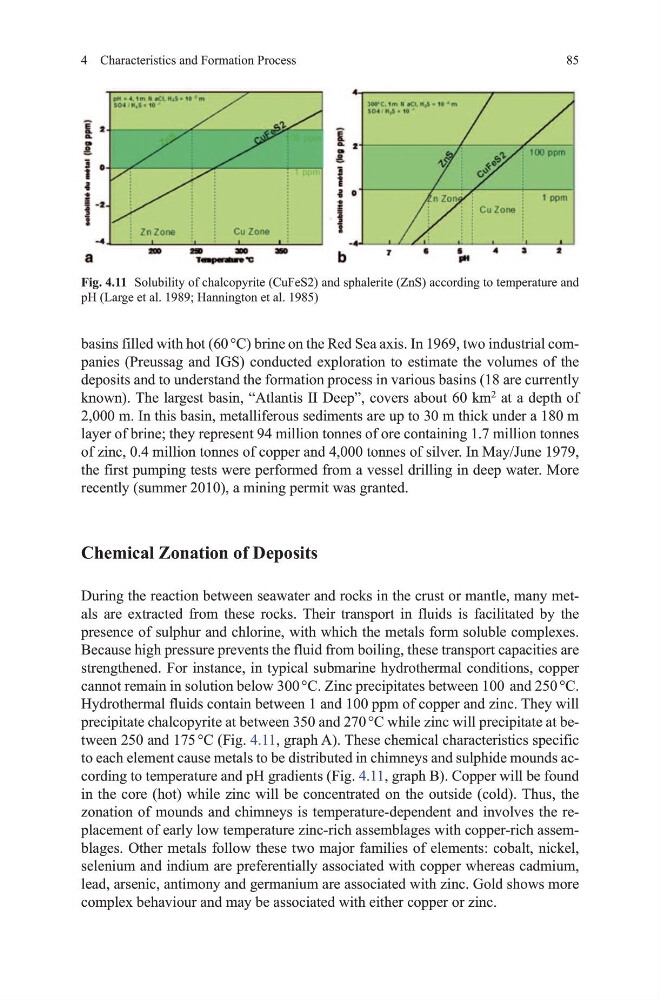
precipitate chalcopyrite at between 350 and 270 °C while zinc will precipitate at between 250 and 175 °C (Fig. 4.11, graph A). These chemical characteristics specific
to each element cause metals to be distributed in chimneys and sulphide mounds according to temperature and pH gradients (Fig. 4.11, graph B). Copper will be found
in the core (hot) while zinc will be concentrated on the outside (cold). Thus, the
zonation of mounds and chimneys is temperature-dependent and involves the replacement of early low temperature zinc-rich assemblages with copper-rich assemblages. Other metals follow these two major families of elements: cobalt, nickel,
selenium and indium are preferentially associated with copper whereas cadmium,
lead, arsenic, antimony and germanium are associated with zinc. Gold shows more
complex behaviour and may be associated with either copper or zinc.
Fig. 4.11 Solubility of chalcopyrite (CuFeS2) and sphalerite (ZnS) according to temperature and
pH (Large et al. 1989; Hannington et al. 1985)
4 Characteristics and Formation Process
basins filled with hot (60 °C) brine on the Red Sea axis. In 1969, two industrial companies (Preussag and IGS) conducted exploration to estimate the volumes of the
deposits and to understand the formation process in various basins (18 are currently
known). The largest basin, “Atlantis II Deep”, covers about 60 km
2
at a depth of
2,000 m. In this basin, metalliferous sediments are up to 30 m thick under a 180 m
layer of brine; they represent 94 million tonnes of ore containing 1.7 million tonnes
of zinc, 0.4 million tonnes of copper and 4,000 tonnes of silver. In May/June 1979,
the first pumping tests were performed from a vessel drilling in deep water. More
recently (summer 2010), a mining permit was granted.
Chemical Zonation of Deposits
During the reaction between seawater and rocks in the crust or mantle, many metals are extracted from these rocks. Their transport in fluids is facilitated by the
presence of sulphur and chlorine, with which the metals form soluble complexes.
Because high pressure prevents the fluid from boiling, these transport capacities are
strengthened. For instance, in typical submarine hydrothermal conditions, copper
cannot remain in solution below 300 °C. Zinc precipitates between 100 and 250 °C.
Hydrothermal fluids contain between 1 and 100 ppm of copper and zinc. They will
precipitate chalcopyrite at between 350 and 270 °C while zinc will precipitate at between 250 and 175 °C (Fig. 4.11, graph A). These chemical characteristics specific
to each element cause metals to be distributed in chimneys and sulphide mounds according to temperature and pH gradients (Fig. 4.11, graph B). Copper will be found
in the core (hot) while zinc will be concentrated on the outside (cold). Thus, the
zonation of mounds and chimneys is temperature-dependent and involves the replacement of early low temperature zinc-rich assemblages with copper-rich assemblages. Other metals follow these two major families of elements: cobalt, nickel,
selenium and indium are preferentially associated with copper whereas cadmium,
lead, arsenic, antimony and germanium are associated with zinc. Gold shows more
complex behaviour and may be associated with either copper or zinc.
Fig. 4.11 Solubility of chalcopyrite (CuFeS2) and sphalerite (ZnS) according to temperature and
pH (Large et al. 1989; Hannington et al. 1985)