

70
Y. Fouquet
gravity and current phenomena, leading to the local generation of areas with low
sedimentation rates in which nodules can form. This results in a discontinuous
regional distribution of nodule fields extending over a few kilometres, within which
nodule facies vary laterally.
Formation Mechanism Sediments in nodule areas are accumulated very slowly
(3–10 mm per 1,000 years) and are composed of dust of continental origin and
skeletons of planktonic organisms (radiolarian ooze). There exists an optimal sedimentation rate for nodule formation: at less than 2 mm in a 1,000 years, only hydrogenated crusts form, while at over 10 mm in a 1,000 years, the seabed becomes
sediment, and nodule formation mechanisms can no longer take place. Radiochronological dating methods have shown nodule growth rates of a few millimetres per
million years. This growth rate, which is considerably lower than the sedimentation
rate, raises the problem of maintaining nodules at the sediment surface. For some
samples, variations in growth rate have been observed in relation to climate variations, with growth possibly stopping during glacial periods.
Four chemical sources of particulate or dissolved elements were considered for
nodule formation: planktonic organisms, continental input from rivers, hydrothermal
vents and volcanic dust. Manganese’s residence time in seawater, evaluated from
input from rivers and its concentration in seawater, has been estimated at around
a 100 years, while that of nickel and copper is closer to a 1,000 years. Cobalt’s
residence time, on the other hand, is only around 10 years. The precipitation of
manganese and iron in seawater is an ordinary process that occurs at all latitudes
and all depths. However, nodules are only found in a small part of the ocean floor,
at depths of over 4,000 m, in areas where carbonates can dissolve due to greater
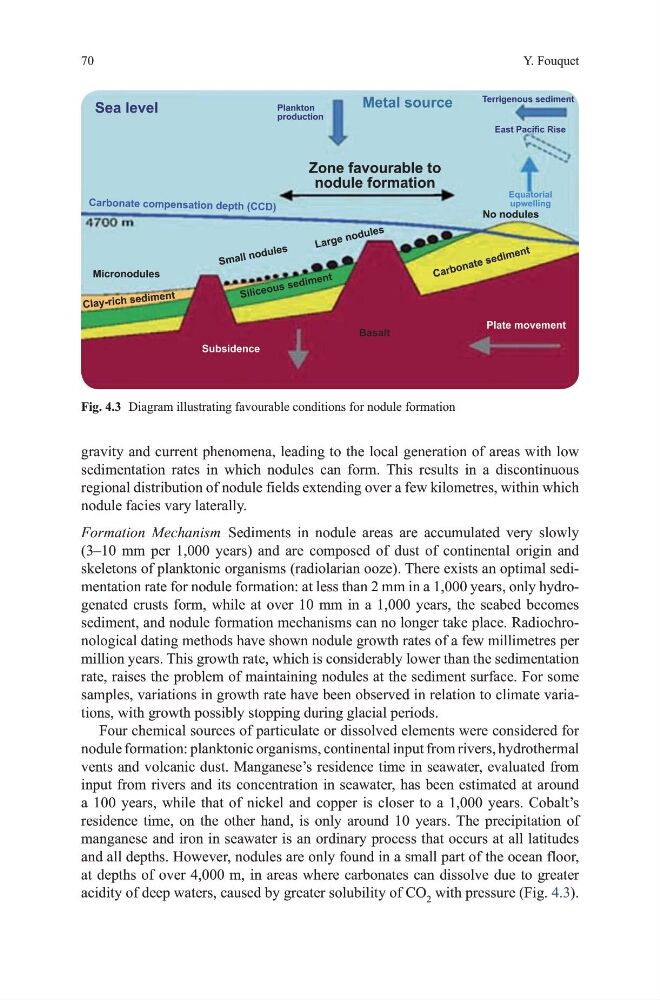
acidity of deep waters, caused by greater solubility of CO 2 with pressure (Fig. 4.3).
Fig. 4.3 Diagram illustrating favourable conditions for nodule formation
Y. Fouquet
gravity and current phenomena, leading to the local generation of areas with low
sedimentation rates in which nodules can form. This results in a discontinuous
regional distribution of nodule fields extending over a few kilometres, within which
nodule facies vary laterally.
Formation Mechanism Sediments in nodule areas are accumulated very slowly
(3–10 mm per 1,000 years) and are composed of dust of continental origin and
skeletons of planktonic organisms (radiolarian ooze). There exists an optimal sedimentation rate for nodule formation: at less than 2 mm in a 1,000 years, only hydrogenated crusts form, while at over 10 mm in a 1,000 years, the seabed becomes
sediment, and nodule formation mechanisms can no longer take place. Radiochronological dating methods have shown nodule growth rates of a few millimetres per
million years. This growth rate, which is considerably lower than the sedimentation
rate, raises the problem of maintaining nodules at the sediment surface. For some
samples, variations in growth rate have been observed in relation to climate variations, with growth possibly stopping during glacial periods.
Four chemical sources of particulate or dissolved elements were considered for
nodule formation: planktonic organisms, continental input from rivers, hydrothermal
vents and volcanic dust. Manganese’s residence time in seawater, evaluated from
input from rivers and its concentration in seawater, has been estimated at around
a 100 years, while that of nickel and copper is closer to a 1,000 years. Cobalt’s
residence time, on the other hand, is only around 10 years. The precipitation of
manganese and iron in seawater is an ordinary process that occurs at all latitudes
and all depths. However, nodules are only found in a small part of the ocean floor,
at depths of over 4,000 m, in areas where carbonates can dissolve due to greater
acidity of deep waters, caused by greater solubility of CO 2 with pressure (Fig. 4.3).
Fig. 4.3 Diagram illustrating favourable conditions for nodule formation