

60
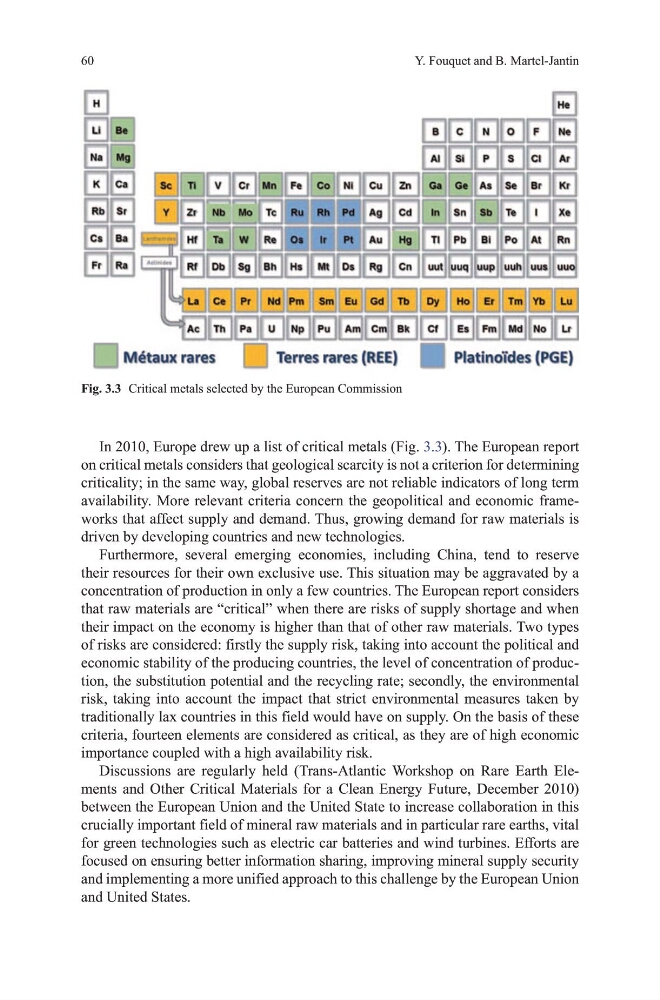
In 2010, Europe drew up a list of critical metals (Fig. 3.3). The European report
on critical metals considers that geological scarcity is not a criterion for determining
criticality; in the same way, global reserves are not reliable indicators of long term
availability. More relevant criteria concern the geopolitical and economic frameworks that affect supply and demand. Thus, growing demand for raw materials is
driven by developing countries and new technologies.
Furthermore, several emerging economies, including China, tend to reserve
their resources for their own exclusive use. This situation may be aggravated by a
concentration of production in only a few countries. The European report considers
that raw materials are “critical” when there are risks of supply shortage and when
their impact on the economy is higher than that of other raw materials. Two types
of risks are considered: firstly the supply risk, taking into account the political and
economic stability of the producing countries, the level of concentration of production, the substitution potential and the recycling rate; secondly, the environmental
risk, taking into account the impact that strict environmental measures taken by
traditionally lax countries in this field would have on supply. On the basis of these
criteria, fourteen elements are considered as critical, as they are of high economic
importance coupled with a high availability risk.
Discussions are regularly held (Trans-Atlantic Workshop on Rare Earth Elements and Other Critical Materials for a Clean Energy Future, December 2010)
between the European Union and the United State to increase collaboration in this
crucially important field of mineral raw materials and in particular rare earths, vital
for green technologies such as electric car batteries and wind turbines. Efforts are
focused on ensuring better information sharing, improving mineral supply security
and implementing a more unified approach to this challenge by the European Union
and United States.
Y. Fouquet and B. Martel-Jantin
Fig. 3.3 Critical metals selected by the European Commission
In 2010, Europe drew up a list of critical metals (Fig. 3.3). The European report
on critical metals considers that geological scarcity is not a criterion for determining
criticality; in the same way, global reserves are not reliable indicators of long term
availability. More relevant criteria concern the geopolitical and economic frameworks that affect supply and demand. Thus, growing demand for raw materials is
driven by developing countries and new technologies.
Furthermore, several emerging economies, including China, tend to reserve
their resources for their own exclusive use. This situation may be aggravated by a
concentration of production in only a few countries. The European report considers
that raw materials are “critical” when there are risks of supply shortage and when
their impact on the economy is higher than that of other raw materials. Two types
of risks are considered: firstly the supply risk, taking into account the political and
economic stability of the producing countries, the level of concentration of production, the substitution potential and the recycling rate; secondly, the environmental
risk, taking into account the impact that strict environmental measures taken by
traditionally lax countries in this field would have on supply. On the basis of these
criteria, fourteen elements are considered as critical, as they are of high economic
importance coupled with a high availability risk.
Discussions are regularly held (Trans-Atlantic Workshop on Rare Earth Elements and Other Critical Materials for a Clean Energy Future, December 2010)
between the European Union and the United State to increase collaboration in this
crucially important field of mineral raw materials and in particular rare earths, vital
for green technologies such as electric car batteries and wind turbines. Efforts are
focused on ensuring better information sharing, improving mineral supply security
and implementing a more unified approach to this challenge by the European Union
and United States.
Y. Fouquet and B. Martel-Jantin
Fig. 3.3 Critical metals selected by the European Commission