

29
1 Study Summary
Similarly, the ISA’s development prospects will take advantage of the authorisation it is granted, by articles 143 and 145 of UNCLOS, to promote marine scientific research in the Area and to ensure protection of the marine environment. The
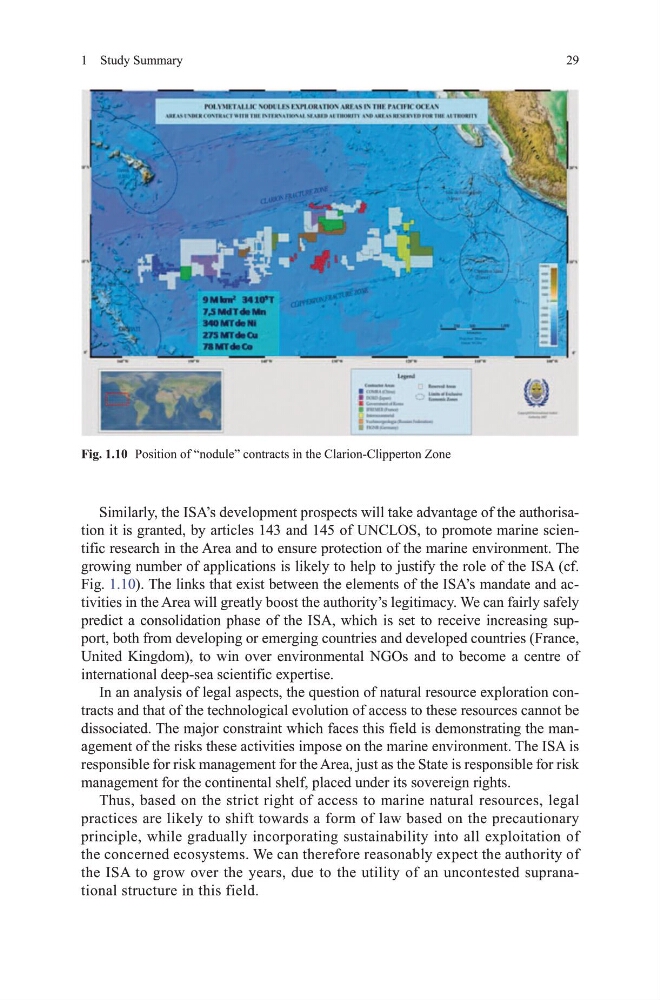
growing number of applications is likely to help to justify the role of the ISA (cf.
Fig. 1.10). The links that exist between the elements of the ISA’s mandate and activities in the Area will greatly boost the authority’s legitimacy. We can fairly safely
predict a consolidation phase of the ISA, which is set to receive increasing support, both from developing or emerging countries and developed countries (France,
United Kingdom), to win over environmental NGOs and to become a centre of
international deep-sea scientific expertise.
In an analysis of legal aspects, the question of natural resource exploration contracts and that of the technological evolution of access to these resources cannot be
dissociated. The major constraint which faces this field is demonstrating the management of the risks these activities impose on the marine environment. The ISA is
responsible for risk management for the Area, just as the State is responsible for risk
management for the continental shelf, placed under its sovereign rights.
Thus, based on the strict right of access to marine natural resources, legal
practices are likely to shift towards a form of law based on the precautionary
principle, while gradually incorporating sustainability into all exploitation of
the concerned ecosystems. We can therefore reasonably expect the authority of
the ISA to grow over the years, due to the utility of an uncontested supranational structure in this field.
Fig. 1.10 Position of “nodule” contracts in the Clarion-Clipperton Zone
1 Study Summary
Similarly, the ISA’s development prospects will take advantage of the authorisation it is granted, by articles 143 and 145 of UNCLOS, to promote marine scientific research in the Area and to ensure protection of the marine environment. The
growing number of applications is likely to help to justify the role of the ISA (cf.
Fig. 1.10). The links that exist between the elements of the ISA’s mandate and activities in the Area will greatly boost the authority’s legitimacy. We can fairly safely
predict a consolidation phase of the ISA, which is set to receive increasing support, both from developing or emerging countries and developed countries (France,
United Kingdom), to win over environmental NGOs and to become a centre of
international deep-sea scientific expertise.
In an analysis of legal aspects, the question of natural resource exploration contracts and that of the technological evolution of access to these resources cannot be
dissociated. The major constraint which faces this field is demonstrating the management of the risks these activities impose on the marine environment. The ISA is
responsible for risk management for the Area, just as the State is responsible for risk
management for the continental shelf, placed under its sovereign rights.
Thus, based on the strict right of access to marine natural resources, legal
practices are likely to shift towards a form of law based on the precautionary
principle, while gradually incorporating sustainability into all exploitation of
the concerned ecosystems. We can therefore reasonably expect the authority of
the ISA to grow over the years, due to the utility of an uncontested supranational structure in this field.
Fig. 1.10 Position of “nodule” contracts in the Clarion-Clipperton Zone