

5 Fusion of Satellite SAR with Passive Microwave Data for Sea Ice Remote Sensing
c:
o
.,
U o
. .
..
<[
c:
o
U
~ x
'" ~
.3 ., .,
.....
lAtaLevel
Fusion
Feature
Betr action
oj Dal.-Ievel fusion
c:
~
c:
u
~
Feat ur eJoint
Joint
identity
decl aratl on
~ x
UJ
.,
u
Level
--.- Identity
~
3 ., .,
...
o
.. ..
<[
b) Fealure·level fusion
c
~
'"
u o Of>
..
<[
Fusion
declaration
Doci si onLevel
Fusion
Joint
identity
decl ar all on
cJ Decision-level fusion
93
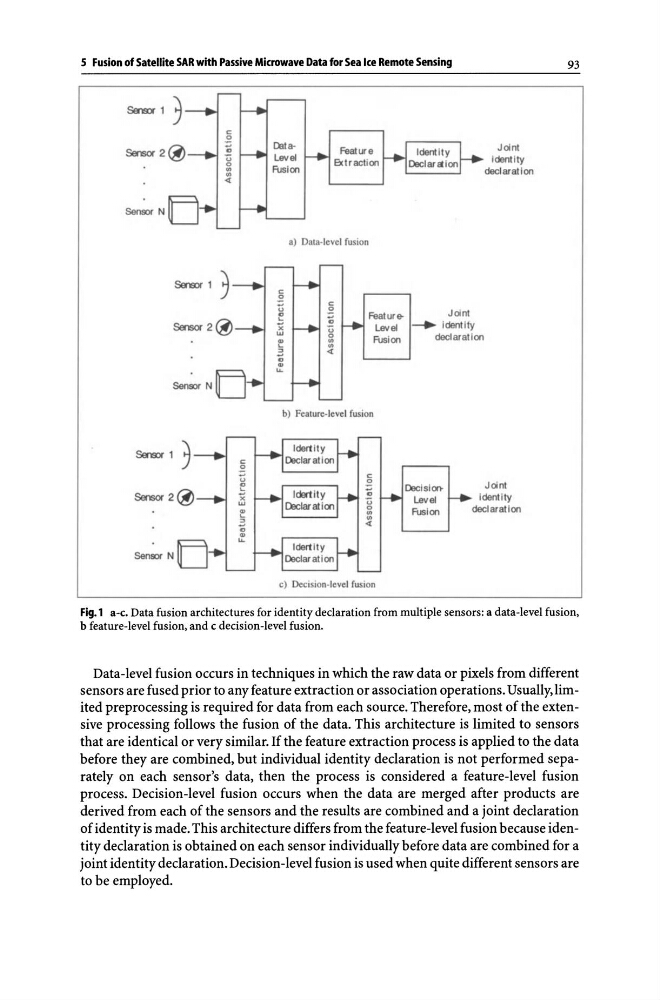
Fig.l a-c. Data fusion architectures for identity declaration from multiple sensors: a data-level fusion,
b feature-level fusion, and c decision-level fusion.
Data-level fusion occurs in techniques in which the raw data or pixels from different
sensors are fused prior to any feature extraction or association operations. Usually,limited preprocessing is required for data from each source. Therefore, most of the extensive processing follows the fusion of the data. This architecture is limited to sensors
that are identical or very similar. If the feature extraction process is applied to the data
before they are combined, but individual identity declaration is not performed separately on each sensor's data, then the process is considered a feature-level fusion
process. Decision-level fusion occurs when the data are merged after products are
derived from each of the sensors and the results are combined and a joint declaration
of identity is made. This architecture differs from the feature-level fusion because identity declaration is obtained on each sensor individually before data are combined for a
joint identity declaration. Decision-level fusion is used when quite different sensors are
to be employed.
c:
o
.,
U o
. .
..
<[
c:
o
U
~ x
'" ~
.3 ., .,
.....
lAtaLevel
Fusion
Feature
Betr action
oj Dal.-Ievel fusion
c:
~
c:
u
~
Feat ur eJoint
Joint
identity
decl aratl on
~ x
UJ
.,
u
Level
--.- Identity
~
3 ., .,
...
o
.. ..
<[
b) Fealure·level fusion
c
~
'"
u o Of>
..
<[
Fusion
declaration
Doci si onLevel
Fusion
Joint
identity
decl ar all on
cJ Decision-level fusion
93
Fig.l a-c. Data fusion architectures for identity declaration from multiple sensors: a data-level fusion,
b feature-level fusion, and c decision-level fusion.
Data-level fusion occurs in techniques in which the raw data or pixels from different
sensors are fused prior to any feature extraction or association operations. Usually,limited preprocessing is required for data from each source. Therefore, most of the extensive processing follows the fusion of the data. This architecture is limited to sensors
that are identical or very similar. If the feature extraction process is applied to the data
before they are combined, but individual identity declaration is not performed separately on each sensor's data, then the process is considered a feature-level fusion
process. Decision-level fusion occurs when the data are merged after products are
derived from each of the sensors and the results are combined and a joint declaration
of identity is made. This architecture differs from the feature-level fusion because identity declaration is obtained on each sensor individually before data are combined for a
joint identity declaration. Decision-level fusion is used when quite different sensors are
to be employed.