

52
D.G. BARBER, A. THOMAS, AND T.N. PAPAKYRIAKOU
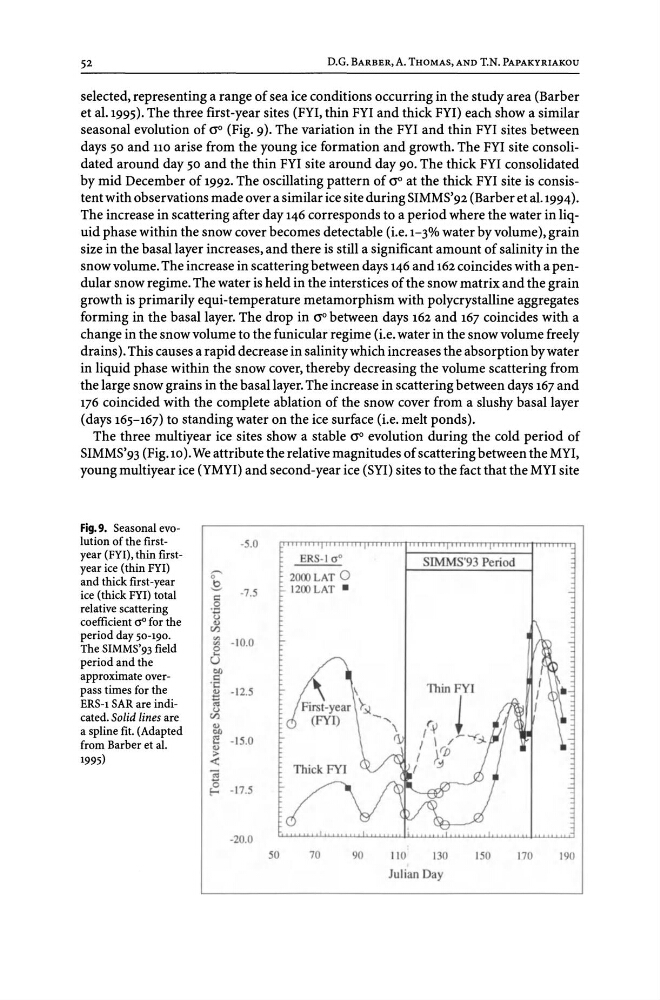
selected, representing a range of sea ice conditions occurring in the study area (Barber
et al.I995). The three first-year sites (FYI, thin FYI and thick FYI) each show a similar
seasonal evolution of (}"o (Fig. 9). The variation in the FYI and thin FYI sites between
days 50 and 110 arise from the young ice formation and growth. The FYI site consolidated around day 50 and the thin FYI site around day 90. The thick FYI consolidated
by mid December of 1992. The oscillating pattern of (}"o at the thick FYI site is consistent with observations made over a similar ice site during SIMMS'92 (Barber et al.I994).
The increase in scattering after day 146 corresponds to a period where the water in liquid phase within the snow cover becomes detectable (i.e. 1-3% water by volume), grain
size in the basal layer increases, and there is still a significant amount of salinity in the
snow volume. The increase in scattering between days 146 and 162 coincides with a pendular snow regime. The water is held in the interstices of the snow matrix and the grain
growth is primarily equi-temperature metamorphism with polycrystalline aggregates
forming in the basal layer. The drop in (}"o between days 162 and 167 coincides with a
change in the snow volume to the funicular regime (i.e. water in the snow volume freely
drains). This causes a rapid decrease in salinity which increases the absorption by water
in liquid phase within the snow cover, thereby decreasing the volume scattering from
the large snow grains in the basal layer. The increase in scattering between days 167 and
176 coincided with the complete ablation of the snow cover from a slushy basal layer
(days 165-167) to standing water on the ice surface (i.e. melt ponds).
The three multiyear ice sites show a stable (}"o evolution during the cold period of
SIMMS' 93 (Fig. 10 ). We attribute the relative magnitudes of scattering between the MYI,
young multiyear ice (YMYI) and second-year ice (SYI) sites to the fact that the MYI site
Fig. 9. Seasonal evolution ofthe first-5.0
year (FYI), thin firstERS- I a ·
SIMMS'93 Period
year ice (thin FYI)
'""
2000LAT 0
and thick first-year
0
ice (thick FYI) total
~
-7.5
12 LAT •
r::
relative scattering
0
'r;
coefficient (J0 for the
<.)
.,
period day 50-190.
V,l
., -10.0
The SIMMS'93 field
Vl
0
...
period and the
U
approximate overCI)
·2
pass times for the
., -12.5
ERS-l SAR are indi:=:
'"
cated. Solid lines are
<.)
V,l
a spline fit. (Adapted
.,
en
from Barber et al.
e -15.0
.,
1995)
>
«
'§
0
-17.5
f-20.0
50
70
90
110
130
150
170
190
Julian Day
D.G. BARBER, A. THOMAS, AND T.N. PAPAKYRIAKOU
selected, representing a range of sea ice conditions occurring in the study area (Barber
et al.I995). The three first-year sites (FYI, thin FYI and thick FYI) each show a similar
seasonal evolution of (}"o (Fig. 9). The variation in the FYI and thin FYI sites between
days 50 and 110 arise from the young ice formation and growth. The FYI site consolidated around day 50 and the thin FYI site around day 90. The thick FYI consolidated
by mid December of 1992. The oscillating pattern of (}"o at the thick FYI site is consistent with observations made over a similar ice site during SIMMS'92 (Barber et al.I994).
The increase in scattering after day 146 corresponds to a period where the water in liquid phase within the snow cover becomes detectable (i.e. 1-3% water by volume), grain
size in the basal layer increases, and there is still a significant amount of salinity in the
snow volume. The increase in scattering between days 146 and 162 coincides with a pendular snow regime. The water is held in the interstices of the snow matrix and the grain
growth is primarily equi-temperature metamorphism with polycrystalline aggregates
forming in the basal layer. The drop in (}"o between days 162 and 167 coincides with a
change in the snow volume to the funicular regime (i.e. water in the snow volume freely
drains). This causes a rapid decrease in salinity which increases the absorption by water
in liquid phase within the snow cover, thereby decreasing the volume scattering from
the large snow grains in the basal layer. The increase in scattering between days 167 and
176 coincided with the complete ablation of the snow cover from a slushy basal layer
(days 165-167) to standing water on the ice surface (i.e. melt ponds).
The three multiyear ice sites show a stable (}"o evolution during the cold period of
SIMMS' 93 (Fig. 10 ). We attribute the relative magnitudes of scattering between the MYI,
young multiyear ice (YMYI) and second-year ice (SYI) sites to the fact that the MYI site
Fig. 9. Seasonal evolution ofthe first-5.0
year (FYI), thin firstERS- I a ·
SIMMS'93 Period
year ice (thin FYI)
'""
2000LAT 0
and thick first-year
0
ice (thick FYI) total
~
-7.5
12 LAT •
r::
relative scattering
0
'r;
coefficient (J0 for the
<.)
.,
period day 50-190.
V,l
., -10.0
The SIMMS'93 field
Vl
0
...
period and the
U
approximate overCI)
·2
pass times for the
., -12.5
ERS-l SAR are indi:=:
'"
cated. Solid lines are
<.)
V,l
a spline fit. (Adapted
.,
en
from Barber et al.
e -15.0
.,
1995)
>
«
'§
0
-17.5
f-20.0
50
70
90
110
130
150
170
190
Julian Day