

3 Role of SAR in Surface Energy Flux Measurements Over Sea Ice
49
It is interesting to note that the time series change in snow and sea ice dielectrics followed a very similar pattern. This means that it really does not matter whether the scattering is largely dominated by volume or surface scattering, or whether the scattering
originates in the snow volume or sea ice surface. So long as the average volume
dielectrics respond directly to the conductive forcings, we can expect a strong linkage
between the energy balance characteristics and microwave scattering.
3.3.2
Multivariate Analysis
In this section we investigate the contributions of snow temperature and radiative fluxes to the explained variation in the ERS-1 0'0 of multiyear ice and first-year sea ice types.
We develop multivariate statistical models of various components of the surface energy balance Eq. (2) for the time series of 0'0 over various years of the SIMMS experiment.
The objective here is to determine whether a statistically significant amount of variation in the observed cro seasonal evolution can be attributed to one or more of the energy balance variables (in the presence of the others). This will provide insights into likely candidate variables to be derived from the time series evolution of 0'0.
In all the multivariate analyses we used a general linear model where partial multivariate regression coefficients were converted to a standardized form. These standardized partial regression coefficients Ware constructed by the simultaneous solution of
multiple regression normal equations. This results in a coefficient which can be direct1y compared (by means of hypothesis tests) both within and amongst analysis results.
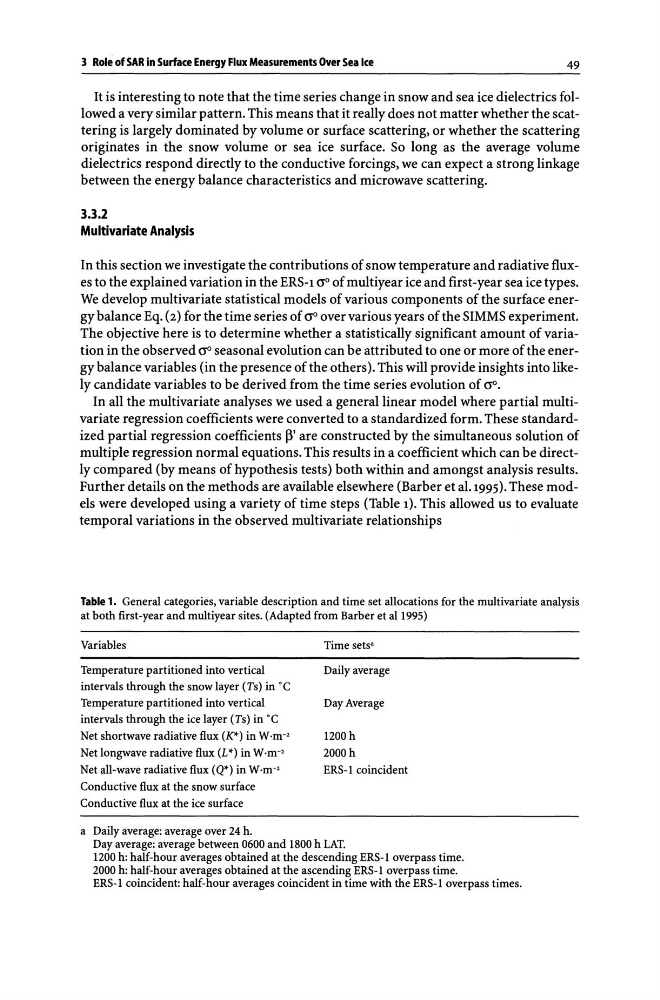
Further details on the methods are available elsewhere (Barber et a1.199S). These models were developed using a variety of time steps (Table 1). This allowed us to evaluate
temporal variations in the observed multivariate relationships
Table 1. General categories, variable description and time set allocations for the multivariate analysis
at both first-year and multiyear sites. (Adapted from Barber et al1995)
Variables
Temperature partitioned into vertical
intervals through the snow layer (Ts) in 0 C
Temperature partitioned into vertical
intervals through the ice layer (Ts) in 0 C
Net shortwave radiative flux (10) in W'm-'
Net longwave radiative flux (L *) in W'm-'
Net all-wave radiative flux (Q*) in W'm-'
Conductive flux at the snow surface
Conductive flux at the ice surface
a Daily average: average over 24 h.
Time sets'
Daily average
Day Average
1200 h
2000h
ERS-l coincident
Day average: average between 0600 and 1800 h LAT.
1200 h: half-hour averages obtained at the descending ERS-l overpass time.
2000 h: half-hour averages obtained at the ascending ERS-l overpass time.
ERS-l coincident: half-hour averages coincident in time with the ERS-l overpass times.
49
It is interesting to note that the time series change in snow and sea ice dielectrics followed a very similar pattern. This means that it really does not matter whether the scattering is largely dominated by volume or surface scattering, or whether the scattering
originates in the snow volume or sea ice surface. So long as the average volume
dielectrics respond directly to the conductive forcings, we can expect a strong linkage
between the energy balance characteristics and microwave scattering.
3.3.2
Multivariate Analysis
In this section we investigate the contributions of snow temperature and radiative fluxes to the explained variation in the ERS-1 0'0 of multiyear ice and first-year sea ice types.
We develop multivariate statistical models of various components of the surface energy balance Eq. (2) for the time series of 0'0 over various years of the SIMMS experiment.
The objective here is to determine whether a statistically significant amount of variation in the observed cro seasonal evolution can be attributed to one or more of the energy balance variables (in the presence of the others). This will provide insights into likely candidate variables to be derived from the time series evolution of 0'0.
In all the multivariate analyses we used a general linear model where partial multivariate regression coefficients were converted to a standardized form. These standardized partial regression coefficients Ware constructed by the simultaneous solution of
multiple regression normal equations. This results in a coefficient which can be direct1y compared (by means of hypothesis tests) both within and amongst analysis results.
Further details on the methods are available elsewhere (Barber et a1.199S). These models were developed using a variety of time steps (Table 1). This allowed us to evaluate
temporal variations in the observed multivariate relationships
Table 1. General categories, variable description and time set allocations for the multivariate analysis
at both first-year and multiyear sites. (Adapted from Barber et al1995)
Variables
Temperature partitioned into vertical
intervals through the snow layer (Ts) in 0 C
Temperature partitioned into vertical
intervals through the ice layer (Ts) in 0 C
Net shortwave radiative flux (10) in W'm-'
Net longwave radiative flux (L *) in W'm-'
Net all-wave radiative flux (Q*) in W'm-'
Conductive flux at the snow surface
Conductive flux at the ice surface
a Daily average: average over 24 h.
Time sets'
Daily average
Day Average
1200 h
2000h
ERS-l coincident
Day average: average between 0600 and 1800 h LAT.
1200 h: half-hour averages obtained at the descending ERS-l overpass time.
2000 h: half-hour averages obtained at the ascending ERS-l overpass time.
ERS-l coincident: half-hour averages coincident in time with the ERS-l overpass times.