

3 Role of SAR in Surface Energy Flux Measurements Over Sea Ice
-5 ,-------------__________________________ -,
:::- -10
VJ
0:::
~
'b -IS
ulliyear
------ - - - - - - - '"- - - - " "irst- Year
"
[\ \
f \
I
\
\ I
-
\ I
\.
-20 '--------------t--t- ~ .g
-g Uo
I Early i
Melt
Wimer
~ I ~
Melt
Onset
Advam:ed
Melt
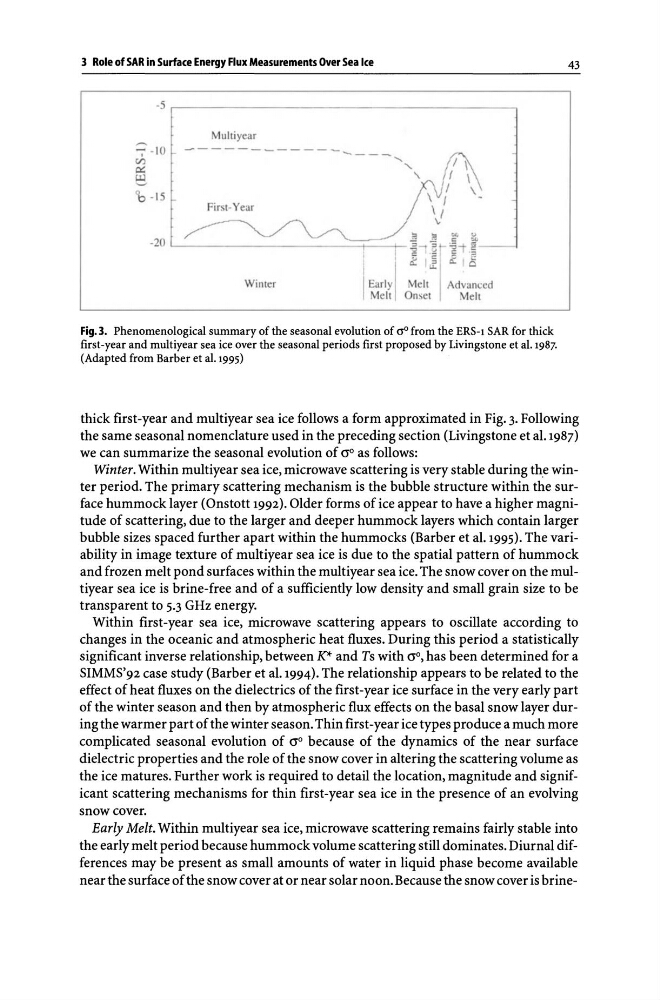
Fig.3. Phenomenological summary of the seasonal evolution of (}"o from the ERS-1 SAR for thick
first-year and multiyear sea ice over the seasonal periods first proposed by Livingstone et al.1987.
(Adapted from Barber et al. 1995)
43
thick first-year and multiyear sea ice follows a form approximated in Fig_ 3. Following
the same seasonal nomenclature used in the preceding section (Livingstone et al.1987)
we can summarize the seasonal evolution of 0'0 as follows:
Winter. Within multiyear sea ice, microwave scattering is very stable during the winter period. The primary scattering mechanism is the bubble structure within the surface hummock layer (Onstott 1992). Older forms of ice appear to have a higher magnitude of scattering, due to the larger and deeper hummock layers which contain larger
bubble sizes spaced further apart within the hummocks (Barber et al. 1995). The variability in image texture of multiyear sea ice is due to the spatial pattern of hummock
and frozen melt pond surfaces within the multiyear sea ice. The snow cover on the multiyear sea ice is brine-free and of a sufficiently low density and small grain size to be
transparent to 5.3 GHz energy.
Within first-year sea ice, microwave scattering appears to oscillate according to
changes in the oceanic and atmospheric heat fluxes. During this period a statistically
significant inverse relationship, between K* and Ts with 0'0, has been determined for a
SIMMS'92 case study (Barber et al.1994). The relationship appears to be related to the
effect of heat fluxes on the dielectrics of the first -year ice surface in the very early part
of the winter season and then by atmospheric flux effects on the basal snow layer during the warmer part of the winter season. Thin first -year ice types produce a much more
complicated seasonal evolution of 0'0 because of the dynamics of the near surface
dielectric properties and the role of the snow cover in altering the scattering volume as
the ice matures. Further work is required to detail the location, magnitude and significant scattering mechanisms for thin first-year sea ice in the presence of an evolving
snow cover.
Early Melt. Within multiyear sea ice, microwave scattering remains fairly stable into
the early melt period because hummock volume scattering still dominates. Diurnal differences may be present as small amounts of water in liquid phase become available
near the surface of the snow cover at or near solar noon. Because the snow cover is brine-
-5 ,-------------__________________________ -,
:::- -10
VJ
0:::
~
'b -IS
ulliyear
------ - - - - - - - '"- - - - " "irst- Year
"
[\ \
f \
I
\
\ I
-
\ I
\.
-20 '--------------t--t- ~ .g
-g Uo
I Early i
Melt
Wimer
~ I ~
Melt
Onset
Advam:ed
Melt
Fig.3. Phenomenological summary of the seasonal evolution of (}"o from the ERS-1 SAR for thick
first-year and multiyear sea ice over the seasonal periods first proposed by Livingstone et al.1987.
(Adapted from Barber et al. 1995)
43
thick first-year and multiyear sea ice follows a form approximated in Fig_ 3. Following
the same seasonal nomenclature used in the preceding section (Livingstone et al.1987)
we can summarize the seasonal evolution of 0'0 as follows:
Winter. Within multiyear sea ice, microwave scattering is very stable during the winter period. The primary scattering mechanism is the bubble structure within the surface hummock layer (Onstott 1992). Older forms of ice appear to have a higher magnitude of scattering, due to the larger and deeper hummock layers which contain larger
bubble sizes spaced further apart within the hummocks (Barber et al. 1995). The variability in image texture of multiyear sea ice is due to the spatial pattern of hummock
and frozen melt pond surfaces within the multiyear sea ice. The snow cover on the multiyear sea ice is brine-free and of a sufficiently low density and small grain size to be
transparent to 5.3 GHz energy.
Within first-year sea ice, microwave scattering appears to oscillate according to
changes in the oceanic and atmospheric heat fluxes. During this period a statistically
significant inverse relationship, between K* and Ts with 0'0, has been determined for a
SIMMS'92 case study (Barber et al.1994). The relationship appears to be related to the
effect of heat fluxes on the dielectrics of the first -year ice surface in the very early part
of the winter season and then by atmospheric flux effects on the basal snow layer during the warmer part of the winter season. Thin first -year ice types produce a much more
complicated seasonal evolution of 0'0 because of the dynamics of the near surface
dielectric properties and the role of the snow cover in altering the scattering volume as
the ice matures. Further work is required to detail the location, magnitude and significant scattering mechanisms for thin first-year sea ice in the presence of an evolving
snow cover.
Early Melt. Within multiyear sea ice, microwave scattering remains fairly stable into
the early melt period because hummock volume scattering still dominates. Diurnal differences may be present as small amounts of water in liquid phase become available
near the surface of the snow cover at or near solar noon. Because the snow cover is brine-